You’ve found a pair of lab-grown diamond hoop earrings you love online. The listing says “VS2 clarity, F color, 14k white gold, prong set, 1.5 total carat weight.” You’re nodding along — but a quiet voice is asking: does any of that actually matter for earrings? The answer is yes, but not in the way the listing implies, and the parts that matter most aren’t the ones getting top billing. Lab-grown diamonds (diamonds grown in a controlled environment using the same carbon chemistry as mined diamonds, just without the mine) have dropped significantly in price over the past three years, making styles that once cost $4,000 accessible at $600–$900. That price shift makes the buying decision more interesting — because now the real question isn’t “can I afford diamonds?” It’s “which diamonds, in which setting, in which metal, actually look the way I want them to look on a moving ear?”
This guide is built for the buyer who already knows what lab-grown means and is now in the weeds of a real purchase decision. We’ll work through clarity grades as they actually read at earring distances, the metal and setting tradeoffs that change durability and sparkle, and the specific configurations worth your money in 2026.
The Clarity Grade That Actually Shows — and the One That Doesn’t
This is the highest-stakes decision point most buyers get wrong, because the logic that applies to an engagement ring stone doesn’t transfer cleanly to earrings.
For a solitaire ring, you’re looking at a single stone from inches away, often under direct light. Eye-cleanliness — whether inclusions (internal flaws; the microscopic crystals, clouds, or feathers trapped inside a diamond as it forms) are visible without magnification — matters there because the stone is the center of the composition and gets scrutinized up close.
For earrings, you’re looking at stones from 18–24 inches away, in motion, often surrounded by metal and other stones. The GIA’s clarity scale runs from Flawless down through VVS1/VVS2, VS1/VS2, SI1/SI2, and I1/I2/I3 (the International Gem Society’s grading overview is a clean reference for what each tier means under magnification). The practical ceiling for earrings is VS2 — and for most hoop and drop styles, SI1 performs identically to eye-clean VS2 at earring distance.
By the numbers:
| Clarity Grade | Eye-clean at 18”? | Price differential vs. VS2 | Recommended for earrings? |
|---|---|---|---|
| VVS1/VVS2 | Yes | +25–40% | Only if resale matters |
| VS1 | Yes | +10–18% | Strong choice, mild premium |
| VS2 | Yes (usually) | Baseline | Solid default |
| SI1 | Usually yes | −15–25% | Best value for earrings |
| SI2 | Sometimes | −30–40% | Inspect stone image first |
Pricescope’s lab-grown diamond buying guide consistently flags the SI1–VS2 range as the practical sweet spot for jewelry where stones aren’t under direct individual scrutiny. For hoops with many small stones (melee, meaning accent diamonds under 0.10 ct each), clarity matters even less — those stones are so small that SI2 is routinely eye-clean.
The buying rule: for a hoop or drop earring, buy the best cut and color you can afford within SI1–VS2, not the best clarity. Reinvest the clarity savings into cut quality or total carat weight, both of which you will see from across a room.
Setting Styles: What They Do to Light, Durability, and Everyday Wearability
Setting style is the decision that most directly shapes how your earrings look and how long they stay looking that way. Here are the four configurations that dominate lab-grown diamond hoops and drops in 2026, with their honest tradeoffs.
Prong Settings
Prong settings (small metal claws that grip the stone at its girdle, the widest part of the diamond) maximize light entry and exit. For a single-stone drop or a hoop where stones are featured, prong settings deliver the most sparkle because light enters from multiple angles. The tradeoff is that prongs snag on hair, fabric, and pillowcases, and the tips wear down over time and need re-tipping (a bench jeweler can do this for $20–$60 per stone, roughly every 5–7 years of daily wear). For earrings — which are handled less aggressively than rings — prong settings are generally lower-risk than they are on a bracelet.
Bezel Settings
A bezel setting wraps a continuous rim of metal around the stone’s girdle. It’s the most protective setting for the diamond (no exposed corners or prongs to catch), it reads as clean and modern, and it’s the better choice for active wearers or anyone who tends to sleep in their jewelry. The visual tradeoff: you lose some of the light return around the stone’s edge. For white gold or platinum bezels with colorless lab-grown stones, this is often invisible in practice — what you sacrifice in technical sparkle, you gain in a crisp, polished silhouette. Brides’ lab-grown diamond jewelry guide highlights bezel settings as a top recommendation for everyday diamond earrings precisely for this reason.
Pavé Settings
Pavé (from the French word for “paved”) involves setting many small diamonds close together in the metal so the surface appears to be paved with stones. Pavé hoops and pavé-accented drop earrings dominate the mid-market right now because lab-grown melee stones are significantly cheaper than their natural equivalents, making dense pavé affordable. The watchout: pavé stones fall out. The setting requires periodic inspection, and if a prong holding a melee stone breaks, you’ll lose the stone before you notice it’s gone. Ask your retailer explicitly whether their pavé earrings are machine-set or hand-set — hand-set pavé (where a bench jeweler places each stone individually) holds better than mass-produced machine-set versions.
Channel Settings
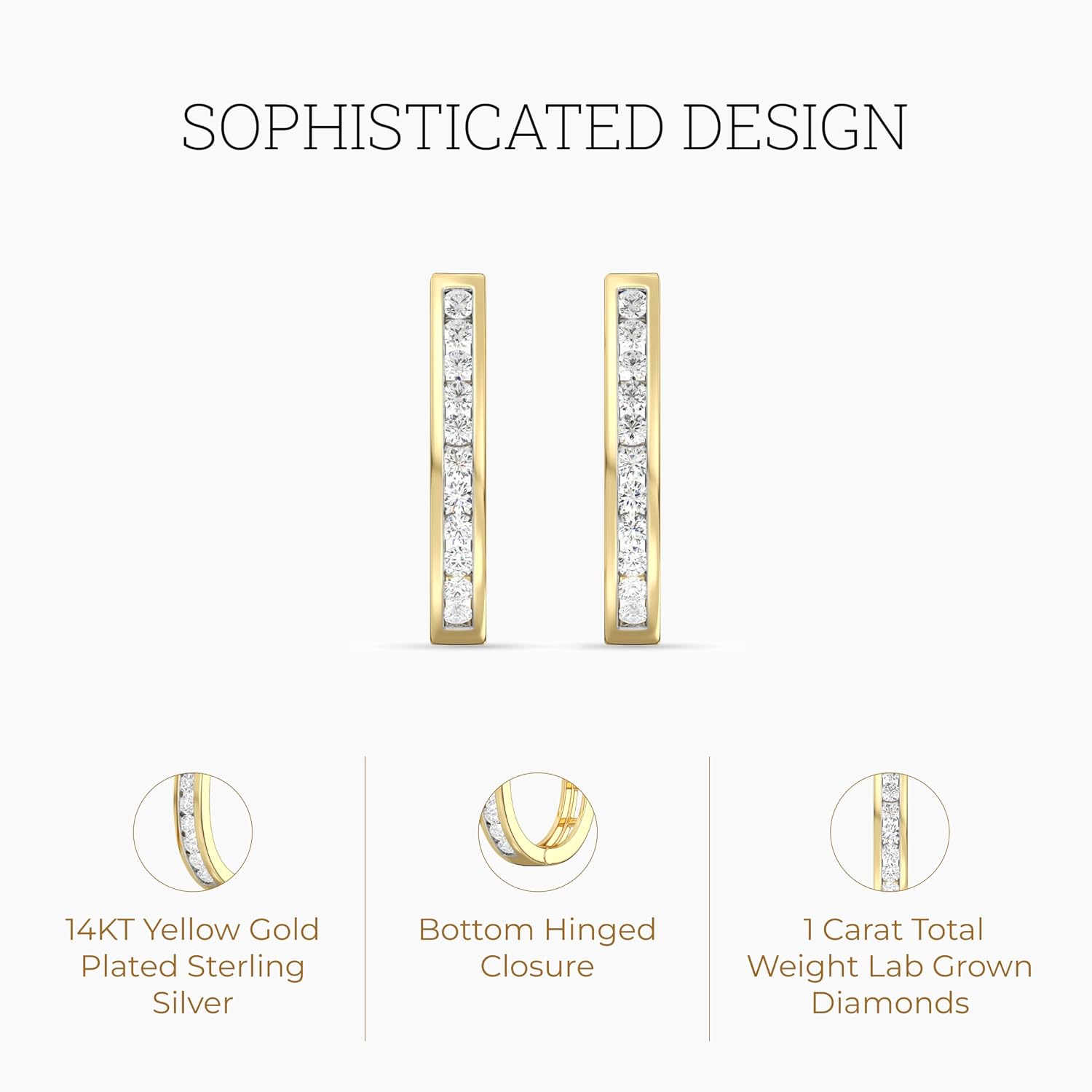
A channel setting runs stones in a continuous line between two rails of metal. This is the most durable high-stone-count configuration — stones can’t snag or fall out the way they can in pavé — and it reads as geometric and graphic rather than sparkly and soft. Channel-set hoops are a strong choice for buyers who want a polished, architectural look and minimal maintenance. The limitation: you can’t see the stones from the side, which reduces sparkle in profile.
Metal Choices: The Variables That Actually Move the Needle
The metal decision for earrings operates differently than for rings, because earrings don’t sustain the same mechanical abuse. Here’s where the tradeoffs actually land:
14k vs. 18k yellow gold. 14k gold (58.5% pure gold, the remainder being alloy metals for hardness) is the workhorse of the American jewelry market for good reason — it’s harder than 18k, holds a setting better over time, and costs less. 18k (75% pure gold) has a richer, more saturated color that some buyers strongly prefer, and it’s the standard in European and luxury-tier pieces. For earrings, the durability advantage of 14k matters less than it does for rings, so this decision legitimately comes down to color preference and budget. The Knot’s metal guide notes that 18k remains the dominant choice in fine jewelry worldwide despite the premium.
14k white gold vs. platinum. White gold is yellow gold alloyed with nickel or palladium, then rhodium-plated (coated with a hard, bright white metal) to achieve its bright color. Over 18–36 months of regular wear, the rhodium plate wears and reveals the slightly warmer tone beneath — earrings will need re-plating eventually. Platinum is naturally white, never needs plating, and is denser and more durable. It’s also 30–50% more expensive by weight and develops a patina (a matte, brushed-looking surface) with wear that some people love and others want polished away. For earrings that get light wear, white gold is a practical, cost-efficient choice. For heirloom-grade pieces where you want the metal to outlast fashion cycles without maintenance, platinum is worth it.
Rose gold. Rose gold (alloyed with copper, which creates the warm pink tone) is the polarizing choice — buyers who love it, love it hard. It has no durability issues specific to earrings. The consideration is that rose gold doesn’t flatter every skin tone equally, and it can make slightly warm-tinted lab diamonds look more yellow. If you’re buying F or G color (near-colorless on the GIA scale), this isn’t a problem. If you’re buying in the H–J range to save money, test against your specific stone before committing to rose gold in a drop setting where the diamond is prominent.
The Configuration Decision: Hoops vs. Drops and When Each Wins
Lab-grown diamond hoops and drops serve different compositional roles, and the best buying decision depends on which role you’re filling.
Hoops — continuous rings of metal that pass through the ear — are the workhorse. A pavé hoop or channel-set hoop in 14k white gold with SI1 lab-grown stones in the 1.0–2.0 total carat range is one of the most versatile pieces in fine jewelry. It reads as finished with casual clothing, doesn’t overwhelm a formal look, and layers well with studs. The buying risk with hoops is getting the diameter wrong: hoops under 25mm read as studs with a gap; hoops over 45mm become a statement piece that not everyone can carry in a professional setting. Most buyers find their sweet spot in the 30–40mm range.
Drop earrings (stones or elements suspended below the ear on a fixed or articulated finding) reward movement — the light return changes as the piece swings, which is part of why they read as festive and dynamic. For drops, cut quality in the feature stone matters more than it does in a hoop, because you are looking at one stone doing most of the visual work. If you’re buying a drop earring pair with a 0.5ct lab-grown stone as the feature, invest in Excellent or Ideal cut grade over clarity grade. GIA’s diamond quality factors documentation explains that cut is the human-controlled variable most responsible for a stone’s brilliance — and in an earring drop, that brilliance is the entire point.
The Decision Rules
If the earrings are for daily wear with minimal fuss: bezel or channel set, 14k white gold, SI1 clarity, Excellent cut, 30–38mm hoop diameter. This configuration survives real life without anxiety.
If the earrings are a milestone piece or gift meant to last decades: prong-set drops or pavé hoops in platinum or 18k gold, VS2 clarity, Excellent or Ideal cut. Pay for the metal and cut; let clarity be your savings lever, not your upgrade target.
If total carat weight is the priority visual goal: pavé hoop, 14k gold, SI1 melee stones. Lab-grown melee prices have dropped sharply — as of mid-2026, pavé hoops with 2.0+ total carats in lab-grown diamonds are available at price points that would have required 1.0ct in natural stones two years ago. That’s the real story of lab-grown earrings in this market cycle, and it’s worth using.