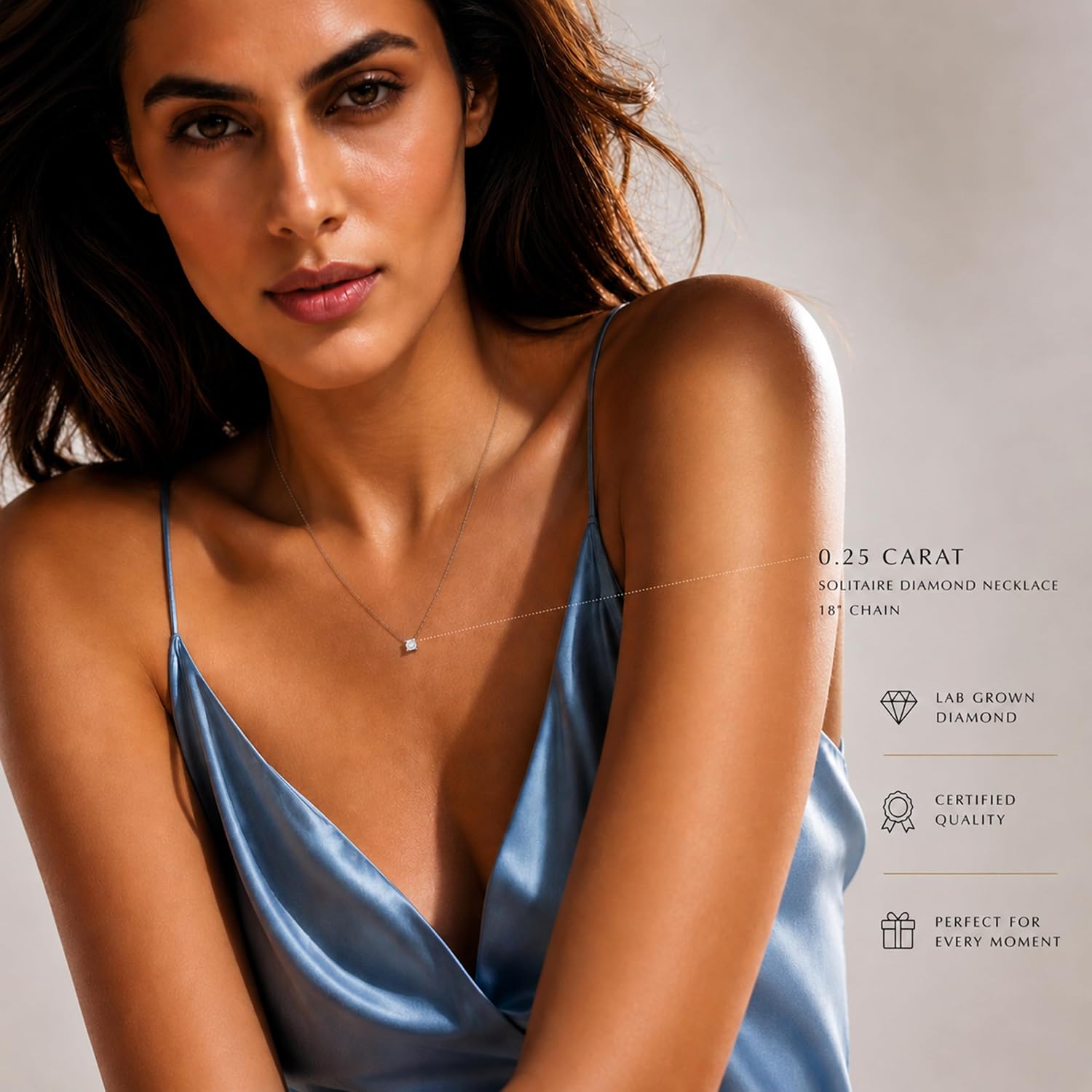
Imagine you’re shopping for a diamond pendant necklace and you find two stones that look nearly identical on screen — same sparkle in the photos, similar price, both marketed as lab-grown diamonds. One comes with a grading report from a respected laboratory. The other comes with a “certificate of authenticity” printed on the retailer’s own letterhead. If you buy the second one, you’re largely trusting a seller to grade their own homework. Lab-grown diamonds (real diamonds, grown in a controlled environment using either high-pressure high-temperature or chemical vapor deposition technology, rather than mined from the earth) have become a mainstream choice for pendant necklaces precisely because they offer the same optical and chemical properties as mined stones at significantly lower price points. But that accessibility also attracted a wave of under-documented stones, confusing grading shorthand, and marketing language that obscures more than it reveals. This guide cuts through that noise. By the end, you’ll know which certifications carry weight, which specs actually move the needle on a pendant’s appearance, and how to make a defensible purchase decision at any budget tier.
| EDITOR'S PICK0.5 to 10 Carat 14K White Gold… | Mid-tierTUHE 7 Stones Moissanite Neckla… | Budget pickJewlpire 925 Sterling Silver Ch… | |
|---|---|---|---|
| Metal | 14K White Gold | 18k Gold Plated | 925 Sterling Silver |
| Stone Type | Lab Grown Diamond | Moissanite | — |
| Carat Weight | 3.0 | 1.7–5.0 | — |
| Stone Count | 1 | 7 | — |
| Chain Length | 18" | 16.5+2.5" | 14–24" |
| Certification | — | ✓ | — |
| Price | $1,690.05 | $139.99 | $18.99 |
| See on Amazon → | See on Amazon → | See on Amazon → |
Why Certification Matters More on a Pendant Than on an Earring
A diamond stud earring is viewed from across a table — the subtleties of cut precision and color grade are largely lost at that distance. A pendant necklace is worn at chest height, in direct conversation range, under office lighting, restaurant lighting, and natural daylight. It gets examined. That changes the calculus.
Certification on a lab-grown diamond pendant serves three distinct functions: it documents what you actually bought, it provides a resale anchor (however modest lab-grown resale currently is), and it disciplines the grading — meaning a certified stone has been evaluated by someone with no financial stake in the grade.
The certifications worth trusting, ranked by consensus among gemological professionals:
- GIA (Gemological Institute of America): The industry standard for mined diamonds, GIA began issuing Lab-Grown Diamond Grading Reports in 2020. Their reports use the same 4Cs (cut, color, clarity, carat weight) grading scales, making cross-shopping with natural stones straightforward. Per GIA’s published grading documentation at gia.edu, lab-grown reports include the same color and clarity descriptors as natural diamond reports.
- IGI (International Gemological Institute): The most commonly encountered certification on lab-grown stones from direct-to-consumer retailers. IGI has been grading lab-grown diamonds since before GIA entered the space, and while some practitioners note that IGI grades can run slightly more generous than GIA on the same stone (a pattern aggregated reviewers on PriceScope’s lab-grown forum have documented for years), IGI-certified stones are meaningfully better documented than retailer-issued “certificates.”
- GCAL (Gem Certification and Assurance Lab): A smaller but respected laboratory that offers light-performance reports alongside traditional 4Cs grading. For pendant buyers who care about optical performance data, GCAL’s “8X” report includes cut-quality metrics beyond what GIA or IGI publish. The Knot’s lab-grown diamond buying guide mentions GCAL as a credible alternative for buyers seeking cut performance documentation.
- AGS (American Gem Society): AGS developed the 0–10 cut grading scale that many precision-cut advocates prefer. AGS has been less active in the lab-grown certification space as of early 2026, but stones with AGS documentation carry credibility when encountered.
What to avoid: Any grading report issued by the retailer itself, or by laboratories you cannot independently verify — EGL USA reports in particular have a documented history of grade inflation that Brides’ buying guides have flagged as a persistent consumer issue.
The Four Specs That Actually Affect How a Pendant Looks
1. Cut Grade: The One Spec to Refuse to Compromise On
Cut is not about shape (round, oval, pear, cushion) — it refers to how precisely the facets are proportioned and aligned to return light to the viewer’s eye. A G color diamond with an Excellent cut will outperform a D color diamond with a Good cut on any lighting condition. For a pendant, where the stone is in motion against a body and catches light at multiple angles throughout the day, cut quality is the primary driver of the “wow” response that justifies the purchase.
On a GIA report, look for “Excellent” under cut grade for round brilliants. IGI uses the same descriptor. For fancy shapes (ovals, pears, cushions), neither GIA nor IGI issues a formal cut grade — here, proportions matter: ask the retailer for the table percentage, depth percentage, and length-to-width ratio, and cross-reference against published guidelines at gemsociety.org, which maintains detailed proportion targets for each shape.
2. Color Grade: Where Lab-Grown Economics Create a Real Opportunity
The GIA color scale runs D (colorless) to Z (light yellow). In a mined diamond, the jump from H to G, or G to F, carries significant price premium. In lab-grown diamonds as of mid-2026, color grades compress dramatically in price because supply is abundant. PriceScope’s current lab-grown pricing data shows F-color lab-grown rounds trading at prices that were H-color territory two years ago.
Practical implication for pendant buyers: A pendant set in yellow gold masks any warmth in a stone — an H or I color is visually indistinguishable from a D when the yellow metal reflects into the pavilion. In white gold or platinum, color becomes visible at I and below in stones above 1 carat. The sweet spot for a white-metal pendant: F–H color, which in lab-grown currently gets you near-colorless appearance without paying the D–E premium that is largely speculative in a market where supply constraints don’t apply.
3. Clarity Grade: The Floor, Not the Ceiling
Clarity grades measure inclusions (internal characteristics) and blemishes (surface characteristics). The GIA clarity scale runs FL (flawless) → IF → VVS1/VVS2 → VS1/VS2 → SI1/SI2 → I1/I2/I3.
For a pendant stone under 1.5 carats, VS2 is effectively the floor for eye-cleanliness — meaning no inclusion visible to the naked eye at conversational distance. SI1 can be eye-clean in well-cut stones, but requires inspection of the actual stone or a magnified vendor image before purchasing. The Gemological Institute of America’s published clarity grading documentation notes that “eye-clean” is not a formal GIA term, which is why buying on grade alone without imagery is higher risk at SI1 and below.
In lab-grown diamonds, the inclusion types differ from mined stones. CVD-grown stones can exhibit “graining” or fine needle-like inclusions; HPHT stones may show metallic flux inclusions. These don’t typically affect beauty but may affect long-term durability assessments — a point that IGI’s lab-grown grading standards documentation addresses in their inclusion-type descriptions.
4. Carat Weight: The Math That Changes at Every Threshold
| Carat Weight | Visual Diameter (Round) | Mid-2026 Lab-Grown Price Range (G/VS2/Excellent, IGI) |
|---|---|---|
| 0.50 ct | ~5.1 mm | $150–$300 |
| 1.00 ct | ~6.5 mm | $400–$900 |
| 1.50 ct | ~7.4 mm | $700–$1,600 |
| 2.00 ct | ~8.1 mm | $1,100–$2,500 |
Price ranges compiled from aggregated retailer listings and PriceScope’s lab-grown price index, May 2026. Natural diamond equivalents run 4–8× higher at comparable grades.
The visual jump from 1.0 to 1.5 carats is meaningful on a pendant. The jump from 1.5 to 2.0 is perceptible but less dramatic. The jump from 0.5 to 1.0 is the most noticeable per dollar in the lineup. If budget is the binding constraint, prioritize cut grade and spend the remaining budget on carat weight rather than chasing D color or FL clarity in a stone that will be worn under fluorescent office lighting.
Setting and Metal: The Certification Doesn’t Cover These
A certified stone in a compromised setting is a poor purchase. Pendant-specific setting considerations:
Prong settings (a solitaire or halo with metal prongs gripping the stone) are the most common and the most maintenance-intensive — prongs catch on fabric and require inspection every 18–24 months. Brides’ pendant buying coverage consistently notes this as the top reason for stone loss in pendant settings.
Bezel settings (a metal rim that encircles the girdle of the stone) are more secure and more modern in aesthetic. They obscure a thin sliver of the stone’s diameter but protect the girdle from impact — relevant for a pendant that contacts hard surfaces when leaned over a desk.
Metal options: Platinum holds prongs and bezels with the least metal fatigue over decades but costs more per gram than 14k or 18k white gold. For a pendant expected to be worn daily and handed down, platinum is the premium-justified choice. 14k white gold is a pragmatic option for buyers in the $500–$1,500 range. Yellow gold, as noted above, permits a warmer color grade stone without visual penalty.
Chain gauge: A pendant heavier than 2 carats in a thick bezel setting requires a chain rated for the load. A 1.0mm box chain — common in mass-market pendants — is undersized for a 2-carat-plus stone. Request or verify chain gauge in writing, and ask specifically whether the bail (the loop connecting stone to chain) is soldered or mechanical. A mechanical bail can open; a soldered bail won’t.
Retailer Navigation: Where Certification Meets Purchasing Reality
Several direct-to-consumer retailers have built their lab-grown pendant inventory around IGI or GIA documentation as a baseline rather than an upsell. James Allen and Blue Nile both allow filtering by certification laboratory in their lab-grown diamond search tools, and both display magnified 360-degree imagery that allows pre-purchase clarity inspection — the functional equivalent of loupe inspection for an online transaction.
For buyers in the $2,500–$10,000 pendant range, Whiteflash’s “A CUT ABOVE” line includes lab-grown rounds cut to ideal specifications with light-performance documentation beyond standard GIA grading — appropriate for buyers who want optical precision documented, not assumed.
Leibish & Co., while primarily known for fancy colored natural diamonds, has expanded into lab-grown fancy colored stones (primarily HPHT-grown yellows and blues) for pendant applications — a category where IGI grading includes color origin documentation specifying the growth method.
The Decision Rule
If your budget is under $1,000: Target a 1.0–1.5 carat round or oval, F–H color, VS2–SI1 clarity (with retailer imagery confirming eye-cleanliness), IGI-certified, Excellent cut, 14k white or yellow gold bezel setting. Don’t pay for GIA when IGI gets you more carat for the same dollar at this tier.
If your budget is $1,000–$3,000: Move to 1.5–2.0 carats, F–G color, VS1–VS2, IGI or GIA certified, Excellent or Ideal cut. Platinum becomes viable at the top of this range. This is the tier where cut documentation starts to matter — request the full grading report PDF before purchase and verify the report number at the certifying lab’s website.
If your budget exceeds $3,000: The case for GIA certification strengthens — not for resale (lab-grown resale remains thin), but for documentation integrity on a purchase that will be part of the household record for decades. Consider GCAL’s 8X report if optical-performance data matters to you. At this tier, the setting craftsmanship warrants the same scrutiny as the stone: ask about the bench jeweler’s credentials, setting inspection protocol, and whether the mounting is custom or cast from a standard die.
Certification is not a luxury feature on a lab-grown diamond pendant — it’s the baseline that makes every other spec claim verifiable. The stone that comes with a report from GIA or IGI has been evaluated by someone whose reputation depends on accuracy. The one that comes with a glossy card from the retailer has not. That asymmetry is worth understanding before any purchase decision, at any budget.