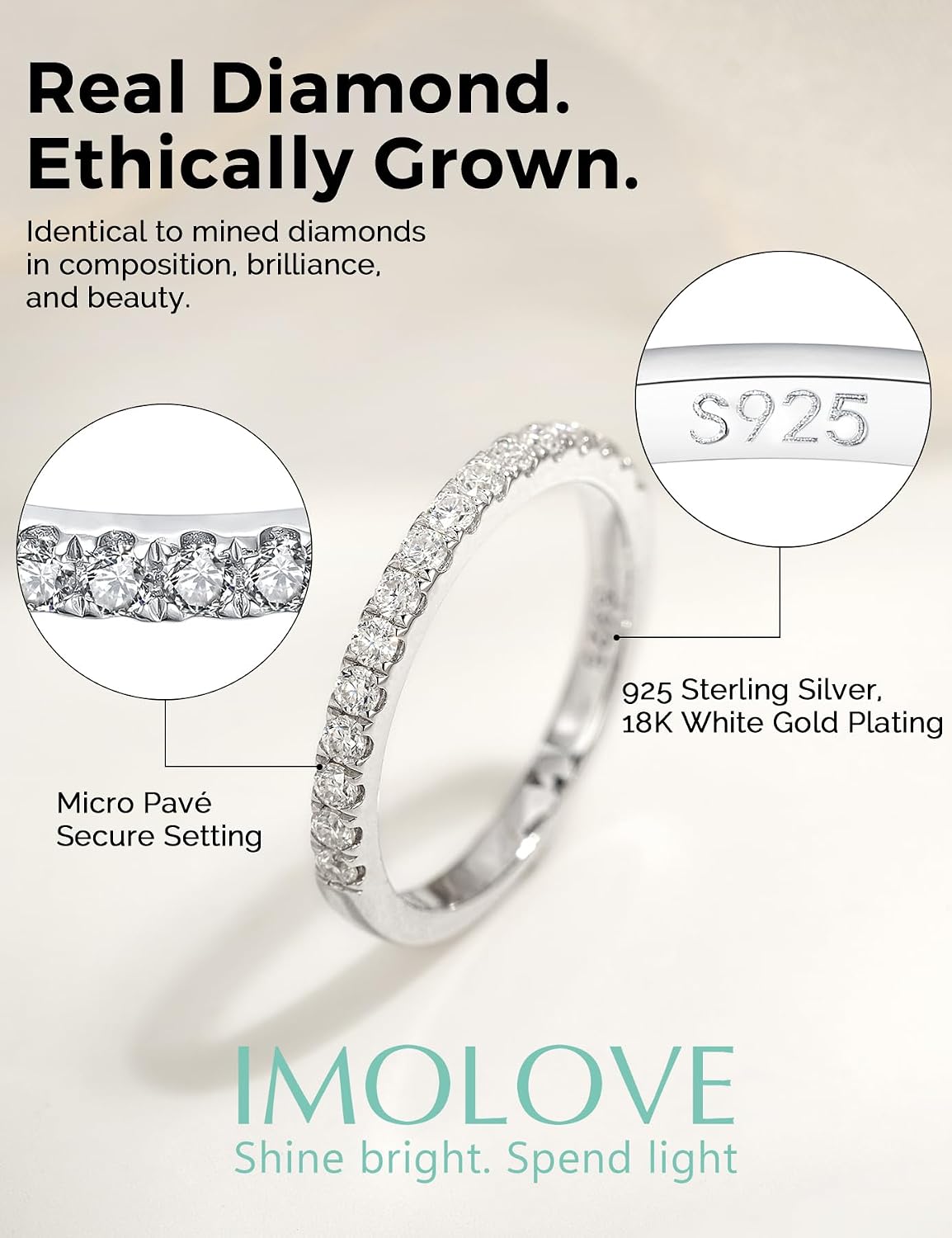
Imagine you’re three months out from your wedding. You’ve chosen the engagement ring — maybe it’s already on your partner’s finger. Now comes the band: the ring that will be worn every single day for the rest of your life, through dish soap and chlorine and gym sessions and gardening. You want it to sparkle. You also want it to survive. And because you’ve been paying attention, you know that lab-grown diamonds — stones created in a controlled environment that are chemically and physically identical to mined diamonds, just not pulled from the earth — are now priced low enough that you can afford a full eternity band (diamonds all the way around) for what a mined half-eternity would have cost five years ago. That value equation is compelling. But a lab-grown diamond in the wrong setting or the wrong metal won’t serve you well a decade from now. This guide covers the decisions that actually matter: which clarity grades to buy, which metals to choose, and which setting styles hold up to daily wear versus which ones will cost you stones down the road.
| EDITOR'S PICKIMOLOVE Lab Grown Diamond Weddi… | Mid-tierIMOLOVE Moissanite Wedding Band… | Budget pickPAVOI Gold Plated Solid 925 Ste… | |
|---|---|---|---|
| Stone | Lab grown diamond | Moissanite | CZ simulant |
| Metal | 18K white gold / silver | Sterling silver | Sterling silver |
| Plating | — | White gold plated | 14k gold plated |
| Stone carat | 0.42 CT | — | — |
| Style | Half eternity | 3-stone eternity | Eternity |
| Sizes | 4–11 | 4–11 | — |
| Price | $99.99 | $59.99 | $19.95 |
| See on Amazon → | See on Amazon → | See on Amazon → |
How Clarity Works in an Eternity Band — and Why It’s Different from an Engagement Ring
When people shop for an engagement ring, they often obsess over the center stone’s clarity grade — the degree to which a diamond is free of internal flaws (called inclusions) and surface blemishes. That’s reasonable for a solitaire, where one stone is the entire show under close scrutiny. A wedding band changes the math significantly.
An eternity ring or wedding band typically features anywhere from 10 to 30 small stones, usually ranging from 0.03 ct to 0.15 ct each depending on band width and stone shape. At that size, the human eye struggles to resolve inclusions without magnification. The Gem Society’s diamond clarity guide makes a practical point that applies directly here: below roughly 0.25 ct, the difference between VS2 (very slightly included — inclusions visible only under 10x magnification) and SI1 (slightly included — inclusions visible under magnification, occasionally borderline visible to the naked eye) becomes nearly impossible for most people to detect in normal lighting conditions.
The practitioner move: Buy VS2 or SI1 for your band stones without hesitation. Spending up for VVS or FL (flawless) clarity in a 0.05 ct melee stone is money that does not translate to visible sparkle. Redirect that budget toward a higher total carat weight, a better metal, or a more secure setting style.
The GIA’s resource on laboratory-grown diamonds confirms that lab-grown stones receive the same grading standards as mined diamonds — the 4Cs apply identically. This matters because some lower-tier lab-grown band products on the market use stones that don’t come with grading documentation. For bands under $500 with very small melee, that’s often acceptable. For any purchase over $800, request at minimum a manufacturer’s grading report or a retailer’s in-house quality disclosure covering the clarity and color range of the melee used.
By the Numbers
| Stone Size | Recommended Clarity | Reason |
|---|---|---|
| Under 0.10 ct (melee) | SI1–VS2 | Inclusions invisible at this scale; over-grading wastes budget |
| 0.10–0.25 ct | VS2–VS1 | Slight step-up warranted; still skip VVS |
| Over 0.25 ct | VS1–VVS2 | Inclusions can become visible; clarity investment justified |
Metal Choice: Platinum vs. White Gold vs. Yellow Gold for a Daily-Wear Band
This is the decision most buyers underestimate, and the one that most affects long-term satisfaction with a band worn every day.
Platinum is the most durable choice for prong-set or pavé-set bands by a significant margin. It’s denser than gold alloys, and critically, it displaces rather than loses metal when scratched — meaning a scratch moves platinum around on the surface rather than removing it. Over decades, platinum develops a patina (a soft, matte sheen) that many owners report actually prefer to a high-polish finish. The trade-off is cost: platinum bands typically run 30–50% more than comparable 14k white gold, and they require occasional professional re-polishing if you want to restore high shine. For a pavé or channel-set eternity band where prong integrity directly determines whether you keep your stones, the durability premium is worth it.
14k white gold is the practical mainstream choice. It’s harder than platinum on the Mohs scale in one sense — its alloyed structure resists surface scratching more visibly in the short term — but it wears away more permanently over time because metal is actually removed when scratched, not displaced. White gold is also rhodium-plated from the factory (rhodium is a platinum-group metal that gives white gold its bright white color), and that plating wears off every 1–3 years depending on skin chemistry and wear intensity. Re-plating costs $50–$150 per service at most jewelers. If you’re buying a lab-grown band partly for its value proposition, factor this recurring maintenance cost into your calculation.
18k yellow gold deserves a mention because it’s the most maintenance-friendly finish in one respect: there’s no plating to wear off. Yellow gold shows scratches and needs occasional polishing, but its color is permanent. For bezel-set or channel-set bands (settings that don’t rely on delicate prongs), yellow gold at 18k is an excellent daily-wear choice. It’s softer than 14k, so it’s not ideal under high-contact prong settings, but in a full bezel it holds stones securely without stressing the metal.
Rose gold (14k or 18k) has become popular for wedding bands and holds up similarly to yellow gold equivalents. The copper alloy that gives rose gold its color can cause sensitivity in a small percentage of wearers — worth knowing before you commit.
Brides.com’s wedding band buying guide consistently highlights that buyers who prioritize long-term durability rate platinum higher than gold alternatives, particularly for eternity bands where prong security is non-negotiable.
Setting Styles: Which Ones Actually Survive Daily Life
This is where the research produces the clearest practitioner guidance. Setting style is the single biggest driver of whether you lose stones over time — and lab-grown diamond bands are no different from mined-diamond bands in this regard. The stones are not the vulnerability. The metal holding them is.
Pavé and Micro-Pavé: Beautiful, Higher-Maintenance
Pavé settings (from the French word for “paved”) feature tiny stones set very closely together, held in place by small beads or prongs of metal. Micro-pavé refers to the same concept at an even smaller scale. The aesthetic is stunning — a band that looks like it’s encrusted with diamonds rather than having gaps of metal between them. The trade-off is structural: those small prongs are fine and can catch on fabric, get compressed during manual labor, or wear down faster than heavier prong-set or channel-set alternatives.
PriceScope’s community forums include extensive long-run owner discussions on eternity bands — a consistent pattern across those conversations is that pavé bands worn daily without removal during manual tasks lose at least one stone within the first five years at a meaningfully higher rate than channel or bezel settings. If you plan to remove your band for heavy-duty activities, pavé is workable. If you’re the type of person who won’t remember to take it off, consider a more protective setting.
Channel Set: The Daily-Wear Workhorse
Channel setting encases each stone in a continuous groove of metal on both sides, with no exposed prongs. Stones sit flush or nearly flush. This is the setting style with the strongest case for daily wear without removal — there’s no protrusion to catch, no small prong to wear down, and stones are protected on their girdle (the widest edge of the stone) rather than held only at their tips.
The trade-off: channel setting is harder and more expensive to resize, and if a stone chips or needs replacement, extraction is more involved than in a prong setting. For lab-grown diamonds, where stone replacement costs are lower than for mined equivalents, this is a manageable concern rather than a dealbreaker.
Bezel Set: Maximum Protection, Understated Look
A bezel setting wraps a thin rim of metal around the entire circumference of each stone. It’s the most protective option available — stones cannot fall out under normal wear conditions, and there are no prongs or channels to fail. The aesthetic leans modern and minimal. If the pavé halo isn’t your visual signature, a bezel-set band in platinum or 18k yellow gold represents the strongest durability argument for a daily-wear piece.
Prong Set (Shared-Prong/U-Prong): Maximizes Brilliance, Requires Vigilance
Shared-prong settings — where adjacent stones share a single prong between them — allow maximum light return and a look that approaches pavé’s continuous sparkle with slightly more structural metal. Well-executed shared-prong work in platinum is a reasonable daily-wear choice, but it requires annual prong inspection by a jeweler to catch any bends or wear before a stone loosens.
The “If X, Then Y” Decision Framework
You’re at the decision point. Here’s the direct practitioner read:
If you’re buying for maximum daily wearability and rarely remove jewelry during physical tasks: Choose a channel-set or bezel-set band in platinum or 14k white gold. Skip micro-pavé. Your VS2/SI1 lab-grown melee will look identical to higher clarity grades. Budget the maintenance savings into total carat weight.
If you want the pavé aesthetic and will commit to removing the ring during manual work: Micro-pavé in platinum is viable and visually exceptional. Build annual jeweler check-ups into your routine — prong integrity is what separates a ring you have forever from one you have a difficult conversation about.
If you’re stacking this band next to an existing solitaire or halo ring: Match the metal color to your engagement ring. Dissimilar metals wear each other down through friction over years of contact. The Knot’s 2024 Jewelry & Engagement Study notes that band stacking has become the norm for couples purchasing two or more rings — metal compatibility is now a factor retailers actively advise on.
If you’re on a firm budget under $1,500: Lab-grown diamond eternity bands in 14k white gold with channel or shared-prong setting offer the clearest value. The lab-grown pricing premium is lowest at smaller melee sizes, which means you can access a true full-eternity look (stones all the way around) at price points where a mined-diamond equivalent would be a half-eternity at best.
If you’re buying a premium piece over $3,000: Platinum becomes the right call on durability grounds alone, and it’s worth requesting melee documentation confirming VS2 or better across the full stone set. Retailers like Whiteflash and James Allen publish detailed band specifications; comparing melee quality documentation between vendors at this price point is a worthwhile twenty minutes before you commit.
The lab-grown diamond market in mid-2026 prices these stones at roughly 70–80% below comparable mined equivalents, according to ongoing market tracking by PriceScope’s price database. That spread makes the quality-up, setting-right strategy more accessible than at any point in the category’s history. The smart move is not to capture the savings as cash — it’s to spend them on the metal and setting that make the band worth wearing for the next fifty years.