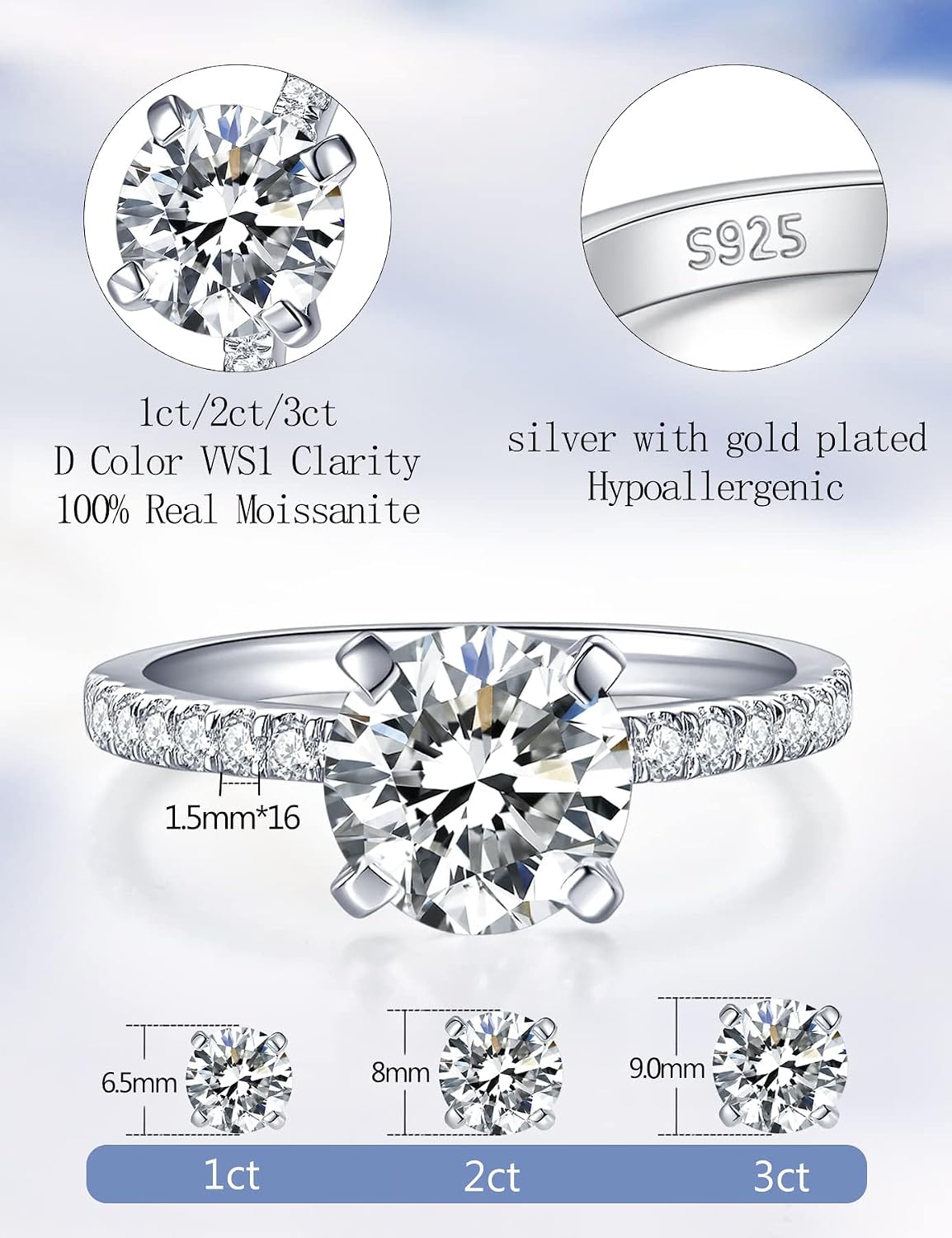
Imagine you’re planning a proposal on a budget that most engagement ring guides treat as a rounding error. You search “moissanite engagement ring under $200” and a cascade of listings appears — round cuts, oval cuts, halo settings, solitaires — all gleaming in product photography that looks identical to rings selling for ten times the price. Moissanite (pronounced moy-suh-NITE) is a lab-grown gemstone — silicon carbide, to be precise — that looks remarkably like a diamond to the naked eye and costs a fraction of the price. It scores 9.25 on the Mohs hardness scale (diamonds are 10), it disperses light with even more fire than diamond, and it’s real: a genuine crystal with measurable properties, not glass or cubic zirconia. The under-$200 category is real too. But it’s a category with meaningful trade-offs that most product listings don’t surface. This article names them explicitly.
By the time you finish reading, you’ll know exactly what separates a $180 moissanite ring that’s a genuine value from one that will frustrate you within a year — and you’ll have the vocabulary to compare listings without being misled by photography.
| EDITOR'S PICKSolid 14k White Gold 4-Prong Pe… | Mid-tierSterling Silver 4-Prong Petite… | Budget pickIMOLOVE Solitaire Moissanite En… | |
|---|---|---|---|
| Metal | 14k White Gold | Sterling Silver | 925 Silver, 18K plated |
| Stone | Moissanite | Diamond or Moissanite | Moissanite |
| Stone Weight | 1.0 CT | 1.0 CT | 1 CT |
| Clarity | — | — | VVS1 |
| Setting | 4-prong twisted vine | 4-prong twisted vine | Solitaire halo |
| Price | $320.99 | $57.99 | $54.99 |
| See on Amazon → | See on Amazon → | See on Amazon → |
What the $200 Price Point Actually Buys
Let’s start with a clear-eyed look at what’s physically possible at this price.
Moissanite stones themselves are inexpensive relative to diamonds but not free. A well-cut, 6.5mm round moissanite (the visual equivalent of approximately 1 carat in diameter) from a name brand like Charles & Colvard — the original U.S. patent holder and still the benchmark brand per the International Gem Society’s moissanite buying guide — retails for roughly $300–$600 loose. That already exceeds the $200 total budget. So what’s in the box when you spend under $200?
You are almost certainly looking at one or more of the following:
- A smaller stone — typically 5mm to 6mm round (closer to 0.5–0.75 carat visual equivalent) rather than the 1-carat look many buyers want.
- An unbranded or off-brand moissanite — often described vaguely as “DEF color, VVS clarity” without third-party grading documentation.
- A base metal setting — sterling silver (marked 925), white gold plating over brass or copper, or stainless steel rather than solid 10K or 14K gold.
- Minimal quality documentation — no GIA report (GIA grades colored stones and diamonds; moissanite reports come from labs like the International Gemological Institute or Charles & Colvard’s own grading), and often no independent certification at all.
None of these automatically means bad. But each is a trade-off you need to price consciously.
The Stone: Grading Claims You Can and Can’t Trust
By the numbers:
- A branded 6.5mm Charles & Colvard Forever One moissanite: ~$350–$500 loose (2025–2026 pricing, per Charles & Colvard’s published retail)
- An unbranded 6.5mm moissanite in a sub-$200 ring: typically $40–$80 stone cost implied by the margin math
- Color range: DEF (colorless) vs. GHI (near-colorless) — both acceptable to the naked eye, with DEF showing less warmth under certain lighting
The most common listing language you’ll encounter is “DEF colorless, VVS clarity moissanite” — and this claim is largely accurate in the sense that moissanite as a lab-grown stone is almost universally produced at high clarity. PriceScope’s community discussions on moissanite quality, accumulated across hundreds of buyer reviews from 2024 and 2025, consistently note that inclusions severe enough to affect appearance are rare even in budget moissanite. That’s a genuine advantage of a lab-grown stone: the growth process doesn’t introduce the random natural inclusions that make low-clarity diamonds visually muddy.
Where unbranded stones diverge from premium moissanite is cut quality. Charles & Colvard publishes explicit cut grade standards for its Forever One and Moissanite by Charles & Colvard lines. Off-brand stones, per aggregated buyer reports on PriceScope and in Brides’ 2025 moissanite ring editorial, sometimes exhibit a “disco ball” effect — excessive light leakage and a rainbow pattern that looks spectacular in photos but reads as artificial in person, especially under natural daylight. This isn’t universal, but it’s the single most common complaint in the sub-$200 category. You can’t verify cut quality from a product photo.
The practical decision frame: If the stone’s cut is your primary concern — and for many buyers it is, because a poorly-cut stone that screams “fake” at an outdoor lunch defeats the whole exercise — the under-$200 ring is risky unless you can find a seller who discloses the cut grade or sourced stone origin. Some smaller direct-to-consumer jewelers in this price range do source from recognized suppliers; the listing will usually say so because it’s a selling point.
The Setting: Where the Budget Category Most Often Cuts Corners
This is where the real friction lives, and where most under-$200 buyers report disappointment at the 12-to-24-month mark.
Sterling silver (925) is the most common setting metal at this price. It’s a legitimate precious metal — not a costume-jewelry material — but it has well-documented durability challenges for everyday wear:
- Silver tarnishes, particularly on fingers that come into contact with lotions, chlorine, or sweat. The Knot’s 2025 jewelry study noted that tarnish and metal maintenance were the top cited frustrations among buyers of silver-setting rings worn daily.
- Prongs on silver settings wear down faster than gold or platinum. A loose stone at 18 months is a statistically meaningful risk, not a paranoid edge case.
- Rhodium plating (applied to silver to give it a white-gold-like brightness) wears through in 6–18 months of daily wear, per the International Gem Society’s metal durability notes.
White gold plating over brass is the other common setting in this price range. It photographs beautifully — indistinguishable from 14K white gold in imagery — but the base metal matters when the plating inevitably wears through. Brass beneath plating can cause skin reactions in people with metal sensitivities.
What you’re giving up: A solid 14K white gold solitaire setting alone, without any stone, typically retails for $150–$300 in the direct-to-consumer market. The math makes clear that a $200 complete ring with stone cannot include solid 14K gold. Any listing claiming 14K gold at this price is either using gold-filled (a layered product, not solid gold) or is misrepresenting the metal.
The decision frame: If the ring will be worn daily as a permanent engagement ring — which is the normal use case — the setting’s long-term durability matters more than it does for occasional wear. For daily wear, a sterling silver setting at $200 is not a failure; it’s a starting point with known maintenance requirements. Budget for rhodium re-plating every 1–2 years ($50–$80 at most local jewelers), and treat it as the plan rather than as a failure.
Where the Under-$200 Category Genuinely Delivers
It’s worth being direct about the real value proposition here, because it’s substantial for the right buyer.
Proposal ring / placeholder logic. The Knot’s 2025 engagement study found that a meaningful percentage of couples — approximately 20% in the survey — purchased a placeholder ring for the proposal and selected the permanent ring together afterward. A well-chosen $180 moissanite solitaire in silver serves this function beautifully. It’s photogenic, it’s a genuine gemstone, and it signals intent without locking both people into a style decision made under proposal-day pressure.
Visual impact per dollar is genuinely excellent. The GIA’s published comparison of light dispersion (fire) between moissanite and diamond notes that moissanite’s fire index (0.104) exceeds diamond’s (0.044). In plain language: moissanite throws more colored light in sparkle than diamond does, particularly in lower-light environments. A 6mm moissanite in a simple prong setting looks, at a glance across a dinner table, like a considerably more expensive ring than it is.
Non-engagement use cases. Promise rings, stacking rings, right-hand fashion rings, and gifts for milestones other than an engagement proposal are all served well by the under-$200 category. The daily-wear durability concern is real for engagement rings but less pressing for rings worn occasionally or rotated.
Ethically uncomplicated sourcing. Moissanite is lab-grown by definition; there is no mining supply chain. For buyers who weight ethical sourcing heavily, this is a genuine attribute at any price point, not a consolation prize.
The Decision Matrix: If X, Then Y
Here’s where the research leads, stated plainly:
If you’re buying a placeholder proposal ring and will upgrade together: A sub-$200 moissanite solitaire in silver is a smart, photogenic, honest choice. Prioritize listings that name the stone supplier or disclose cut grade. Avoid listings with vague “DEF VVS” claims and no other detail.
If you’re buying this as a permanent daily-wear engagement ring with no planned upgrade: The $200 budget works, but go in with eyes open. Accept the silver maintenance cycle (tarnish prevention, rhodium re-plate). If the budget can flex to $350–$500, a sterling silver or 10K gold setting with a branded Charles & Colvard stone eliminates most of the quality uncertainty at the stone level.
If the concern is “will it look fake in person”: The cut quality of the stone matters more than any other single variable. Buy from a seller who discloses cut grade or sources from a named supplier. The “disco ball” effect is cut-related, not inherent to moissanite — well-cut moissanite reads as a beautiful, bright stone, not as an obvious simulant. Per the International Gem Society’s moissanite buying guide, the hearts-and-arrows cut pattern, visible under a loupe, is the mark of a precision-cut stone; some budget sellers do provide this documentation.
If you’re gifting this for a non-engagement milestone: Nearly all the durability concerns become secondary. Buy for visual appeal and personal style.
The under-$200 moissanite ring market is neither a trap nor a miracle — it’s a category with specific strengths and specific limitations that product photography does an excellent job of hiding. The stone itself, even unbranded, is usually a genuine moissanite with real optical properties. The setting and cut quality are where the trade-offs live. Know which of those trade-offs matter for your actual use case, and you’ll make a confident, clear-eyed purchase rather than a disappointed one.