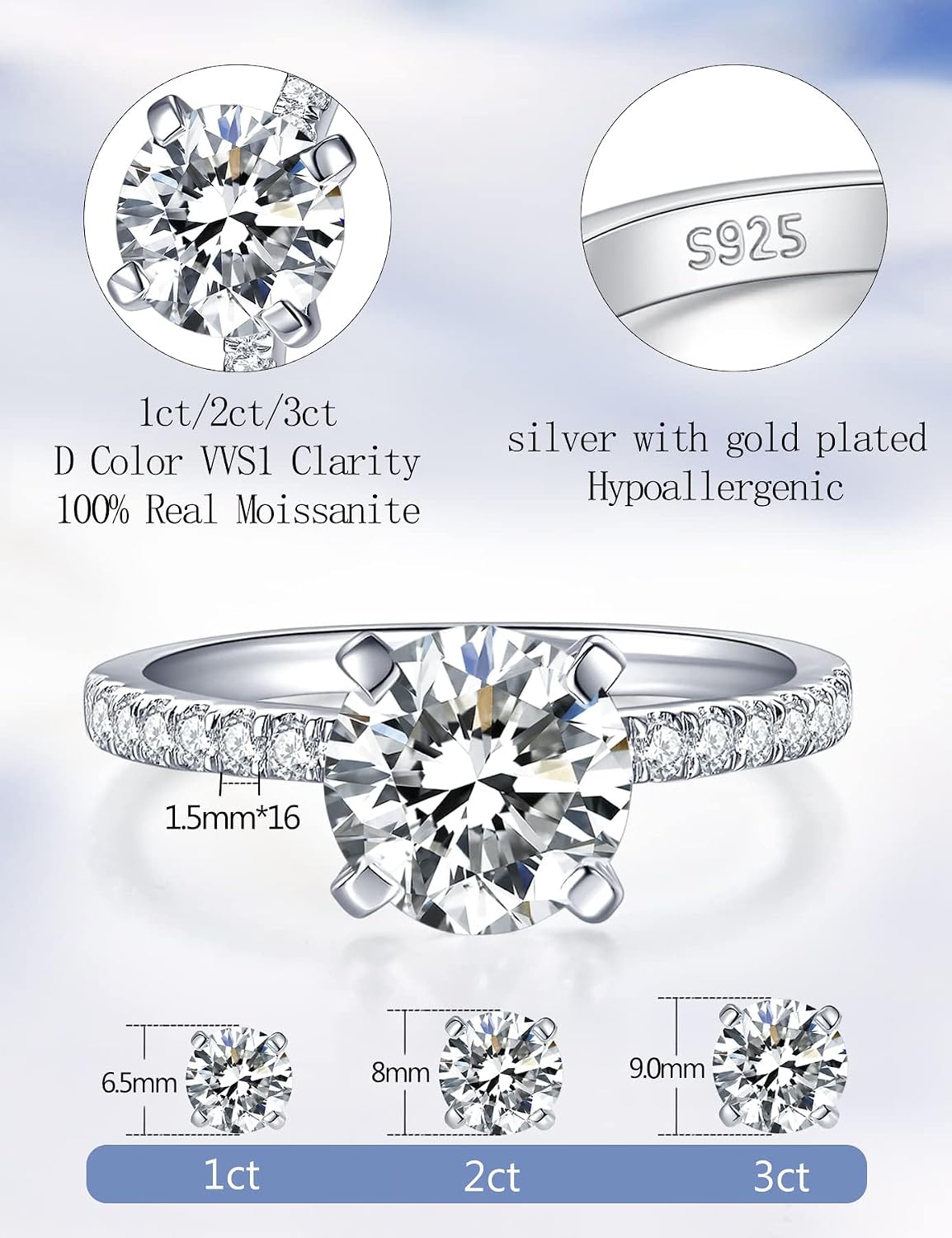
Picture this: you’re three days into a trip abroad, and somewhere between the airport security line and the hotel check-in, you start doing the mental math on the diamond engagement ring on your finger. It’s worth more than your laptop, your camera, and your luggage combined. You weren’t anxious before you left home. Now you are.
That specific feeling — the low-grade dread of traveling with irreplaceable jewelry — is what’s driving a fast-growing category of intentional purchase: the moissanite travel ring (also called a substitute ring or stand-in ring). Moissanite is a lab-created gemstone made from silicon carbide. It looks nearly identical to a diamond to most observers, costs a fraction of the price, and sits at 9.25 on the Mohs hardness scale (diamonds are 10), making it one of the most durable gemstones available. This guide is for the buyer who already knows what moissanite is and wants the honest tradeoff analysis — band durability, stone optics, stacking compatibility, sizing strategy — before committing.
The Real Reason Buyers Buy These (And Why They Don’t Send Them Back)
The stated reason for purchase is almost always practical: “I’m going to Southeast Asia for two weeks,” or “I work in an ICU and can’t wear my real ring on shift.” The unexpected outcome, documented repeatedly across aggregated buyer reviews, is that many of these rings don’t go back into the drawer when the trip ends.
Why? A few converging factors:
The sparkle surprises people. Moissanite has a refractive index of 2.65–2.69, compared to diamond’s 2.42, per the Gemological Institute of America’s overview of the stone. That higher refractive index means moissanite disperses more colored light — the “fire” effect — than diamond does. In outdoor or mixed lighting, moissanite can actually outshine a comparable diamond in terms of visible flash. Buyers who expected a dim simulant instead find a stone that their family members (including, in multiple documented cases, relatives who work in jewelry) can’t immediately distinguish from their mined diamond without tools.
The emotional math shifts. Once a buyer confirms the stone performs visually, the anxiety of daily wear on an expensive piece starts to feel optional. A bartender who reviewed her moissanite ring after extended daily shifts noted the stone itself looked exactly as it did on day one — the issue was the band, not the gem. More on that shortly.
The stack logic takes hold. A standalone substitute ring becomes a permanent stack addition sitting beside the original. The moissanite piece handles Monday through Friday; the diamond comes out for dinner. This is a genuinely common outcome, and it reframes the purchase from “cheap copy” to “intentional collection management.”
According to The Knot’s editorial coverage of the moissanite category, the purchase trigger has broadened considerably from the earlier “budget engagement ring” framing. Travel and occupational wear are now among the most commonly cited reasons for first-time moissanite purchases, particularly in the $150–$500 price range.
The Band Problem: Where the Real Degradation Happens
If you read one section of this piece, make it this one, because it’s where the category consistently underdelivers and where your purchase decision should actually hinge.
Reviewers across the moissanite substitute ring market are nearly unanimous on one point: the stone holds up; the band often doesn’t. Specifically:
- Gold-plated bands on sterling silver shanks begin showing plating wear on the inner shank (the part that contacts your skin and other rings) after two to four months of daily wear in most reviewer accounts. The outer face holds longer, but the underside degrades first.
- “Gold tone” finishes on base metal (brass or copper alloy cores) don’t just fade — they can cause skin discoloration or the “green finger” reaction that buyers dread. This is the metal reacting with sweat and skin chemistry, not a problem with the moissanite itself.
- Vermeil (sterling silver core with a heavier gold plating, typically 2.5 microns or thicker) outperforms standard plating meaningfully, per the International Gem Society’s coverage of plating standards. It still isn’t solid gold, but the degradation timeline extends substantially.
- Solid sterling silver with rhodium plating is the most honest option for a budget substitute ring. Rhodium doesn’t add warmth or gold tone, but it won’t tarnish, won’t turn fingers, and won’t flake.
- Solid 10K or 14K gold bands on moissanite rings do exist in the $300–$600 range and represent a genuine step change in durability. If a nurse or bartender is planning genuine daily wear through shifts for more than six months, this is the tier to consider.
By the numbers:
- Mohs hardness, moissanite: 9.25 (vs. diamond: 10; sapphire: 9)
- Refractive index, moissanite: 2.65–2.69 (vs. diamond: 2.42)
- Standard gold plating thickness: 0.5 microns; vermeil minimum: 2.5 microns
- Estimated plating wear onset with daily wear: 2–6 months depending on skin pH, activity, and product exposure
The practical implication: if you’re purchasing for an ER nurse, a bartender, or anyone whose hands are in water, gloves, or cleaning products regularly, budget for a solid metal band. The stone will be fine. The plating will not.
Stone Optics: The Side-by-Side Comparison Buyers Actually Report
The question buyers most want answered before purchase is: “Will people know?”
The honest answer, based on the pattern across thousands of documented buyer reviews and corroborated by gemological sources including the Gem Society’s detailed moissanite entry, is: probably not in social settings; sometimes yes in controlled viewing.
Here’s the nuance:
Where moissanite reads as “clearly not diamond” to trained eyes: Under direct, single-source light (a jeweler’s loupe, a focused lightbox, or direct sunlight at certain angles), moissanite produces more rainbow fire than a typical diamond. To a gemologist or experienced jeweler, that excess dispersion is a tell. In a bridal salon with track lighting designed to make stones pop, a very experienced eye may notice.
Where moissanite is essentially indistinguishable: In ambient indoor light, candlelight, restaurant settings, and most outdoor environments, the difference is negligible to all but specialists. Brides.com’s comparison guide notes that the visual distinction between moissanite and diamond is considerably smaller in person than jewelry marketing historically suggested, particularly with newer near-colorless (G–H range equivalent) moissanite production.
The “former jeweler in the family” data point: Multiple buyers across review aggregates specifically mention that a relative with a jewelry background couldn’t tell the difference in casual wear situations. This anecdote appears often enough to be statistically interesting. It doesn’t mean the stones are identical; it means the viewing conditions of daily life rarely produce the conditions that reveal the difference.
For travel specifically: customs officials, hotel staff, and street vendors aren’t gemologists. The risk calculus changes entirely when you’re talking about leaving a $12,000 diamond in a hotel safe versus wearing a $200 moissanite to a market.
Practical Decision Framework: If X, Then Y
You’re either already sold on the concept or you’re calibrating where to spend. Here’s how to structure the decision:
If your primary use case is international travel (two to four weeks, low-risk activity): Choose on stone quality and basic band integrity. A solid sterling silver or vermeil band with a 1–2ct DEF equivalent moissanite does the job cleanly. You don’t need to invest in a solid gold band for occasional travel wear.
If your use case is occupational daily wear (healthcare, food service, manual work): The band is your decision variable, not the stone. Prioritize solid 10K or 14K gold, or at minimum a thick vermeil over sterling. Expect to spend $300–$600 for a band that survives six-plus months of shift work without visible degradation.
If you want it to function as a permanent stack addition: Buy at the quality tier where you’d be comfortable wearing it as-is, not just as a substitute. That usually means a better-cut stone (look for “super ideal” or “hearts and arrows” moissanite cuts from established producers) and a solid metal band. The Pricescope community’s long-running moissanite wear threads consistently suggest that buyers who love their substitute rings long-term purchased at a slightly higher initial price point.
If you’re sizing without half sizes available: Size up. Rings are easier to have resized down, and a slightly loose ring is far preferable to one that creates friction on the shank plating. This is especially true for plated bands, where pressure points accelerate wear.
If you want to stack it with your actual engagement ring: Check your engagement ring’s shank width first. A moissanite band that’s narrower than your engagement ring tends to look intentional; a band that’s the same width or wider starts to visually compete. Most buyers in stacking configurations choose a moissanite in a simple solitaire or three-stone setting with a slimmer band profile. The metal tone should either match exactly or go deliberately mixed (rose gold beside yellow gold reads as intentional; a slightly different shade of the same metal looks like a mistake).
Frequently Asked Questions
Will a moissanite travel ring tarnish or turn my finger green with daily wear? The moissanite stone itself will not tarnish, cloud, or cause discoloration — it’s chemically inert. The risk is entirely in the band metal. Solid sterling silver won’t turn fingers green on its own, but base metal (brass, copper alloy) cores under thin gold plating can. Check the band material explicitly before buying; “gold tone” is not the same as “gold filled” or “sterling silver.”
How does moissanite fire compare to a real diamond when seen side by side? Moissanite actually produces more colored fire (dispersion) than diamond due to its higher refractive index, per GIA’s gemological data. Side by side under ambient lighting, most observers find moissanite’s sparkle equal to or greater than diamond’s. Under a focused light source, the excess rainbow flash can read as slightly different from diamond’s more white sparkle — which is the main optical tell for trained eyes.
Is sterling silver with gold plating durable enough for a nurse or bartender? For occasional wear, yes. For genuine daily shift work involving water, gloves, sanitizers, and chemicals, plating degradation on the inner shank is nearly inevitable within months. A solid metal band — 10K gold minimum — is the more honest recommendation for anyone in a hands-on profession.
What happens to the band plating after months of hard wear? The inner shank (bottom of the band) shows wear first, typically as a silver or brass-colored line where the plating has rubbed through. The face of the setting usually holds longer. Vermeil (thicker plating over sterling) extends the timeline but doesn’t eliminate it. Replating is available from most local jewelers for $20–$50 and restores appearance, but it’s a maintenance cost to factor in.
Should I size up or down when half sizes aren’t available? Size up. A slightly loose fit is more comfortable and avoids the friction that accelerates plating wear on the inner shank. If you’re between a 6.5 and a 7 and only whole sizes are available, choose 7.
Can a moissanite substitute ring be worn stacked with a real engagement ring? Yes, and this is one of the most common outcomes buyers report. The practical notes: match or intentionally contrast metals, choose a band profile that complements rather than competes, and be aware that the harder stone (diamond at Mohs 10) can, over time, affect a slightly softer neighbor. In practice, at 9.25, moissanite is close enough in hardness that everyday stacking doesn’t create meaningful abrasion concerns — but avoid grinding the two rings together repeatedly.
The buyer who started this purchase to protect an heirloom ring in an airport security line and ended up wearing the moissanite to work on Monday is not an outlier. It’s the modal outcome. The question worth asking before you buy isn’t whether moissanite is “good enough” — by every gemological and practical measure reviewed here, it is. The question is whether the band is honest about what it’s made of, and whether the quality tier matches how you’re actually going to use it.