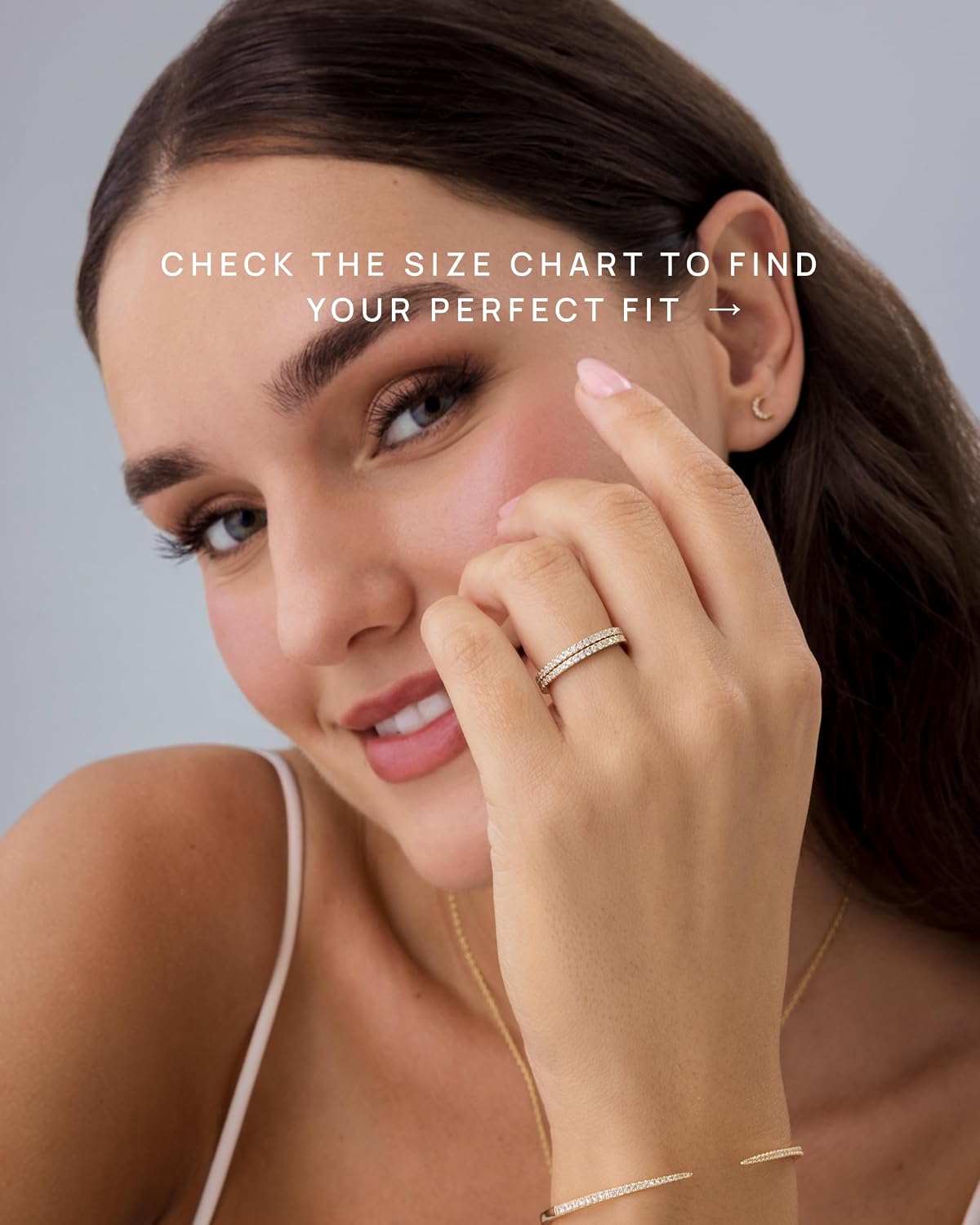
You’ve saved up for something you wear every day — maybe it’s an Oura Ring 4 (a sensor-packed wellness tracker that sits on your finger and monitors your heart rate, sleep, and activity), or maybe it’s a natural diamond engagement ring that cost more than your last vacation. Either way, the math on wearing it while bartending, traveling internationally, or spending three hours in a hospital ICU shift starts to look bad pretty quickly. That’s the exact problem that’s driving a quietly booming use case in the jewelry market: buyers purchasing moissanite (a lab-created gemstone with diamond-level brilliance, rated 9.25 on the Mohs hardness scale) and CZ (cubic zirconia, a synthetic crystal that mimics diamond at a fraction of the cost) stackable bands specifically as substitutes — not costume jewelry, but thoughtful, durable stand-ins that let the real thing stay safe at home.
This article is for the buyer who already has some context: you know the difference between moissanite and CZ, you’ve probably sized yourself, and you have a specific scenario in mind — smart ring pairing, a work environment where rings take abuse, or travel where theft or loss is a real risk. What you need now is a clear framework for which stone, which metal, which sizing strategy, and which trade-offs are actually worth caring about. Let’s work through it.
Why This Use Case Is Growing (and Why It’s Not Just Frugality)
The Oura Ring 4 launched in late 2024 and was widely reviewed by outlets including Wired and PCMag as one of the most accurate consumer health trackers on the market. It costs $350–$500 depending on finish. Wearing a metal stacking ring directly adjacent to it every day raises a legitimate question that buyers have started asking in jewelry forums and review threads: can a hard metal or stone ring scratch the device’s outer titanium shell?
The answer, based on aggregated buyer reports and published materials from Oura’s own support documentation, is nuanced. Titanium sits at roughly 6 on the Mohs hardness scale. Moissanite at 9.25 and CZ at approximately 8–8.5 are both harder than titanium, meaning direct stone-to-device contact could scratch the ring’s surface over time. The practical workaround buyers report: wear the stacking ring on an adjacent finger, or position it so the stone face doesn’t drag across the device body. Metal-on-metal contact (a gold-plated band against titanium) is less of a concern — gold at 2.5–3 Mohs is softer and unlikely to mark titanium. This is a real trade-off worth understanding before you build a stack.
Beyond the Oura scenario, the motivations reviewers consistently cite fall into three buckets:
- Work environments: Nurses, bartenders, physical therapists, and tradespeople report wearing moissanite or CZ bands daily for months — through handwashing, glove-on-glove-off cycles, and chemical exposure — and noting minimal sparkle loss or tarnishing on quality pieces.
- Travel: International travelers cite both loss risk and customs attention as reasons to leave fine jewelry home. A CZ eternity band (an eternity band is a ring with stones set all the way around the shank, giving continuous sparkle from every angle) clears security without triggering concern and represents a $30–$120 loss if stolen — not a $3,000 one.
- Life phases: Pregnancy swelling, postpartum hands, and extended outdoor projects (one buyer’s account of wearing a CZ band through nine months of dishwashing, gardening, and cleaning without removal is among the most cited durability data points in stackable ring reviews on PriceScope’s community forums) all create demand for rings you can wear hard and replace cheaply.
Moissanite vs. CZ in an Eternity Band: The Decision Frame
Both stones work in this use case. The decision comes down to three variables: budget ceiling, durability threshold, and sparkle priority.
By the numbers:
| Moissanite Eternity Band | CZ Eternity Band | |
|---|---|---|
| Typical retail range | $80–$400+ | $20–$120 |
| Mohs hardness | 9.25 | 8–8.5 |
| Expected sparkle life (daily wear) | 2–5+ years before any cloudiness | 12–24 months before visible dulling |
| Replating needed (gold-plated)? | Yes, every 1–2 years | Yes, every 6–18 months |
The GIA’s consumer education resources on moissanite note that its double-refractive structure gives it more fire (rainbow flashes) than a diamond of equivalent size — a property that reads as noticeably more dramatic in eternity bands than CZ, which is single-refractive and produces a cleaner, brighter white flash. In a side-by-side eternity band comparison, the difference is visible in natural light. Whether that matters depends on your stack. If you’re pairing with a natural diamond solitaire and want to blend, CZ’s flatter flash may actually be a better visual match. If you’re building a standalone stack, moissanite’s fire is legitimately impressive and consistently surprises buyers who expected “fake-looking.”
The Knot’s 2025 stackable ring guide notes that across verified buyer reviews, moissanite bands in sterling silver or gold-fill settings report significantly higher long-term satisfaction than CZ in the same metal types — largely because the stones themselves don’t cloud at the same rate, even when the plating wears.
The honest CZ caveat: plating lifespan is the real variable, not the stone. The Gem Society’s cubic zirconia gemstone information page notes that CZ itself is chemically stable, but the 14K gold plating on most mass-market eternity bands thins at stress points (especially inside the shank) with daily wear. Reviewers who replace plating annually report bands that still look excellent at three-plus years. Reviewers who skip replating report discoloration at 12–18 months.
Sizing: The Half-Size Problem and How to Solve It
This is the most consistent frustration across eternity band reviews, and it’s structural — not a quality control issue. Because stones are set continuously around the band, eternity bands cannot be resized the way a solitaire can. Cutting and adding metal would break the stone setting. Most manufacturers produce whole sizes only (5, 6, 7, 8), which means buyers who wear a 6.5 or 7.5 face a forced choice.
The strategies buyers use, in order of effectiveness:
-
Size up and use a ring adjuster: Small silicone ring snugglers (available at most hardware and pharmacy retailers) add interior volume and are invisible when worn. They’re particularly effective for buyers whose size floats — fingers swell in heat, shrink in cold, and change with hydration. Multiple buyers in PriceScope forum threads report this as the most reliable solution for the eternity-band sizing gap.
-
Size up and layer with a thicker band: If you’re building a stack anyway, a slightly loose eternity band is held in place by the bands on either side of it. This works especially well for three-ring stacks where the eternity sits in the middle.
-
Size down and accept snug fit: Only viable if you know your fingers don’t swell. Reviewers in hands-on professions (nurses especially) consistently warn against this — after a long shift, a slightly-too-tight ring becomes a genuinely uncomfortable ring.
-
Custom sizing through individual jewelers: For moissanite bands in the $150–$400 range, some smaller direct-to-consumer jewelers offer half-size production runs or can produce a custom size with a 2–4 week lead time. Worth asking before purchasing if your size falls between whole sizes.
Building a Stack That Looks Intentional
A stack of three or four rings that reads as considered rather than cluttered follows a few structural rules that The Knot’s editorial team and Brides.com’s styling coverage consistently cite:
The anchor principle: One ring reads as the “statement” — typically the widest, the most brilliant, or the most colorful. Everything else supports it. For smart ring wearers who keep the Oura on the index finger, a moissanite or CZ eternity on the ring finger with a thin plain band as a separator reads as intentional framing rather than random stacking.
Metal consistency matters more than stone consistency: Mixed metals (yellow gold, rose gold, white gold) in the same stack read as eclectic but put-together if you commit fully. The mistake is one odd-metal-out: three yellow gold bands and one rose gold band looks accidental. Three yellow and two rose, worn in a clear alternating or grouped pattern, reads as a design choice.
Width variation is your friend: A 2mm plain band, a 3mm CZ eternity, and a 4mm moissanite eternity worn together create visual rhythm. Three identical 3mm bands look like you ran out of ideas.
Leave breathing room: A stack that covers the entire finger from knuckle to base looks heavy. Two or three rings grouped toward the base, with visible finger skin above, reads as more intentional in 2025–2026 styling across publications including Vogue and Harper’s Bazaar.
Frequently Asked Questions
1. Can a metal stacking ring scratch or damage an Oura Ring or other smart ring? The Oura Ring 4’s outer shell is titanium (Mohs ~6). A plain gold-plated band (Mohs ~2.5–3) won’t scratch it. Moissanite (9.25) and CZ (8–8.5) stones could mark titanium on direct contact, particularly if the ring rotates and drags the stone face across the device. The practical fix: wear the stacking ring on an adjacent finger, or ensure the stone faces don’t contact the device directly during wear.
2. How long does 14K gold plating last on a CZ eternity band worn daily? Aggregated buyer reports put the realistic window at 12–24 months before visible wear at high-contact points, particularly inside the shank. Replating at a local jeweler typically costs $30–$60 and restores the look fully. Buyers who replate annually report bands that look consistently excellent for three-plus years.
3. What’s the best way to size a stackable band if your size falls between whole sizes? Size up by a half size and use a silicone ring adjuster, or build a stack where adjacent bands hold the looser ring in place. If you’re purchasing a moissanite band in the mid-range ($150+), ask the jeweler directly about custom half-size production — it’s more commonly available than listings suggest.
4. Is moissanite sparkle noticeably better than CZ in an eternity band setting? Yes, visibly so in natural light. Moissanite’s double-refractive structure produces stronger fire (colored flashes) compared to CZ’s brighter but flatter white flash. Whether “better” is the right word depends on your stack — CZ actually blends more cleanly with natural diamonds, while moissanite stands on its own more dramatically.
5. Will these rings turn my finger green with daily wear? With quality pieces in sterling silver or gold-plated brass, some buyers with sensitive skin or high-acidity sweat report faint green discoloration under the band. It’s harmless and washes off. Gold-fill (a thick mechanically bonded gold layer, heavier than plating) is significantly more resistant to this than gold-plated brass. If you’re wearing daily and your skin runs acidic, gold-fill or solid sterling silver is worth the small price premium.
6. How do I build a stack that looks intentional rather than mismatched? Anchor with one statement ring, vary band widths deliberately, commit to a metal direction (consistent or clearly contrasting), and leave some bare finger visible. Three rings grouped at the base of your finger with skin above reads as styled; five rings covering every millimeter reads as accumulated.
The Decision Rule
If you’re an Oura wearer, a nurse, a bartender, or someone about to take a two-week international trip: moissanite wins on durability and long-term satisfaction, CZ wins on expendability and low-stakes wear. The clearest if/then frame:
- If you’d be genuinely upset losing it: buy moissanite in gold-fill or solid sterling, size up with an adjuster, and treat it as a two-to-five-year daily driver.
- If it needs to be truly throwaway: buy CZ in gold-plated brass, expect to replate or replace at 18 months, and don’t overthink it.
- If you’re pairing with a smart ring: keep stones on adjacent fingers, not the same one as the device, and lean toward plain bands closest to the tracker.
- If sizing is uncertain (pregnancy, travel to hot climates, hands-on job with variable swelling): always size up and adjust — you cannot resize an eternity band later.
The case for this whole category isn’t that it replaces fine jewelry. It’s that it protects it — and in 2026, with smart ring adoption accelerating and international travel back to pre-2020 volumes, that’s a genuinely smart use of $50 to $200.