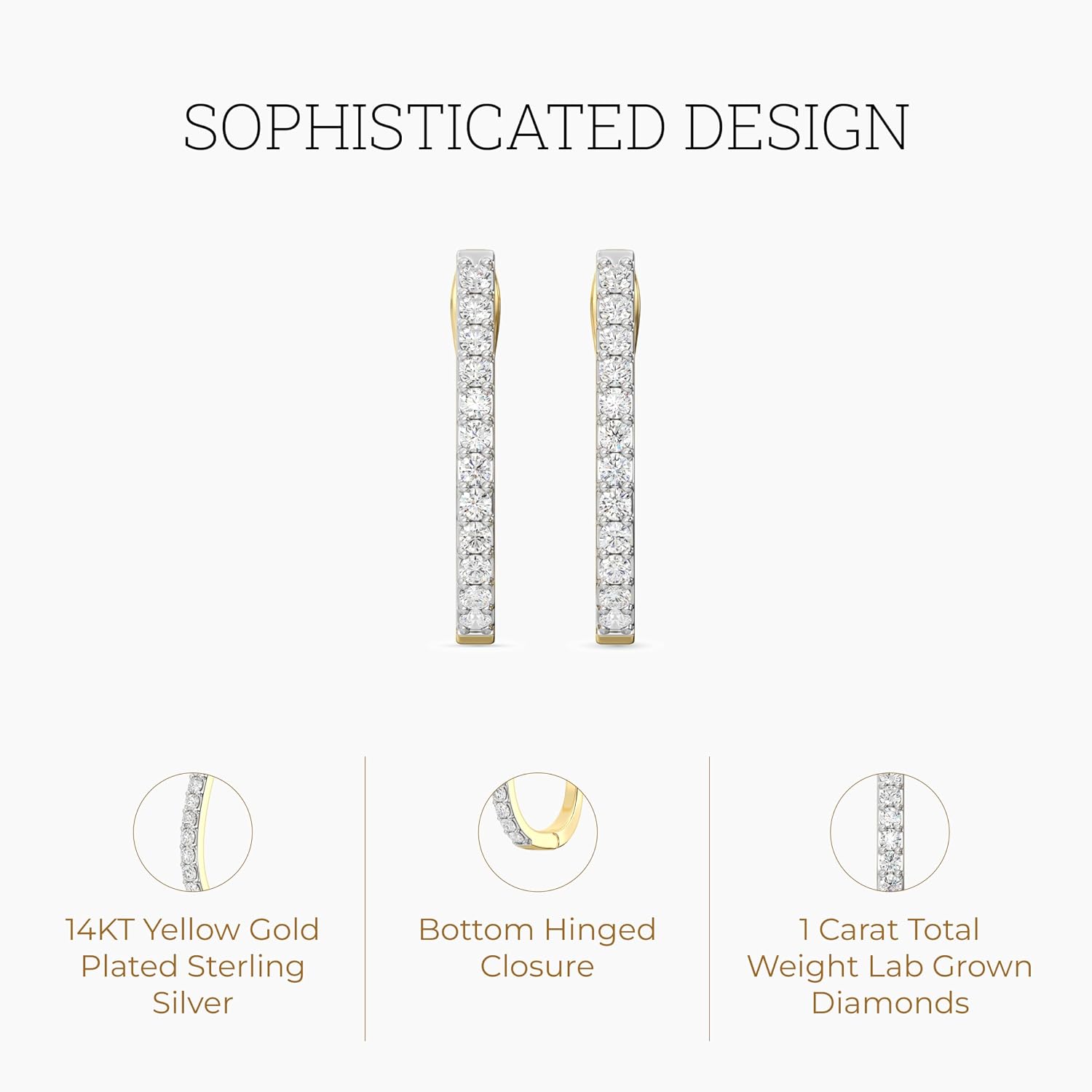
Imagine you’re getting dressed for a dinner that’s slightly more important than the average Tuesday. You reach for the hoop earrings you ordered three weeks ago — the ones that looked substantial in the listing photos — and they’re smaller than you remember. You click the closure, glance in the mirror, and head out. An hour later, one earring is gone.
That scenario plays out more often than it should with lab-grown diamond hoop earrings, and it has almost nothing to do with the diamonds. It has to do with a specific clasp failure mode, the gap between listing photography and reality, and a few setting decisions that buyers routinely underestimate. Lab-grown diamonds — stones grown in a controlled environment that are chemically, optically, and physically identical to mined diamonds, per the Gemological Institute of America’s Lab-Grown Diamonds FAQ — have made fine-jewelry hoops accessible at price points that would have been impossible five years ago. But accessible doesn’t mean effortless. This guide is for the buyer who already understands what a lab-grown diamond is and wants to make a decision they won’t second-guess.
Prong Set vs. Channel Set: The Tradeoff Is Visibility vs. Security
Both settings hold lab-grown diamonds along the inner or outer curve of a hoop. The difference is how they hold them — and that mechanical difference has real consequences for how the earring looks and how long the stones stay put.
Prong setting uses small metal claws (typically two to four per stone) to grip each diamond individually. Each stone sits slightly elevated above the metal band, which means light enters from more angles and the stones face up brighter. At a normal conversational distance — say, across a dinner table — prong-set hoops read as a continuous sparkle rather than a row of stones. The Gem Society’s overview of diamond setting styles notes that prong settings consistently produce more scintillation (the flash of light when the stone or the viewer moves) precisely because of that elevation. The tradeoff: prongs are exposed metal, which means they can snag on hair, fabric, or pillow seams, and they require more attention over time to ensure none bend away from the stone.
Channel setting recesses each diamond into a groove cut directly into the metal band, with a thin wall of metal on each side holding the stone in place. The profile is flatter and sleeker — more architectural than sparkling. At conversational distance, channel-set hoops look like a continuous line of light rather than individual points of sparkle. Brides’ roundup of best diamond hoop earrings consistently characterizes channel-set designs as the better choice for earrings worn daily or during activity, because there are no prongs to catch or bend. The tradeoff: less brilliance face-up, and if one stone works loose, the channel itself may need professional attention rather than a simple prong re-tip.
The practical decision frame:
- If you’re buying hoops primarily for evenings or occasions → prong set. The extra sparkle earns its keep.
- If you’re buying for an earring you plan to wear continuously — including during sleep — → channel set. The lower-profile design has fewer failure points.
- If the hoops will be your daily pair for 18+ months → consider whether you’ll actually re-prong them when needed. If not, channel set is the more honest choice.
The Clasp Failure Mode You Actually Need to Know About
This is the section that justifies reading this article carefully. Across aggregated buyer reviews, one safety issue surfaces with enough consistency that it deserves clear treatment: the hoop closure appears to engage but has not actually locked.
Here is the failure sequence, reconstructed from detailed buyer accounts: The post (the straight pin that passes through the ear) enters the closure housing. The closure clicks, or feels like it clicks. The earring looks secure in the mirror. But if the post isn’t aligned precisely with the locking channel inside the housing — typically because the earring rotated slightly during insertion — the closure is resting on the post rather than gripping it. It looks locked. It isn’t.
One buyer’s account is worth quoting closely: she discovered the earring was gone and could only trace it back to the moment she noticed a faint sound she had attributed to something else. The post had never engaged the locking mechanism. The closure had simply seated itself without capturing the post.
How to prevent this:
- After inserting the post through your ear, slow down before closing. Hold the earring so the hoop is in its natural hanging position.
- Push the post fully into the closure housing before applying rotational pressure to lock it.
- After you feel or hear the click, give the earring a gentle downward tug — not enough to hurt, enough to confirm the post is captured, not just resting.
- Look at the closure in a mirror with good light. A properly locked hinge-style closure will be flush with no daylight between the post and the housing lip.
The Knot’s diamond earring buying guide recommends this pull-test as standard practice for any hinge-back or huggie-style closure, and it applies equally to larger hoops with the same mechanism. This is not a quality complaint specific to budget options. Expensive hoops with the same closure design have the same failure mode if the post isn’t precisely aligned.
The Size Illusion: Why Your Hoops Will Look Shorter In Person
Nearly every buyer who mentions hoop size in reviews notes the same thing: the earrings hang shorter than the listing images suggested. This is not a product defect. It is a predictable consequence of how hoop earrings are photographed.
Listing photography typically shows earrings on a flat surface, an angled display card, or a model with the hoop pulled forward and photographed from a near-straight-on angle. When a hoop hangs naturally from an ear, gravity pulls the bottom arc downward and the sides compress slightly toward the face. The visible “height” — the drop from the lobe to the lowest point — is often 20–30% less than the flat-lay diameter would suggest.
By the numbers:
| Listed diameter | Typical hang drop (lobe to lowest point) | Common buyer expectation gap |
|---|---|---|
| 25 mm | ~16–18 mm | ~7–9 mm shorter than expected |
| 35 mm | ~22–25 mm | ~10–12 mm shorter than expected |
| 50 mm | ~32–36 mm | ~14–18 mm shorter than expected |
PriceScope’s community discussions on hoop sizing confirm this pattern: buyers consistently report that 30mm hoops read as “small hoops” when worn, not the medium-statement piece the listing implied.
The correction is simple: if you want the hoops to appear a certain size on your ear, order the next size up from your intuition. If you want hoops that look substantial without being dramatic, 35–40mm is typically where that lands for most face shapes and lobe positions. If you are buying online and cannot try first, look for listings that include a worn photo — not just a flat-lay — and prioritize those.
The Flower Design Exception: When “Fine-Jewelry Adjacent” Is the Right Description
Among hoop earring designs, flower-motif hoops using pavé or prong-set lab-grown diamonds occupy an interesting category. Buyer language around these is notably stronger than standard hoop reviews — words like “spectacular” and “absolutely gorgeous” appear in accounts from buyers who describe being surprised by how impressive they look in person. One buyer specifically purchased a flower hoop design to replace an earring lost during a visit to Blarney Castle in Ireland, which suggests these pieces were functioning as genuine fine-jewelry stand-ins, not costume jewelry.
What explains the reaction gap? Flower settings cluster multiple stones in a dimensional arrangement that catches light from multiple angles simultaneously. At conversational distance, the effect reads as more complex and more expensive than the price suggests — particularly in lab-grown diamonds, where the stones have the same optical properties as mined diamonds at a fraction of the material cost, per GIA’s documentation of lab-grown diamond characteristics. If you’re shopping for a piece that will consistently prompt compliments from people who know jewelry, the flower hoop format has an unusually strong track record in buyer reports.
Sensitive Skin, Sleep Wear, and Plating: What Owners Actually Report
Two questions come up constantly in hoop earring reviews: can I sleep in these, and will the metal irritate my ears?
Owners who describe wearing hoops continuously — including during sleep — cluster around two metal types: solid sterling silver and solid 14k gold. The word “constantly” appears in their accounts without qualification. No reports of irritation, no loosened stones from pillow contact. Channel-set designs appear to be more sleep-friendly than prong-set, for the mechanical reason already covered: no prong edges to catch on pillowcases.
Gold-plated sterling silver is a different situation. The plating — typically a micron-thin layer of gold bonded to a sterling base — can wear through at contact points over time, particularly at the post and closure where friction is highest. When the plating wears, the underlying sterling silver (which contains nickel in some alloys) can contact the ear canal, and nickel is a documented contact allergen. Brides’ earring coverage notes that buyers with sensitive ears should specifically look for posts labeled “nickel-free sterling” or verify the plating thickness if they plan to wear pieces overnight.
Solid 14k gold — whether yellow, white, or rose — avoids this issue entirely. The metal composition is consistent throughout, and 14k is well-tolerated by most people with metal sensitivities. If sensitive ears are a concern and the budget allows, solid gold is the more conservative choice.
1/2 CTTW vs. 1 CTTW: The Everyday Wear Decision
CTTW stands for “carat total weight” — the combined weight of all diamonds in the piece, not a single stone. For hoops, this weight is distributed across dozens of small stones along the band, so a 1/2 CTTW hoop and a 1 CTTW hoop may appear more similar in person than the weight difference implies.
The practical distinction:
- 1/2 CTTW is the everyday sweet spot for most buyers. The stones are present and visible in direct light, the earring doesn’t read as costume, and the size-to-weight ratio means the hoops stay lightweight enough to forget you’re wearing them.
- 1 CTTW reads noticeably more substantial in photographs and at close range. The face-up coverage is denser. If these hoops will occasionally function as your “dressed” earring — doing the work of a statement piece — the 1 CTTW earns its upgrade.
The Knot’s earring guide characterizes the 0.5–1 CTTW range as the “versatile daily” category precisely because neither extreme requires a dedicated occasion.
Frequently Asked Questions
How do I make sure a hoop earring clasp is actually locked and not just appearing to be? After the post enters the closure and you hear or feel a click, give the earring a firm (not painful) downward tug. If the earring stays in place, the post is captured. If it slides free, the post was resting on the housing rather than locked inside it. Re-insert, ensure the post is fully aligned with the locking channel, and test again before leaving the house.
Are these hoops safe to sleep in? Owners who wear channel-set or huggie-style hoops overnight consistently report no problems — no loosened stones, no irritation. Prong-set designs carry more risk of catching on bedding. The main precaution is confirming the clasp is actually locked before you fall asleep, not just before you leave the house.
Will the gold plating on sterling silver hoops irritate sensitive ears? Freshly plated posts are usually fine. The risk is wear-through at the post, which exposes the underlying sterling and any nickel in the alloy. If you have known metal sensitivity, choose nickel-free sterling or solid 14k gold.
Why do the hoops look longer in the listing photos than they appear in person? Flat-lay and display-card photography shows the full diameter. When worn, the hang drop (lobe to lowest point) is typically 20–30% less than the listed diameter because gravity changes the geometry. Order the next size up from your instinct to hit your target visual size.
What’s the visible difference between prong-set and channel-set lab diamond hoops at a normal conversational distance? Prong-set reads as individual points of sparkle with more flash when the wearer moves. Channel-set reads as a continuous line of light — steadier, more architectural. The difference is apparent at about 3–5 feet. Beyond 8–10 feet, both read as “diamond hoops.”
Is 1/2 CTTW or 1 CTTW the right size for everyday wear? 1/2 CTTW is the practical default — lightweight, genuinely sparkly, works from desk to dinner. Choose 1 CTTW if you want the hoops to occasionally function as a statement piece or if you want coverage that photographs well at close range. Both are legitimate daily earrings; the 1 CTTW is heavier and costs more, but neither is excessive for regular wear.