Imagine you’ve been watching lab-grown diamond pendant prices for a few months. You know the basics — a lab-grown diamond (a real diamond, chemically and optically identical to a mined stone, created in a controlled environment rather than extracted from the earth) costs roughly 80–90% less per carat than its natural equivalent at mid-2026 pricing, according to Pricescope’s Lab-Grown Diamond Price Index and Community Reviews. You also know that “certified” means a third-party gemological lab — most commonly IGI (International Gemological Institute) for lab-grown stones — has independently graded the diamond for cut, color, clarity, and carat weight. What the product listings won’t tell you is that the chain the pendant ships with is almost certainly the weak link in the package, that buyers in this category regret going smaller far more often than going larger, and that at least one buyer walked her pendant into an actual jewelry store and had a professional comment on the stone’s quality unprompted. This article maps the real-world friction points — and organizes them by buyer tier — so you can buy once and buy right.
| EDITOR'S PICK0.5 to 10 Carat 14K White Gold… | Mid-tierGILDED 1 CTTW Lab-Grown Diamond… | Budget pickBelacqua Lab Grown Diamond Pend… | |
|---|---|---|---|
| Carat Weight | 3.0ct | 1 CTTW | 0.5–2ct range |
| Metal | 14K Yellow Gold | Sterling Silver | Sterling Silver |
| Stone Clarity | VS | — | SI |
| Stone Color | E-F | — | G |
| Clasp Type | — | — | Spring Ring |
| Price | $1,690.05 | $159.99 | $79.99 |
| See on Amazon → | See on Amazon → | See on Amazon → |
How Lab-Grown Diamond Solitaire Pendants Break Down by Tier
Not every buyer comes to this category with the same priorities. A first-time pendant buyer testing the format is making different tradeoffs than someone buying a meaningful anniversary gift, and both are in a different position than the buyer who wants an everyday stone that will survive five years of daily wear without a second thought. The three profiles below capture the most common buyer scenarios, each with distinct recommendations.
Budget Entry Point: The 0.25 CT Certified Solitaire for First-Time Buyers
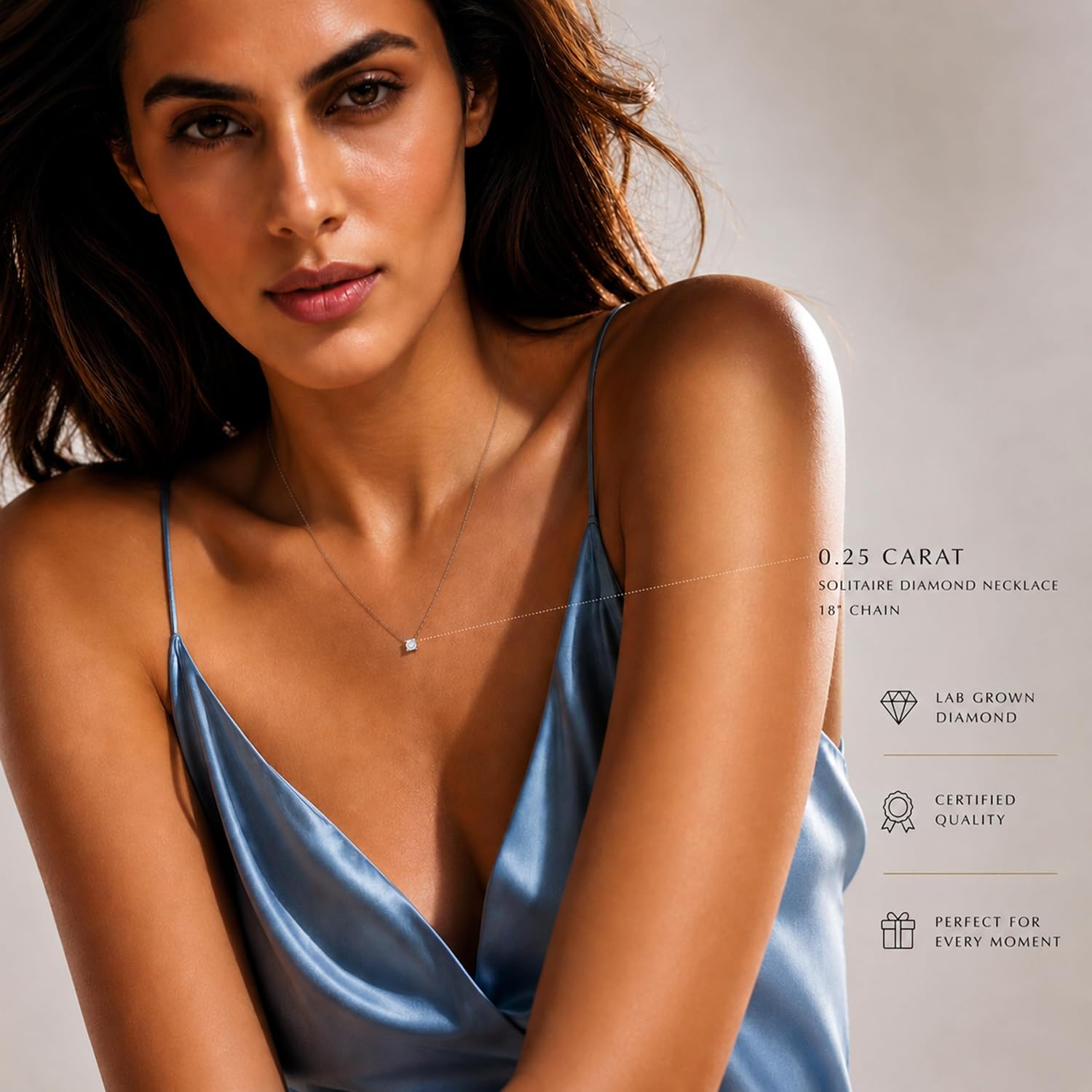
For buyers spending in the lower tier of this category, the typical product is a round brilliant solitaire in the 0.25 CT range, set in a four-prong or bezel setting in 10K or 14K gold, with an IGI certificate attached — or at least advertised. The stone delivers real sparkle at a price that makes the purchase feel low-risk.
The tradeoff at this tier is scale. According to the Gem Society’s Diamond Carat Weight and Face-Up Size Chart, a 0.25 CT round brilliant has a table diameter of approximately 4.1mm. Against the visual noise of fabric and skin at collarbone length, that reads as subtle — present, but not unmistakable. If the intent is a noticeable pendant rather than a quiet one, buyers at this tier frequently report wishing they had stretched to the next size.
Chain quality at this price tier is almost universally thin — typically 1mm or under — and reviewers consistently describe it as presentation-grade rather than daily-wear-grade. Budget approximately $30–$60 for a 14K replacement chain purchased separately.
Belacqua
$79.99
In stock on Amazon
Check price on AmazonMid-Tier: The 0.50 CT IGI-Certified Solitaire for Everyday Elegance
The mid-tier is where most repeat buyers land, and where the regret data from Pricescope’s community reviews is most instructive. At 0.5 CT, the Gem Society’s face-up size data puts the round brilliant diameter at approximately 5.2mm — a 27% increase in visual footprint over the 0.25 CT option. That difference, modest on paper, is clearly visible at conversational distance when the pendant is worn against skin.
Stones in this tier are most commonly graded by IGI, whose Laboratory-Grown Diamond Grading Reports are the industry standard for lab-created stones. A genuine IGI report — one with a report number verifiable through IGI’s online portal — is meaningfully different from a seller’s grade description in a product listing. The report travels with the stone and matters for insurance and resale.
GIA’s educational materials on Understanding Diamond Cut confirm what gemologists consistently note: cut quality is the primary driver of visual brilliance in a round solitaire, ahead of color and clarity at the grades most buyers select (G–H color, VS1–VS2 clarity). At the mid tier, prioritize an Excellent or Very Good cut grade over marginal improvements in color or clarity.
The Knot’s Diamond Pendant Buying Guide identifies chain gauge as one of the most overlooked variables in pendant purchases for buyers planning daily wear — and mid-tier pendants are no exception. The included chain is better than in the budget tier but still typically thinner than what daily wear demands. A 1.5mm to 1.8mm 14K box or cable chain, purchased separately, is the standard recommendation.
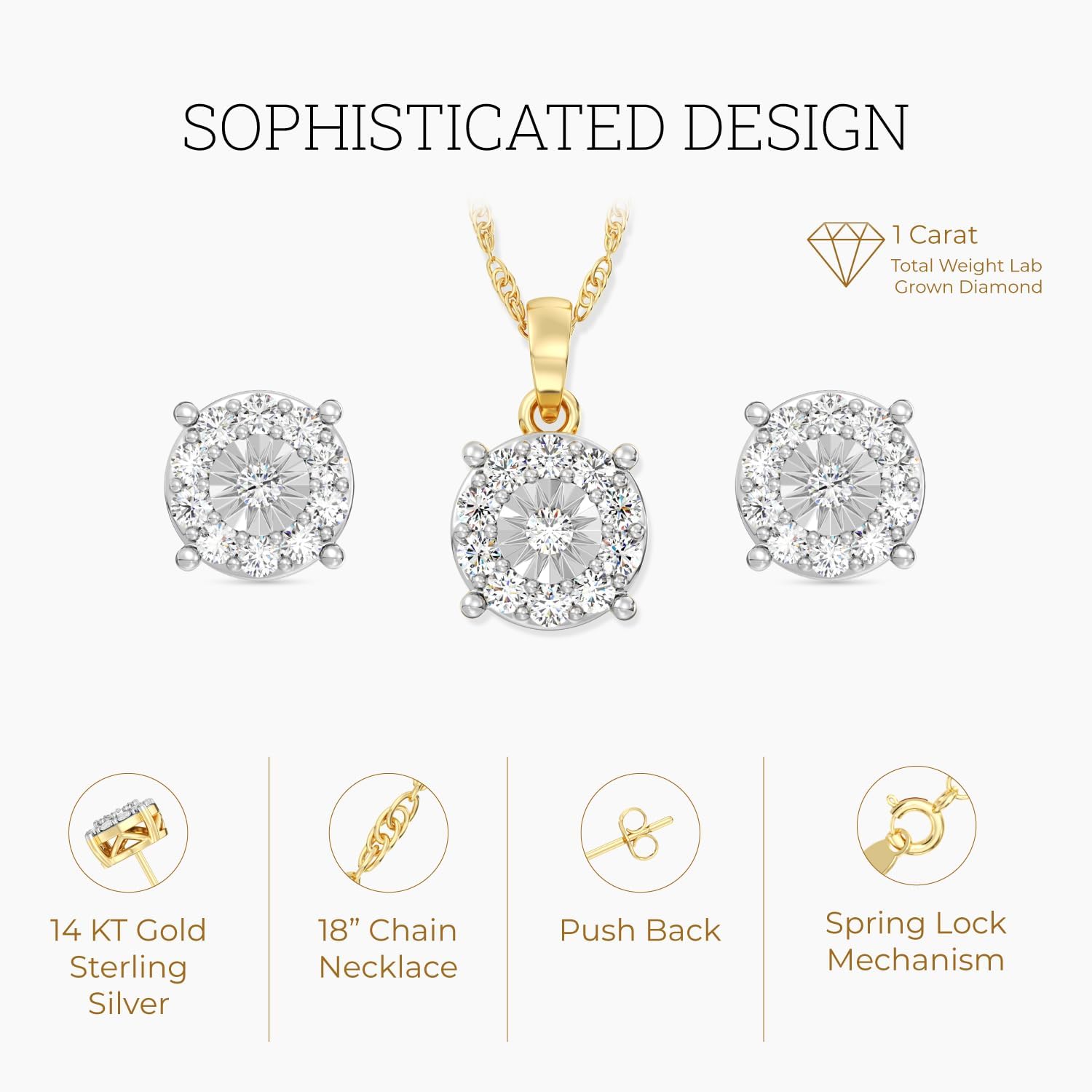
GILDED
$159.99
In stock on Amazon
Check price on AmazonPremium Tier: The 1.0 CT+ Certified Solitaire for Statement Wear
At one carat and above, a lab-grown diamond solitaire pendant enters statement territory. The Gem Society’s size data puts a 1.0 CT round brilliant at approximately 6.5mm in diameter — unmistakable at conversational distance in most lighting. Pricing at this tier has compressed significantly as of mid-2026, per Pricescope’s ongoing Lab-Grown Diamond Price Index tracking, making one-carat lab-grown stones accessible at price points that would have bought a 0.4–0.5 CT stone two years ago.
At this investment level, certification is non-negotiable. Verify the IGI report number before finalizing any purchase. A premium-tier stone without a verifiable independent grading report is a red flag, not a bargain. GIA’s guidance on diamond grading underscores that independent certification is the buyer’s primary protection against misrepresentation of quality attributes — and that a certified stone’s grade is verifiable by any qualified gemologist regardless of where it was purchased.
Chain replacement at the premium tier is also more important, not less. A heavier stone exerts more stress on a thin chain, and the cost asymmetry between a $20 chain failure and a lost stone makes the upgrade straightforward to justify. A 1.8mm to 2.0mm 14K or 18K cable chain is appropriate for daily-wear use at this stone weight.

0.5
$1,690.05
In stock on Amazon
Check price on AmazonThe Chain Problem Is Real — and Nearly Universal
Across aggregated buyer reviews covering multiple lab-grown diamond solitaire pendants in the accessible-to-mid-market price tier, one complaint appears with enough consistency to qualify as a category-wide pattern rather than a brand-specific flaw: the included chain is too thin for confident daily wear.
Reviewers describe chains variously as “delicate,” “too fine,” and — in one case — as something the buyer “knew she’d replace immediately” before the box was even closed. This isn’t a quality-control failure in the traditional sense. Manufacturers in this segment include thin chains because they photograph cleanly, ship without kinking, and keep the declared product weight low. The chain does its job for the listing. It may not do its job for your lifestyle.
The practical takeaway: budget for a chain replacement before you finalize your purchase decision. The Knot’s Diamond Pendant Buying Guide notes that chain gauge and metal weight are among the most overlooked variables in pendant purchases, particularly for buyers who plan daily wear. A pendant designed to sit well on a 1.5mm to 1.8mm cable or box chain is a different purchase calculus than the same pendant shipped with a 1mm singapore or snake chain that may require careful handling.
What to do: When you identify a pendant you like, note whether the listing specifies chain gauge. If it doesn’t, assume it’s at the thinner end of the spectrum. Plan on purchasing a replacement chain — ideally 14K or 18K gold in a box or cable style at 1.5mm to 1.8mm — as a simultaneous add-on. Jewelers, including local independent stores, will swap a pendant bail onto a new chain in minutes, often at no charge if you purchased the chain from them.
Carat Sizing: The Direction of Regret Runs Larger
Pendant sizing regret is structurally different from ring sizing regret, and it’s worth understanding why before you anchor on a number.
With rings, buyers occasionally report going larger than they needed and feeling the stone looks ostentatious for their hand. With pendants, the review pattern runs almost entirely the other direction: buyers wish they had gone larger. The reason is geometry. A pendant hangs against fabric, skin texture, and the visual noise of a neckline. A stone that looks substantial in a product photo — shot against a white background with close-focus optics — can read as modest or even small against the visual context of a worn look.
Round brilliant face-up diameter by carat weight, per the Gem Society’s Diamond Carat Weight and Face-Up Size Chart:
| Carat Weight | Approx. Diameter (mm) | Visual Context |
|---|---|---|
| 0.25 CT | ~4.1 mm | Subtle; reads as a fine jewelry accent |
| 0.50 CT | ~5.2 mm | Clearly present; visible from a few feet away |
| 1.00 CT | ~6.5 mm | Statement-level; unmistakable at conversational distance |
If you are deciding between 0.25 CT and 0.5 CT and your intent is that the pendant be noticeable — not just known to be there — the 0.5 CT is almost certainly the right call. Lab-grown diamond pricing in mid-2026 has compressed the cost difference between these two tiers substantially, per Pricescope’s Lab-Grown Diamond Price Index, which makes the upgrade easier to justify than it would have been even two years ago.
When the Jeweler Weighs In: A Meaningful Data Point
One of the more useful pieces of buyer data in this category comes from a reviewer who did something most online pendant buyers don’t think to do: she took the pendant to a local jeweler for assessment.
The jeweler’s reported response was positive — commenting on the stone’s quality and confirming that the price paid represented a genuine value relative to the stone’s characteristics. This anecdote matters for two reasons.
First, it confirms what GIA’s educational materials on diamond grading have long maintained: a certified stone’s quality attributes are real and verifiable by any qualified gemologist, regardless of where the stone was purchased. An IGI-certified lab-grown diamond graded VS1/G is a VS1/G stone whether it came from a flagship retailer or a direct-to-consumer listing, as documented in IGI’s Laboratory-Grown Diamond Grading Reports methodology.
Second, it normalizes something that more buyers should do: bring the pendant to a local jeweler. Not to validate the purchase retroactively, but proactively — to have the chain swapped, the setting checked, and a professional opinion rendered on whether the prongs are secure. Independent jewelers generally welcome this kind of visit. It builds a service relationship, and it’s a completely reasonable thing to do with a significant purchase.
Certification Reality: What “IGI Certified” Actually Means
There is meaningful variation in how sellers describe certification in lab-grown pendant listings. Some pendants ship with a physical IGI certificate or a certificate number linked to IGI’s online verification portal. Others are described with grade-language (“VS1 clarity, G color”) without an attached certificate.
The distinction matters. A true IGI report — one with a report number you can verify through IGI’s public lookup tool — gives you an independent third-party assessment that travels with the stone and retains value if you ever want to resell, insure, or upgrade. A grade description in a product listing is a seller claim, not an independent verification.
Pricescope’s community review threads consistently flag this distinction as a key differentiator between lab-grown pendant listings, even at similar price points. Genuine certification adds a floor of accountability that grade descriptions alone cannot provide.
What to check before purchase:
- Does the listing specify an IGI report number, or does it ship with a certificate card?
- Is the grading language specific (e.g., “IGI Report #LG12345678, VS1, G, Excellent Cut”) or generic (“high-quality lab-grown diamond”)?
- If a report number is provided, can it be confirmed through IGI’s verification system before you complete the purchase?
Frequently Asked Questions
Is the chain that comes with a lab diamond pendant strong enough for daily wear? In most cases in this product tier, the included chain is designed for presentation rather than durability. Reviewers across multiple products describe the chains as too thin for confident daily wear. Plan to replace it with a 1.5mm to 1.8mm box or cable chain in 14K or 18K gold for everyday reliability.
Can I take a lab-grown diamond pendant to a local jeweler to have it set on a new chain? Yes, and you should. Local jewelers can swap a pendant from one chain to another, check prong security, and verify the stone’s setting — typically quickly and at low cost. One buyer in this category did exactly this and had the jeweler independently comment on the stone’s quality. The experience is worth having.
How does 0.25 CT compare to 0.5 CT when worn as a pendant — is the size difference visible? Yes, the difference is visible in normal wear conditions. According to the Gem Society’s Diamond Carat Weight and Face-Up Size Chart, a 0.25 CT round brilliant measures approximately 4.1mm across; a 0.5 CT measures roughly 5.2mm — a 27% increase in diameter. Against the visual context of skin and fabric, the 0.5 CT reads as clearly present where the 0.25 CT reads as subtle. Buyers in this category consistently report wishing they had sized up, not down.
Do lab-grown diamond pendants come with real IGI certificates or just grade descriptions? It varies by listing. Some include a physical IGI certificate with a verifiable report number; others use grade-language in the listing description without an attached independent certificate. Always check whether the listing specifies an IGI report number before purchase.
What does the packaging look like — is it gift-ready without additional wrapping? Most reviewers describe the packaging as genuinely gift-ready — velvet-lined boxes with ribbon closures that present well. One documented exception: at least one buyer received a pendant tangled inside the box during shipping. A quick inspection before gifting is good practice regardless of how clean the exterior looks.
The Decision Frame
If your primary use case is daily wear, replace the chain before the first wear — don’t wait for a failure event. If you are deciding between carat sizes, size up; the regret data in this category runs nearly one-directional toward wishing for more stone. If certification matters to you (and for a meaningful purchase, it should), verify the IGI report number before finalizing the order, not after. And if you have a local jeweler you trust, a ten-minute visit with a new pendant — to check the setting, swap the chain, and get a professional set of eyes on the stone — is one of the most underused moves in the direct-to-consumer jewelry buying process. The jeweler in the review data didn’t charge for the opinion. She offered it freely, because a well-cut certified stone, wherever it was purchased, is still a well-cut certified stone.