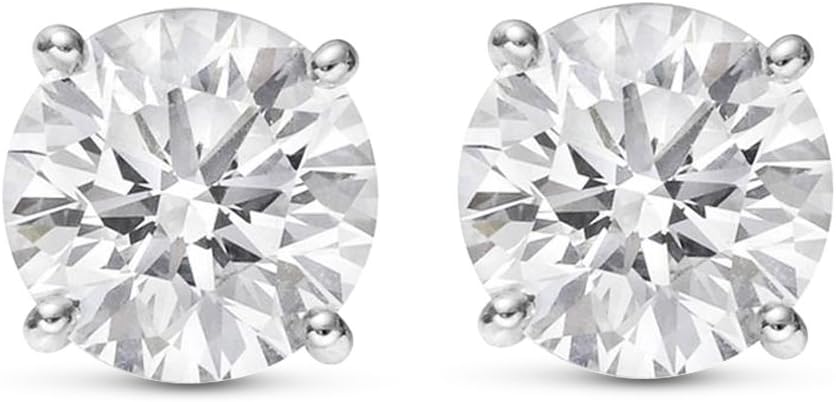
Lab-grown diamonds are real diamonds — chemically, optically, and structurally identical to diamonds mined from the earth. The only difference is where they were made: a controlled factory environment rather than a geological one. Because the growth process eliminates the supply chain costs of mining, lab-grown diamonds typically retail for 60–85% less than natural diamonds of equivalent size and grade, a gap that has widened steadily through 2025 and into early 2026, according to Pricescope’s Lab Grown Diamond Price & Value Tracking community price index. For stud earrings specifically, this price compression is a genuine game-changer: a matched pair of 1 carat total weight (ctw) lab-grown diamond studs in good-quality grades can now be found at price points that would have bought a quarter-carat natural pair five years ago. But the lower barrier to entry also means more decisions to make — about certification, stone grades, carat calibration for your ear, and a category-specific concern about post hardware that affects real buyers every day. This guide walks you through all of it.
| EDITOR'S PICKBelacqua Lab Grown Diamond Stud… | Mid-tier0.5 to 12 Carat 14K White Gold… | Budget pickGilded Lab-Grown Diamond Stud E… | |
|---|---|---|---|
| Metal | 14K White Gold | 14K White Gold | 925 Silver, 14K Plated |
| Certification | — | IGI Certified | — |
| Color Grade | F | E/F | — |
| Clarity | VS | VS2/SI1 | SI1 |
| Carat Options | 1/4 to 4 ct | 0.5 to 12 ct | — |
| Gift Box | ✓ | — | — |
| Price | $499.99 | $337.37 | $99.99 |
| See on Amazon → | See on Amazon → | See on Amazon → |
Why IGI Certification Matters for Lab Diamond Studs (and What to Actually Check)
When a stud earring listing mentions “IGI certified,” it means the International Gemological Institute — one of the two grading labs most widely recognized for lab-grown diamonds alongside GIA — has evaluated each stone and issued a formal report. Per the International Gemological Institute’s standard Laboratory-Grown Diamond Grading Report documentation (2025), a lab-grown diamond report covers the same 4Cs (cut, color, clarity, carat weight) as a natural diamond report, and also identifies the stone as laboratory-grown. That identification line is non-negotiable for ethical sourcing confidence: it’s the paper trail that separates a lab-grown stone from an undisclosed mined stone, and it’s why buyers consistently cite certification alongside price as a primary decision driver.
What the certificate tells you:
- Color grade: For studs, F–G is the practical sweet spot. D–E is technically “colorless” but offers diminishing visual return in a small melee or solitaire stud setting, especially set in white gold or silver. H–I is faintly warm but usually invisible to the naked eye in a bezel or prong-set stud under about 0.75 ct per ear.
- Clarity grade: VS1–VS2 means “very slightly included” — inclusions not visible to the naked eye. SI1 means “slightly included” — most SI1 stones are eye-clean, but not all. More on this in the FAQ.
- Cut grade: IGI grades cut on round brilliants. For studs, “Excellent” cut matters more than most buyers realize — it’s what produces the scintillation (sparkle pattern) visible at conversation distance, which is exactly where people notice your earrings.
The practical verification step: IGI certificates each carry a unique report number. Any legitimate IGI-certified product should have this number either on the certificate card included with the jewelry or retrievable through IGI’s online verification tool. If a listing says “IGI certified” but provides no report number, treat that claim skeptically.
The Knot’s Lab-Grown Diamond Buying Guide (2024–2025 editorial) notes that the lab-grown category has enough variance in seller transparency that certificate verification has become a standard recommendation — not a paranoid one.
Calibrating Carat Size: What Actually Looks Right on an Earlobe
The carat sizing decision for studs is more physical than it sounds. Carat is a weight measure (1 carat = 0.2 grams), but what buyers actually care about is face-up diameter — how wide the stone looks when you’re looking at someone wearing it.
By the numbers — approximate round brilliant face-up diameter by carat weight:
| Carat (per ear) | Face-up diameter | Everyday read |
|---|---|---|
| 0.25 ct | ~4.1 mm | Subtle, second-piercing scale |
| 0.50 ct | ~5.1 mm | Classic everyday stud |
| 1.00 ct | ~6.5 mm | Statement, clearly visible |
| 2.00 ct | ~8.1 mm | Bold, occasion-appropriate |
For context: buyers who purchase lab-grown studs at 4 carat total weight (2 ct per ear) as a gift describe a genuinely bold look that photographs well and reads from several feet away. That same purchase in natural diamonds would cost multiples of the lab-grown price at current market levels, per Pricescope’s 2026 pricing data.
The sizing decision framework:
- Everyday, professional environment: 0.50–1.00 ctw (0.25–0.50 ct per ear) is the range that reads as polished without being conspicuous. Gilded — $99.99
- Statement piece, social wear: 1.00–2.00 ctw gives the “diamond studs” look most buyers are chasing. 0.5 — $337.37
- Second or cartilage piercing: 0.25 ctw or smaller. Stone diameter matters more than carat here — you want something that sits flush and doesn’t extend past the flat cartilage surface.
- Going large: 3.00–4.00 ctw is a fully deliberate aesthetic choice that lab pricing now makes accessible. Set expectations: at this size, the earring will be the first thing people notice. Belacqua — $499.99
Brides’ 2025 editorial “The Best Lab-Grown Diamond Earrings” consistently reinforces that buyers underestimate how large 1.00 ct per ear appears in person. If you’re buying based on product photos alone, size up your mental model of the stone, not down.
The Post Problem: Gauge, Sensitivity, and What the Reviews Actually Say
This is the practical concern that most lab-grown stud buying guides skip entirely, and it’s real enough to affect your purchase decision.
Standard earring post gauge is 20 gauge (0.8 mm diameter). Most jewelry manufactured for the North American market uses this as a baseline because it fits the vast majority of piercing jewelry, including standard ear-piercing needles. Buyers with sensitive ears — or anyone who has had their ears pierced at a reputable studio rather than a mall kiosk — are often pierced at 20g or 18g and have healed accordingly.
Complaints surfacing in customer reviews of value-tier lab diamond earring lines — including hoop and stud styles from the same manufacturing supply chains — identify posts measured thicker than standard gauge as a recurring frustration. The concern maps directly onto the stud category because post hardware specs are often standardized across an entire product line regardless of stone shape or setting style.
Why this matters more for lab-grown studs specifically:
-
Price-point sourcing: Lab-grown diamond studs at accessible price points are often manufactured in high-volume settings where post hardware sourcing is standardized to cost, not to gauge precision. A post that runs 18g instead of 20g will physically not fit some healed piercings without force — and forcing it causes tissue irritation.
-
Sensitive-ear buyers: Nickel sensitivity is common. Per GIA’s Diamond Clarity Characteristics and related metal content guidance within GIA’s 4Cs education resources, white gold alloys below 14k and some silver alloys can contain nickel. For truly sensitive ears, the relevant questions are: Is the post solid sterling silver, 14k+, or surgical-grade implant titanium? Is it rhodium-plated? A listing that says “hypoallergenic” without specifying material is a yellow flag.
-
Second and cartilage piercings: These piercings are typically done at 16g or 18g and often need more precision on post length as well as diameter. A post that’s too long will move inside a helix or flat piercing and irritate the surrounding tissue during healing or long-term wear.
The practical checklist before purchasing:
- Look for explicit post gauge specification in the product listing (20g / 0.8 mm is the target)
- Look for explicit metal content on the post itself, not just the setting (sterling silver, 14k gold, or surgical titanium are the benchmark materials)
- Read reviews specifically for mention of post fit, not just stone appearance — this is the detail that separates a painful experience from a comfortable one
- If a seller proactively addresses post fit concerns through customer service follow-up, that responsiveness is worth factoring into your decision, particularly when buying for someone with known sensitivity
Decision Rules: If X, Then Y
You’ve absorbed the framework. Here’s how to map it to a specific buying scenario:
If you want everyday studs in a professional setting with IGI certification and genuine eye-clean clarity: Target F–G color, VS1–VS2 clarity, Excellent cut, 0.50–1.00 ctw, from a seller who provides the IGI report number and specifies 20g post gauge. This is the broadest-confidence configuration. Gilded — $99.99
If you want maximum visual size at the lowest cost and don’t need flawless clarity: F–G, SI1 (visually inspect or request photos of the actual stones — SI1 ranges widely), 1.00–2.00 ctw. You’ll save meaningfully over VS grades. The Knot’s Lab-Grown Diamond Buying Guide notes SI1 lab diamonds often outperform their natural SI1 equivalents in eye-cleanliness because lab growth can be more controlled. 0.5 — $337.37
If you’re buying for a second or cartilage piercing: Go 0.25 ctw or under per stone, prioritize post length and gauge specification over stone grade, and confirm the post material explicitly. Stone quality is a secondary concern here.
If ethical sourcing is a primary driver: IGI certification provides the lab-grown identification on paper. Beyond that, look for sellers who disclose growing method (HPHT vs. CVD — both are legitimate; neither is “better” for stud earrings, though CVD tends to dominate in gem-quality production). Buyers who cite ethical sourcing as a decision factor are responding to this paper trail, not a marketing claim.
If you’re buying large (2.00+ ctw) for a special occasion or as a gift: Calibrate expectations on diameter using the table above, confirm post gauge if the recipient has sensitive ears, and factor in that at this size, setting quality and prong craftsmanship become more visible — look for four-prong or six-prong settings with reviews that mention stone security over time. Belacqua — $499.99
Frequently Asked Questions
What carat size lab-grown diamond stud is right for everyday wear? For most buyers, 0.50–1.00 ctw (0.25–0.50 ct per ear) is the everyday sweet spot. It reads as polished and noticeable at conversation distance without being conspicuous in professional or casual settings. First-time stud buyers almost universally report that stones appear larger in person than in product photography, a point reinforced by Brides’ 2025 lab-grown earrings editorial.
Do lab-grown diamond studs come with an IGI certificate? Some do, some don’t. IGI certification is not universal across the lab-grown stud category — it’s a feature that should be explicitly listed, not assumed. When a listing claims IGI certification, look for a report number you can verify through IGI’s online verification tool. Uncertified lab-grown studs may be legitimate stones, but you’re trusting the seller’s grading claims rather than an independent lab’s assessment.
Are the posts on lab diamond studs hypoallergenic and standard gauge? This varies by product and is not a safe assumption. Standard gauge is 20g (0.8 mm). Some products in this category have received complaints about thicker-than-standard posts that do not fit healed piercings comfortably. “Hypoallergenic” in listings typically means the setting metal is sterling silver or gold, but the post itself may not be separately specified. If you have sensitive ears, explicitly look for post material and gauge in the product specs — or contact the seller before purchase.
What is the difference between VS1–VS2 and SI1 clarity for stud earrings? VS1–VS2 stones have inclusions that are very difficult to see even under 10x magnification and are invisible to the naked eye — essentially no visual difference in a stud setting. SI1 extends the range into territory where some stones may have inclusions visible under close inspection in good light, though many are still eye-clean. Per the Gemological Institute of America’s Diamond Clarity Characteristics education resource, SI1 is not a problem category — it’s a value tier. For stud earrings viewed at arm’s length or greater, the practical difference between VS2 and SI1 is negligible for most buyers. The meaningful tradeoff is price: SI1 grades typically cost meaningfully less than VS1–VS2 in lab-grown at comparable color and carat.
Can I wear lab-grown diamond studs in a second or cartilage piercing? Yes, but sizing and hardware matter more here than in a standard lobe piercing. Choose stones under 0.30 ct per ear to keep face-up diameter small enough for flat placement. Confirm post length is appropriate for the piercing depth (cartilage is thicker than lobe tissue), and confirm post gauge matches your piercing. If your cartilage piercing was done professionally, it may be at 16g or 18g — verify before purchasing a stud with a standard 20g post.