Imagine this: you find a pair of round lab-grown diamond stud earrings that look stunning in the listing photos — bright, clean, genuinely sparkly — and the price is right. Then you notice two versions. One is set in 14K gold. The other is set in gold-plated sterling silver. The price gap between them might be $40, or it might be $200. Which one do you actually buy?
This article answers that question head-on. If you already know what lab-grown diamonds are — stones grown in a controlled environment that are chemically and physically identical to mined diamonds, as described by the Gemological Institute of America in their “Lab-Grown Diamonds” educational resource — and you’re weighing a real purchase decision right now, this is the breakdown you need. We’ll cover metal durability, skin sensitivity, closure hardware, stone sizing for different looks, and certificate credibility. By the end, you’ll have a clear if-X-then-Y decision rule.
| EDITOR'S PICKBelacqua Lab Grown Diamond Stud… | Mid-tier0.5 to 12 Carat 14K White Gold… | Budget pickGilded Lab-Grown Diamond Stud E… | |
|---|---|---|---|
| Metal | 14K White Gold | 14K White Gold | 925 Silver + 14K Gold Plat |
| Color Grade | F | E/F | — |
| Clarity | VS | VS2/SI1 | SI1 |
| Setting | 4-Prong | 4-Prong | 4-Prong Basket |
| Price | $499.99 | $337.37 | $99.99 |
| See on Amazon → | See on Amazon → | See on Amazon → |
The Core Trade-Off: What the Metal Price Gap Is Really Buying You
The price difference between 14K gold and gold-plated sterling silver settings isn’t about the diamond. Lab-grown diamonds in both settings can be graded identically — same cut grade, same color, same clarity — and the stone itself behaves the same regardless of the setting metal. What you’re paying more for is the longevity and stability of the mount.
Budget Tier: Gold-Plated Sterling Silver
Gold-plated sterling silver uses a base of sterling silver — 92.5% pure silver — coated with a thin layer of gold through electroplating. The gold layer is measured in microns. According to the International Gem Society’s “Gold Jewelry Buying Guide,” plating thinner than 1–2 microns will typically wear through with daily friction in a matter of months. The same guide explains that “vermeil” — a regulated U.S. term — requires at least 2.5 microns of gold over sterling silver, but many plated products on the market do not meet that standard and are not labeled as vermeil. Contact points like posts and backs show wear first, since those surfaces experience the most friction.
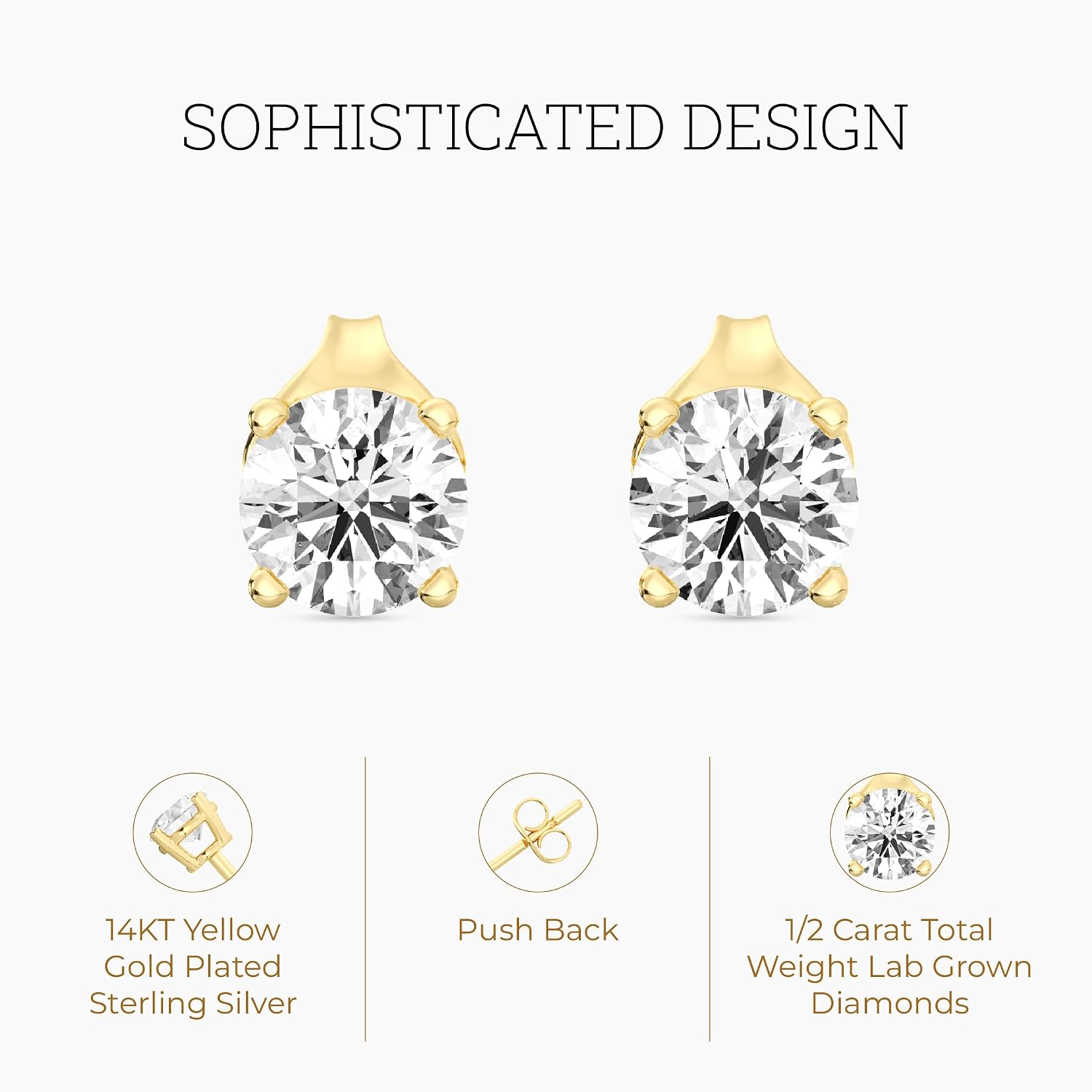
Gilded
$99.99
In stock on Amazon
Check price on AmazonMid-Tier: Gold-Plated Sterling Silver at Vermeil Grade
Some manufacturers produce plated studs that meet or exceed the vermeil threshold of 2.5 microns. These sit at a price point between standard plated pieces and solid gold, and they meaningfully outperform standard plating for daily wear. The caveat: durability is still finite. Even vermeil-grade plating will eventually wear through at friction points, and the timeline depends on how frequently the earrings are worn, how they’re stored, and whether they’re exposed to lotions, sweat, or saltwater.
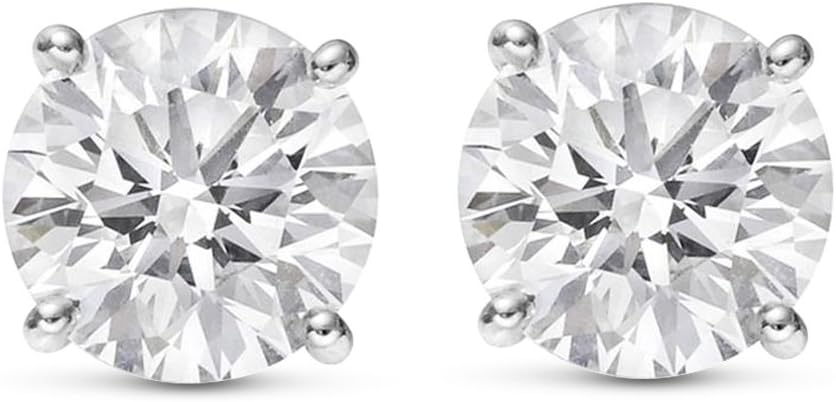
0.5
$337.37
In stock on Amazon
Check price on AmazonPremium Tier: 14K Solid Gold
14K gold is a solid alloy throughout. The International Gem Society’s “Gold Jewelry Buying Guide” explains that 14K means 14 parts gold out of 24, making it 58.3% pure gold. The remaining 41.7% is typically copper, silver, or zinc, added to increase hardness. This alloy is durable enough for daily wear, won’t tarnish under normal conditions, and does not have a coating that can wear away. The posts and butterfly backs are solid gold all the way through. For anyone purchasing a pair intended as a go-to daily earring, this is the metal that delivers on that promise without maintenance intervention.

Belacqua
$499.99
In stock on Amazon
Check price on AmazonSide-by-Side Durability Comparison
| Metal Type | Plating Layer | Tarnish Risk | Typical Lifespan (Daily Wear) |
|---|---|---|---|
| 14K solid gold | N/A (solid) | Very low | Decades |
| Gold-plated sterling silver (vermeil-grade, 2.5+ microns) | 2.5+ microns | Moderate once worn | 12–24 months |
| Gold-plated sterling silver (standard, under 1.5 microns) | 0.5–1.5 microns | Higher | 6–12 months |
The cost-per-wear math favors 14K gold for any earring intended to be worn most days. A $150 pair of plated studs that degrades visibly in 12–18 months costs more per year of presentable wear than a $280 pair of 14K studs worn for a decade.
Skin Sensitivity: Where Plated Silver Actually Surprises Buyers
Here’s where the expected narrative gets complicated. Many buyers of lower-priced gold-plated lab-diamond studs — including self-identified sensitive-ear owners — report no irritation initially. That seems counterintuitive. Shouldn’t a plated post be riskier than solid gold?
The answer is nuanced. When plating is intact, the ear contacts only the gold surface, not the base metal. Sterling silver itself is generally well-tolerated. The real culprit in most “sensitive ear” reactions is nickel, which appears as an alloy component in lower-quality gold and as a binding layer in some plating processes. A well-plated sterling silver post with no nickel in the plating stack can genuinely be comfortable for many sensitive wearers — temporarily.
The long-term risk is post-wear exposure: once plating wears through at the post shaft (the portion that passes through the earlobe), the base metal contacts skin. For buyers with confirmed nickel sensitivity, this can become a problem 6–18 months into daily wear even if the first several months were fine. Solid 14K yellow gold, by contrast, contains virtually no nickel, making it the more consistently safe long-run choice for reactive ears.
Practical rule: If you’re buying a second pair of studs for rotation wear — worn 2–3 times per week, not daily — a quality gold-plated option poses low real-world risk. If you’re buying the pair you’ll put on every morning and forget about, solid 14K gold posts are the safer bet across a multi-year horizon.
Closure Hardware, Post Length, and the Screw-Back Question
Across aggregated buyer reviews of lab-grown diamond stud earrings, screw backs earn the most consistent, unsolicited praise of any single product feature. Multiple long-term owners specifically cite them as essential for daily wear. Push backs — also called butterfly backs — grip via spring tension and are faster to put on, but that same spring can loosen over time, and there’s no mechanical lock preventing the earring from sliding off if the butterfly spreads.
Screw backs use a threaded post: you physically thread the back onto the post and tighten it, creating a lock that requires intentional reverse motion to remove. The trade-off is a slightly longer assembly time when putting earrings on. Posts must be aligned precisely, or the mechanism cross-threads and becomes difficult to close.
The post length complaint is one of the most repeated negatives in this category, and it’s directly tied to closure type. Owners consistently report that posts feel too long — the earring sits away from the ear, or the excess length pokes uncomfortably. This complaint is especially common on screw-back earrings, which require longer posts to accommodate threading.
The good news: post length is fixable. A local jeweler can shorten a post for $10–$25 per pair in most markets. This is a routine bench alteration that preserves the stone, setting, and closure entirely. If post length is bothering you, don’t return a pair you otherwise like — take them to a bench jeweler and ask for a post trim.
Stone Sizing and Color Grade: The Decisions That Actually Affect the Look
Total carat weight for scale: The Knot’s “Diamond Stud Earrings Buying Guide” offers a useful framework. For everyday professional wear — something you put on with whatever you’re wearing and don’t think about — 0.5 to 1.0 CTW (combined total weight for both ears) is the sweet spot. It reads as polished without reading as dressed up. For a statement look or occasion wear, 1.5 to 2.0 CTW reads noticeably sparkly and intentional. Above 2.0 CTW in round brilliant cuts, studs become a focal point of the look, which is either exactly what you want or too much for casual contexts.
F vs. G color at stud scale: Brides.com’s diamond stud earrings buying guide notes that color differences compress significantly in smaller stones. In a round brilliant cut under 1.0 ct per ear, the difference between F color (near-colorless, essentially no visible tint) and G color (also near-colorless, with the slightest warmth) is not detectable by the naked eye under normal viewing conditions. Both F and G face-up white and brilliant in a yellow or white gold setting. Unless you’re comparing them side-by-side under grading lights — which you won’t be doing while wearing them — the color grade distinction at this scale is largely academic. If the budget forces a trade-off, spend down on color grade and up on cut quality.
Frequently Asked Questions
Will gold-plated sterling silver posts irritate sensitive or reactive ears?
For most wearers, intact gold plating causes no irritation — the ear contacts gold, not the base metal. The risk window opens when plating wears through at the post shaft, typically within 12–24 months of daily wear. If you have confirmed nickel sensitivity, solid 14K gold posts are the only reliably safe long-term choice. For occasional wearers or those with mild sensitivity, quality plated posts often work fine with monitoring.
Do I actually need screw backs, or are push backs secure enough for everyday wear?
For daily wear, screw backs are worth it. Butterfly backs loosen with wear and handling, and lost earrings are a documented failure mode. The mechanical lock of a screw back meaningfully reduces loss risk. Push backs are acceptable for occasional or event wear where you’re mindful of the jewelry.
What carat total weight is right for everyday wear vs. a statement look?
0.5–1.0 CTW reads subtle and professional for daily wear. 1.5–2.0 CTW reads as a definite jewelry moment — appropriate for evenings, occasions, or a bolder everyday look. Under 0.5 CTW, the stones can be difficult to see at conversational distance. The Knot’s “Diamond Stud Earrings Buying Guide” frames this range as standard guidance for first-time stud buyers.
Does an IGI certificate hold the same weight as a GIA certificate?
The certificate’s value comes from the issuing lab, not the sales channel. The International Gemological Institute (IGI) is a globally recognized grading laboratory that issues standardized lab-grown diamond reports using consistent grading criteria accepted across the industry. Pricescope’s editorial wiki on lab-created diamonds acknowledges that some professionals view GIA as the highest consistency benchmark, but for studs in the accessible price range, an IGI certification is entirely credible and sufficient for purchase confidence.
Can I really tell the difference between F and G color at the stud earring scale?
No, not in normal wear conditions. Both grades are in the near-colorless range and face-up white in round brilliant cuts. The GIA educational resource “Lab-Grown Diamonds” notes that even trained observers struggle to detect single-grade color differences in mounted stones under normal lighting. The distinction matters more in larger solitaires where color is easier to read face-up.
Are posts being too long a fixable problem?
Yes, completely fixable. Post trimming is a standard bench jeweler alteration. Take the earrings to a local jeweler, explain the discomfort, and ask them to shorten the posts. The work typically takes 15–30 minutes and costs $10–$25 per pair. The stone, setting, and closure remain intact. Don’t return a pair you otherwise love over post length.
The Decision Rule
If you’re buying one pair to wear most days: 14K solid gold is worth the premium. The durability, tarnish resistance, and skin safety across multi-year daily wear make the cost difference close in the first 18 months and clearly favorable by year three. Add screw backs if available.
Belacqua
$499.99
In stock on Amazon
Check price on AmazonIf you’re buying a rotation pair, a gift for an occasional wearer, or a trial to see if lab-grown diamond studs suit your style: Quality gold-plated sterling silver is a legitimate starting point. The stone quality is the same, the look is nearly identical in the short run, and you’re not over-investing in a wear category you haven’t committed to yet.
Gilded
$99.99
In stock on Amazon
Check price on AmazonIf you have confirmed nickel sensitivity: Skip plated options entirely. Solid 14K yellow gold posts are the non-negotiable choice for reactive ears.
The diamond does the sparkling. The metal just needs to hold it safely and comfortably for as long as you plan to wear it. Buy the metal that matches that timeline.