Picture this: you’ve done enough research to know that lab-grown diamonds — stones grown in a controlled environment using the same carbon chemistry as mined diamonds — are chemically and optically identical to natural diamonds. You’re not shopping for a costume piece. You want studs that look serious. But you’re staring at two listings that are close in price, and the gap between them turns out to be enormous in ways the product titles don’t spell out. One pair is IGI-certified (IGI, the International Gemological Institute, is a widely used independent grading lab that evaluates a stone’s cut, color, clarity, and carat weight) round-cut lab diamonds set in 14K solid gold — real gold all the way through. The other is a gold-plated sterling silver setting, dressed up to look similar. This article exists to name the tradeoffs explicitly, show the math, and give you a clear decision rule by the end.
The Materials Gap Is Bigger Than the Price Gap
This is the central tension in this comparison, and it’s worth stating plainly before we go further: gold-plated sterling silver and 14K solid gold are not versions of the same thing at different price points. They are fundamentally different materials with different timelines and different biological responses in the human body.
Solid 14K Gold: What “All the Way Through” Means
Solid 14K gold is an alloy in which 58.3% of the metal is pure gold, with the remainder typically copper, silver, or palladium — a composition confirmed in the International Gem Society’s Gold Alloys and Jewelry Metals Guide (gemsociety.org). That ratio runs all the way through the earring post, the setting, and the backing. It does not chip, flake, or reveal a base metal underneath. Reviewers of solid 14K IGI-certified stud sets consistently describe zero metal-sensitivity reactions, even in healed piercings they describe as historically reactive. That aligns with what The Knot’s Jewelry Care and Metal Durability Guide notes: solid gold is the standard recommendation for everyday earring wear because no base metal is ever exposed to skin.

Belacqua
$499.99
In stock on Amazon
Check price on AmazonGold-Plated Sterling Silver: Understanding the Surface Layer
Gold-plated sterling silver is sterling silver (92.5% silver, 7.5% copper) with a thin layer of gold applied to the surface. The International Gem Society’s metals guide notes that fashion-grade gold plating typically ranges from 0.5 to 2.5 microns in thickness — a measurement that has no analog in solid gold, because solid gold has no plating layer to measure at all. With daily wear, especially in earrings where the post travels through tissue repeatedly, that surface layer thins and eventually exposes the sterling base. For most wearers, that timeline is measured in months rather than years under regular use.
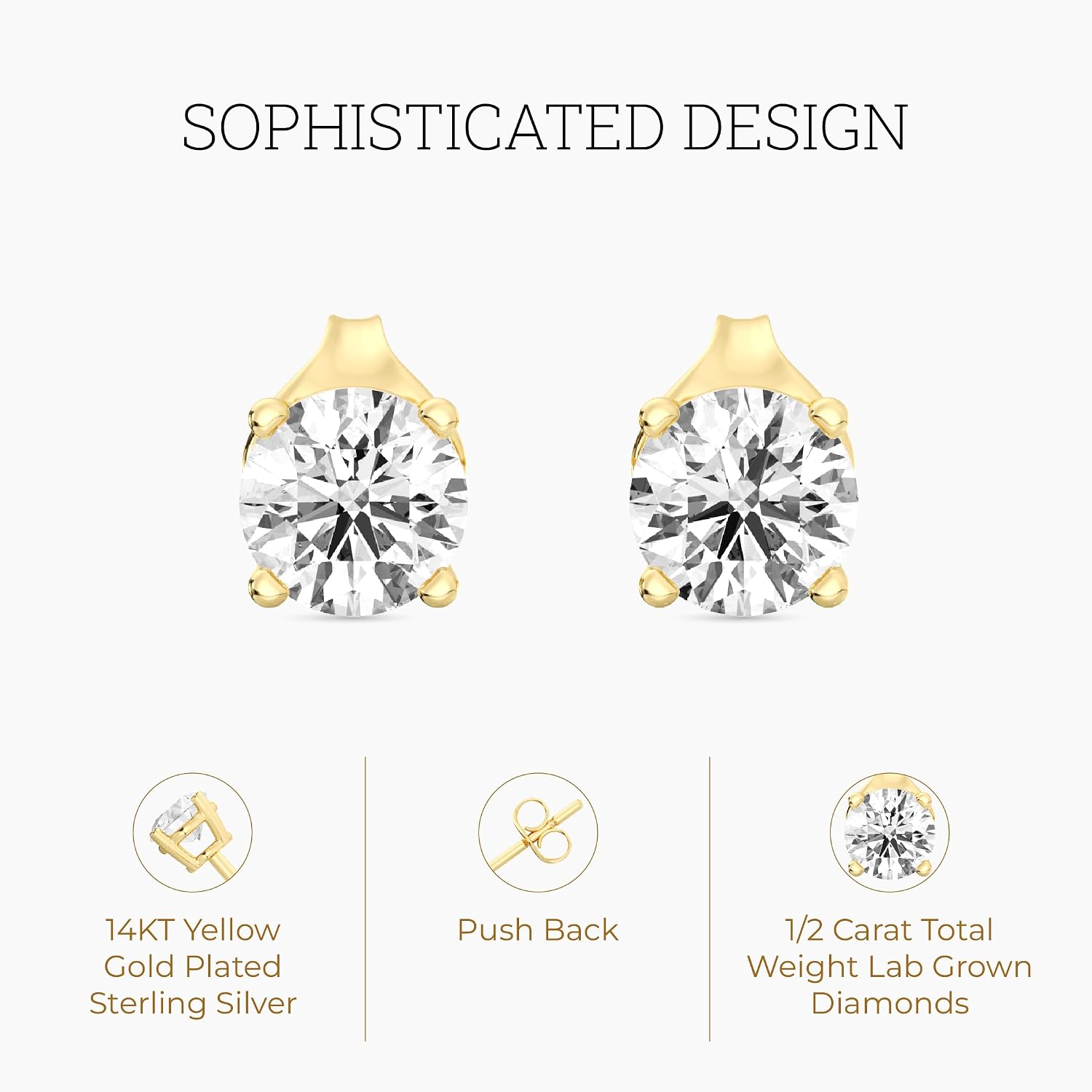
Gilded
$99.99
In stock on Amazon
Check price on AmazonSide-by-Side: What Each Material Delivers
| Feature | 14K Solid Gold + IGI Cert | Gold-Plated Sterling Silver |
|---|---|---|
| Gold content | 58.3% throughout | ~0.5–2.5 micron surface layer only |
| Metal longevity (daily wear) | Decades | Months to ~2 years before replating |
| Hypoallergenic post | Yes (nickel-free options available) | Depends on plating integrity over time |
| Resettable by local jeweler | Yes | Rarely practical; low setting value |
| Grading documentation | IGI certificate per stone | Typically none |
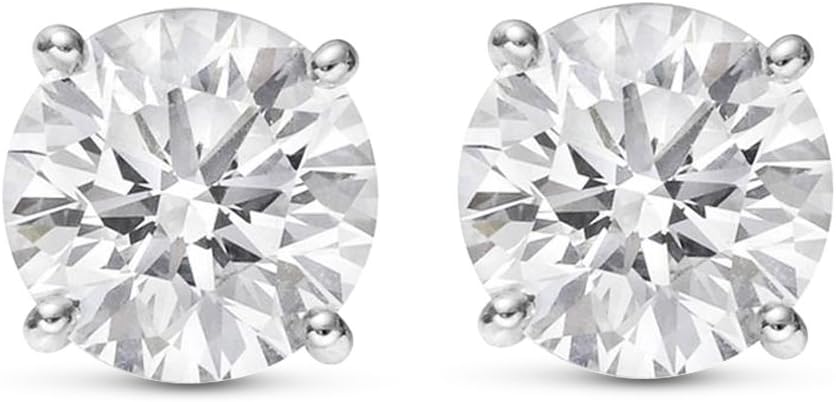
0.5
$337.37
In stock on Amazon
Check price on AmazonWhat IGI Certification Actually Buys You (and What It Doesn’t)
IGI’s lab-grown diamond reports cover the four Cs: cut grade, color grade, clarity grade, and carat weight. For stud earrings specifically, cut and color are the grades that most affect what you see day to day.
Cut grade determines light return — how much of the light that enters the stone bounces back to your eye as brilliance rather than leaking out the sides or bottom. IGI grades cut on a scale from Excellent to Poor. Studs certified at Excellent or Very Good cut will look noticeably brighter than uncertified stones of the same color and clarity, because the proportions are verified by an independent laboratory rather than assumed from seller descriptions.
Color grade runs from D (colorless) to Z (visibly yellow). According to IGI’s published grading methodology for lab-grown diamonds, stones in the D–F range (the colorless tier) look crisp against white gold or platinum prongs, while G–H stones (near-colorless) are often the best value-per-appearance choice in yellow gold settings, where the warm metal absorbs slight warmth in the stone.
According to Brides’ Lab-Grown Diamond Buying Guide, IGI is the most commonly used certification body for lab-grown stones specifically — not because GIA doesn’t certify lab-grown diamonds (they do), but because IGI built its lab-grown workflow earlier and more comprehensively, meaning the supply chain for certified lab-grown earrings skews heavily IGI. It is also worth knowing, as Brides notes, that GIA’s lab-grown grading reports have historically applied stricter color and clarity thresholds, which can mean the same stone earns a modestly lower grade from GIA than from IGI — relevant context when comparing a GIA-certified natural stone to an IGI-certified lab stone on the secondary market.
What IGI certification does not do: it doesn’t evaluate how the earring setting is constructed, doesn’t guarantee post thickness or gauge, and doesn’t speak to whether the specific retailer will stand behind the product if a stone arrives defective. Reviewer accounts of solid 14K IGI-certified stud sets in this category frequently single out responsive customer service — replacement without friction when a stone arrived with a flaw — as a meaningful part of the overall value proposition. The certificate documents the stone; the retailer’s policies protect the purchase.
The Strategic Case for Gold-Plated: Secondary Piercings Done Right
If you stop at “plated is always worse,” you’ll miss a real use case. Gold-plated sterling silver lab diamond studs are receiving specific praise from buyers who are using them in their second or third ear piercings — cartilage or upper lobe positions that see less daily rotation pressure than the primary lobe piercing, and where the buyer’s priorities shift.
In a secondary piercing, the calculus changes in a few ways:
- Post rotation is minimal. Once a secondary piercing is fully healed and you’ve found your preferred stud, you may not remove it for months. That dramatically reduces the mechanical wear that strips plating.
- Visual real estate is smaller. A 0.1–0.2 total carat weight stud in a cartilage position isn’t carrying the same aesthetic load as a larger primary lobe stud. The “is it real gold” question matters less when the stone is that small in that position.
- Price efficiency is real. If you’re stacking four or five ear positions simultaneously, the cost difference between solid gold and plated across all positions compounds quickly and the plated option frees budget for a stronger centerpiece.
One important flag worth naming: post gauge consistency is a real quality-control consideration across any budget earring brand. If post thickness matters for your anatomy — and for cartilage piercings, it often does — verify post gauge specifications before ordering, and check current reviewer feedback specific to the stud style rather than relying on brand-level assumptions.
Carat Size Reality Check: What the Numbers Actually Look Like on an Ear
Multiple reviewers across the solid 14K certified stud category describe the same experience: they ordered a size, worried it was too large when it arrived in the box, then put the earrings on and immediately felt differently. This is a documented pattern, and it’s worth understanding why.
Carat weight describes mass, not diameter. A round brilliant diamond’s face-up diameter — what you see looking at someone wearing the earring — follows approximate benchmarks that the Gemological Institute of America publishes in its diamond size and carat weight reference materials at gia.edu. Assuming ideal-cut proportions:
- 0.125 ct per earring (0.25 TCW total pair) → approximately 3.2 mm face-up diameter
- 0.25 ct per earring (0.5 TCW total pair) → approximately 4.1 mm face-up diameter
- 0.50 ct per earring (1.0 TCW total pair) → approximately 5.1 mm face-up diameter
A poorly cut stone of the same carat weight can measure smaller face-up because mass is distributed inefficiently in the depth rather than the table. This is another place IGI-certified Excellent-cut stones earn their keep — you’re getting the expected diameter for the stated weight, confirmed by an independent grader rather than implied by a marketing description.
The “looks smaller in the box, bigger on the ear” effect is real because earlobes provide contrast and framing. If you’re on the fence between two sizes, reviewer consensus across this category lands consistently on “size up” as the right call.
One terminology trap to avoid: some listings state total carat weight (TCW) for the pair, while others state carat weight per stone. A “0.5 TCW” listing means each stone is 0.25 ct. A “0.5 ct per earring” listing means the pair is 1.0 TCW. Always confirm which convention the listing uses before comparing prices, because this single variable can make two listings appear much closer in value than they actually are.
Frequently Asked Questions
Is gold-plated sterling silver safe for sensitive ear piercings? It can be, particularly in healed piercings with minimal post movement. The risk is that plating eventually wears through, exposing the sterling silver underneath. Sterling contains copper, which is a common skin irritant. If your piercings are known to be reactive, solid 14K gold or implant-grade steel is a more reliable long-term choice, as The Knot’s Jewelry Care and Metal Durability Guide advises for everyday earring wear.
What does IGI certification actually tell me about a lab-grown diamond stud? An IGI report verifies the stone’s cut grade, color grade, clarity grade, and carat weight — all measured by an independent laboratory, not the seller. It confirms the stone is genuinely lab-grown and documents its characteristics in a way that survives resale or insurance appraisal. It does not evaluate the setting, post quality, or retailer return policies.
What is the visible size difference between 0.25 TCW and 0.5 TCW stud earrings? On a per-earring basis, 0.25 TCW means each stone is 0.125 ct (roughly 3.2 mm diameter). A 0.5 TCW pair means each stone is 0.25 ct (roughly 4.1 mm). That approximately 0.9 mm difference is noticeable side by side but subtler than buyers often expect when comparing weights on paper. On the ear, the 0.5 TCW pair has meaningfully more presence.
Can lab-grown diamond studs be re-set by a local jeweler? The stones can be re-set — lab-grown diamonds are worked by bench jewelers identically to natural diamonds. Solid 14K gold settings can be repronged, retipped, and modified by most local jewelers. Gold-plated settings are generally not worth the labor cost of re-setting, as the setting itself has limited intrinsic value and surface plating cannot be economically restored at a typical jewelry bench.
Do solid 14K lab diamond studs hold their value better than gold-plated versions? Yes, meaningfully so. Solid 14K gold carries intrinsic melt value that tracks gold spot prices — Pricescope’s lab-grown diamond market coverage notes that gold spot prices were trading in the range of $3,200–$3,300 per troy ounce as of mid-2026. The stones themselves, as documented by IGI certificates, are resaleable through estate jewelers and peer platforms. A gold-plated setting has no meaningful secondary-market value: the metal content is negligible, and the setting cannot be separated from the plating for resale purposes.
The Decision Rule
If you’re choosing a primary lobe stud you’ll wear daily, the math strongly favors solid 14K with IGI certification: better longevity, no replating cost, hypoallergenic reliability, a resaleable stone, and — per the consistent reviewer pattern — a visual result that owners who already own high-grade natural diamond studs describe as genuinely competitive. The solid 14K IGI-certified round brilliant stud sets represent this tier.
Belacqua
$499.99
In stock on Amazon
Check price on AmazonIf you’re stacking a secondary or cartilage position, gold-plated sterling silver lab diamond studs are a legitimate strategic choice — not a compromise, but a deliberate allocation of budget toward a position that doesn’t demand the same durability standards. Verify the post gauge suits your piercing before committing, and set expectations that replating or outright replacement is part of the two-to-three-year cost horizon.
Gilded
$99.99
In stock on Amazon
Check price on AmazonSimple decision rule:
- Primary stud, daily wear, any sensitivity history → solid 14K IGI-certified, size up from your first instinct.
- Secondary position, healed and stable, budget stacking → gold-plated sterling silver studs are purpose-fit; factor in a two-to-three-year replacement horizon as part of the true cost.