A tennis bracelet is exactly what it sounds like: a single, flexible line of matched diamonds (or diamond-quality stones) set in a precious metal and worn around the wrist. The name comes from a 1987 moment when tennis player Chris Evert lost hers mid-match and stopped play to find it — and the style has never really gone out of fashion since. Lab-grown diamonds (real diamonds, chemically identical to mined ones, grown in a controlled environment rather than extracted from the earth) have made the look dramatically more accessible. A bracelet that would have cost $8,000–$15,000 in natural diamonds ten years ago can now be had in lab-grown for $500–$2,500 depending on total carat weight and metal quality. That price compression is genuinely exciting — but it has also flooded the market with options at every quality tier, and the failure modes are real. If you’re about to pull the trigger on one, this guide is built around the problems buyers actually report, not the marketing copy.
| EDITOR'S PICKHouston Diamond District 2 to 5… | Mid-tier3 to 30 Carat 14K White Gold Ro… | Budget pickBelacqua Lab Grown Diamond Tenn… | |
|---|---|---|---|
| Carat Weight | 5 Carats | 3 Carat | 1 Carat |
| Metal | 14K White Gold | 14K White Gold | Sterling Silver |
| Diamond Color | E-F | D-E | G |
| Clarity | VS2-SI1 | VS1-VS2 | SI |
| Prong Setting | 4 Prong | 3 Prong | — |
| Length | 7 Inches | 7 Inches | 6/7/8 Inches |
| Price | $1,774.79 | $1,392.30 | $169.99 |
| See on Amazon → | See on Amazon → | See on Amazon → |
The Clasp Problem Is the First Thing You Need to Understand
Across aggregated reviews of lab-grown tennis bracelets in the $300–$2,000 range, clasp failures represent the most consistent complaint — and the pattern is worth understanding before you buy, not after.
The failure modes break into two categories. The first is mechanical failure on arrival: clasps that simply don’t work when the bracelet comes out of the box. One reviewer documented receiving a bracelet whose box-tongue clasp wouldn’t engage at all on first use — and because she had purchased it well in advance as a birthday gift, she was past the return window by the time the recipient tried to wear it. That sequencing detail matters. If you’re buying a tennis bracelet as a gift more than two or three weeks ahead, check the return and exchange policy before you order, not after.
The second category is premature wear failure: clasps and prong settings that fail within days of normal use. A documented case in consumer reviews involved a 3-prong bracelet breaking within three days of wear — not a drop, not abuse, just regular daily movement. These aren’t isolated edge cases; they represent a meaningful minority of purchases at certain price tiers.
What this means for your decision: Clasp design is not cosmetic. The two most common clasp styles on tennis bracelets are the box-tongue clasp (a rectangular tab that snaps into a box-shaped housing) and the fold-over safety clasp (a hinged mechanism with a secondary push-button release). For daily wear, reviewers consistently rate fold-over safety clasps as more secure and easier to operate one-handed. The box-tongue is sleeker and lower-profile, but it requires two hands and offers less tactile confirmation that it’s locked. If you are buying for daily wear, prioritize the fold-over, even if the product photos make the box-tongue look cleaner.
Carat Weight: The Regret Direction Is Almost Always “I Should Have Gone Bigger”
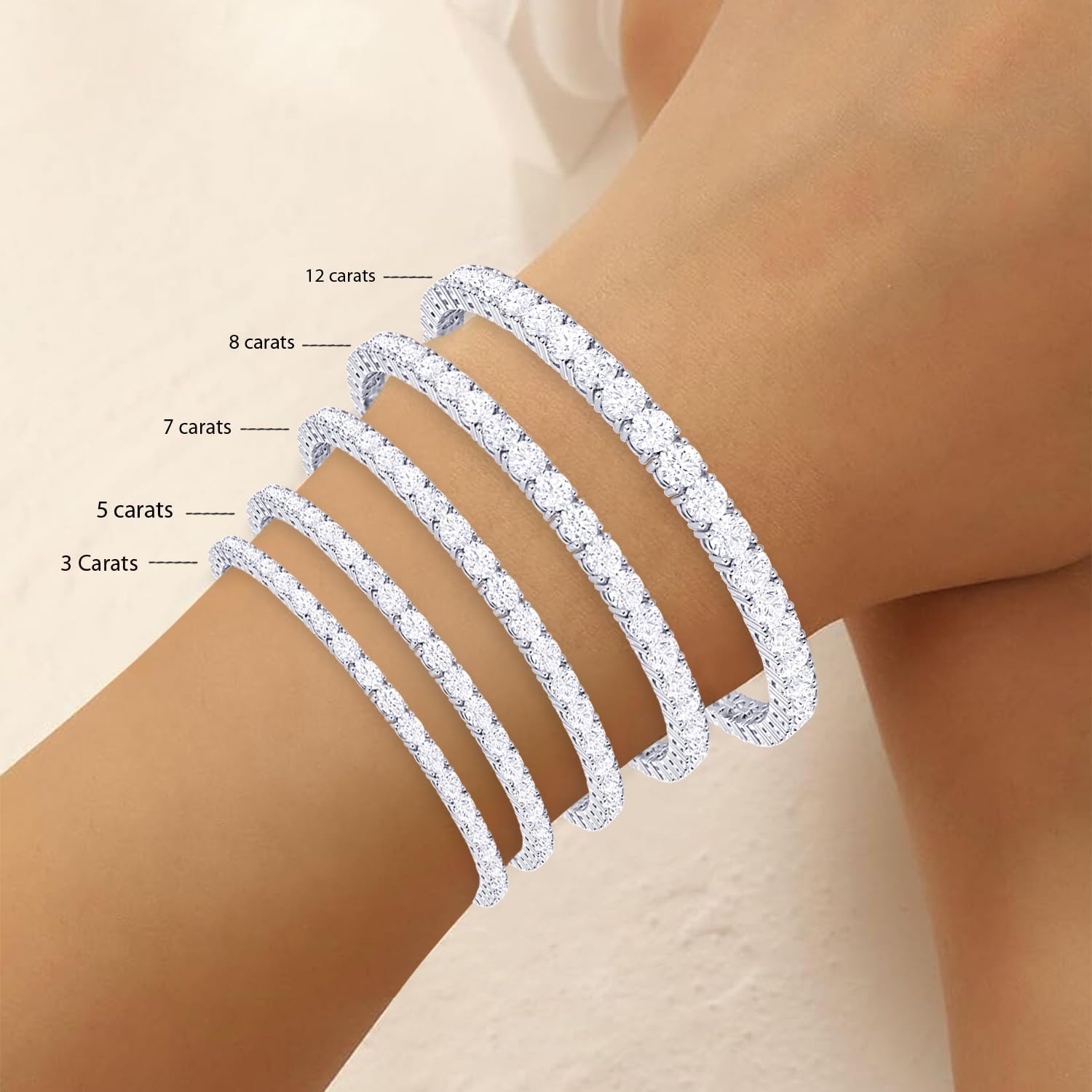
The most consistent regret pattern in tennis bracelet reviews is undersizing on carat weight. Multiple buyers who selected 3-carat total weight bracelets report wishing they had ordered 4 or 5 carats after seeing the bracelet on their wrist. This is a predictable bias: carat weight sounds substantial in the abstract, but on a bracelet distributed across 30–50 individual stones, 3 total carats can look quite dainty, especially on wrists larger than 6.5 inches.
Here is a rough calibration framework based on the review data:
By the numbers — carat weight vs. wrist size:
| Total Carat Weight | Visual Impression | Best Fit |
|---|---|---|
| 2–3 ct | Delicate, stackable | Wrists under 6.5 in, stacking look |
| 4–5 ct | Classic full tennis bracelet | Most wrists, statement wear |
| 6–8 ct | Bold, high-impact | Wrists 7 in+, or intentional drama |
Per PriceScope’s community guidance on lab-grown bracelet sizing, the individual stone size per carat also matters: a 3ct bracelet made with thirty 0.10ct stones reads visually smaller than one made with fifteen 0.20ct stones, even at the same total weight. Ask the retailer about stone count and per-stone carat weight, not just total weight.
The practical rule: if you’re deciding between two tiers and your wrist measures 6.5 inches or more, go up. The cost difference between a 3ct and a 4ct lab-grown bracelet is often $200–$400 — meaningfully less than the cost of returning and reordering.
Setting Styles: 4-Prong vs. Channel Set
The two dominant setting styles at this price tier each have a genuine argument, and the right answer depends on how you intend to wear the bracelet.
4-prong settings hold each stone individually in four tiny metal claws, leaving the sides of the stone exposed. Owners consistently praise this look for its “dainty,” minimal-metal appearance — the stones appear to float on the wrist, and the light return (fire and sparkle) is maximized because nothing is blocking the sides. The Knot’s tennis bracelet guide notes that prong settings are the traditional choice precisely for this reason: more exposed diamond surface equals more visual impact. The trade-off is maintenance: prongs can catch on fabric, snag fine knitwear, and bend over time. They require periodic inspection and occasional re-tipping by a jeweler.
Channel settings set each stone between two continuous parallel rails of metal, with no prongs visible. Reviewers praise the cleaner, sleeker profile — it sits flatter against the wrist and doesn’t catch on clothing. This is the better choice for someone who wears the bracelet under sleeves, handles textiles professionally, or simply prefers an uninterrupted metal look. The trade-off: slightly less sparkle (the channel walls block some side light) and harder to service if a stone shifts.
3-prong settings exist as a middle ground — lower metal profile than 4-prong, more open than channel — but the failure data is worth noting. The documented case of a 3-prong bracelet breaking within three days suggests that this configuration, at least at lower price tiers, may sacrifice structural integrity for aesthetics. Brides.com’s tennis bracelet coverage specifically flags that 4-prong settings, while more visible, are generally considered the most secure hold for individual stones in a bracelet context.
E-F Color, VS2-SI1 Clarity: What You’re Actually Buying
Most lab-grown tennis bracelets at the $500–$2,500 price point are marketed with E-F color and VS2-SI1 clarity grades. Here’s what that actually means in a bracelet setting, because the answer is different than it would be for a solitaire engagement ring.
Color (E-F): The GIA’s diamond quality factor documentation places E and F in the “colorless” category — the top tier below the theoretical-perfect D. In a tennis bracelet, stones are small (often 0.07–0.20ct each), and color differences between adjacent grades are essentially invisible to the naked eye at that size, per Gem Society’s published guide on diamond grading. What E-F does guarantee is that the bracelet won’t develop a visible yellow cast across the line of stones, which can happen at the G-H range when many stones are mounted together and the cumulative warmth becomes perceptible. For a lab-grown bracelet, E-F is the right call.
Clarity (VS2-SI1): VS2 (very slightly included — inclusions not visible to the naked eye) and SI1 (slightly included — inclusions potentially visible under magnification but not typically visible to the naked eye) are both eye-clean in stones under 0.25ct, per GIA clarity scale documentation. In a tennis bracelet, where stones are small and mounted in motion, VS2-SI1 is functionally identical in appearance to VS1 or VVS. The reviewers who describe being “astonished” by the sparkle of E-F lab stones in a bracelet setting are describing a genuine visual reality — the fire and light return of a well-cut lab diamond is indistinguishable from a mined stone at these grades, and in a line of 30-50 matched stones, the collective effect is dramatic.
The clarity grade that matters most in a bracelet is not VS2 vs. SI1 — it’s whether the stones are well-matched in cut quality. Poorly cut stones will appear dull even at VVS clarity. Ask whether stones are cut to standard or ideal proportions.
Frequently Asked Questions
How do I choose the right carat weight — will 3ct look too small on my wrist? On a wrist of 6.5 inches or larger, 3ct can read as delicate rather than substantial. Multiple buyers report this regret specifically. Measure your wrist, consult the table above, and if you’re between sizes, size up. The visual return on going from 3ct to 4ct in a tennis bracelet is proportionally greater than the cost difference.
What kind of clasp is safest for daily wear? For daily wear, a fold-over safety clasp with a secondary release mechanism is the most reliable option documented in buyer reports. Box-tongue clasps are sleeker but have a higher rate of engagement failures. Verify clasp type before purchasing, not from the product title, but from the product description or customer service confirmation.
What should I do if my clasp doesn’t work when the bracelet arrives? Contact the retailer immediately — do not wait. Document the defect with photos or video before attempting to force the clasp, which could void a warranty. If the bracelet was a gift already given, the time-sensitivity problem is real: check whether the retailer offers an exchange credit rather than a return, since most have 30-day windows. Escalate promptly.
Is E-F VS2-SI1 clarity visible to the eye in a tennis bracelet? Both grades are eye-clean at the stone sizes used in tennis bracelets. You will not see inclusions with the naked eye at VS2 or SI1 in stones under 0.25ct. The color grades E-F are genuinely colorless at these sizes. The bigger visual variable is cut quality and stone-to-stone matching.
What is the difference between a 3-prong and 4-prong setting? A 4-prong setting holds each stone with four metal claws, offering secure retention and maximum light exposure. A 3-prong uses fewer claws for a lower-profile look but — based on buyer-documented failure cases — appears to be structurally less reliable at budget price tiers. For a bracelet intended for regular wear, 4-prong is the more established and better-tested configuration.
Should I buy a lab diamond tennis bracelet as a gift, or is sizing too risky? Tennis bracelets fit more loosely than rings, and most standard lengths (7–7.5 inches) accommodate the majority of adult wrists. Sizing risk is lower than with rings. The greater risk with gifting is the return window problem: if you buy weeks ahead and receive a defective clasp, you may be past the return date when the gift is opened. Buy closer to the occasion, or verify exchange policy explicitly at purchase.
The bottom line decision rule: If you are buying for daily wear, prioritize clasp type and setting construction over total carat weight, then size up on carats from your first instinct. If you are buying as a gift, verify the return/exchange window before you purchase, buy as close to the occasion as logistics allow, and confirm fold-over clasp construction in writing. E-F color and VS2-SI1 clarity are the right grade targets for this format — the fire reviewers describe is real, and at this price tier in lab-grown, the value-to-visual-impact ratio is genuinely difficult to argue with. The failure cases are avoidable with the right clasp, the right setting, and a retailer who stands behind both.