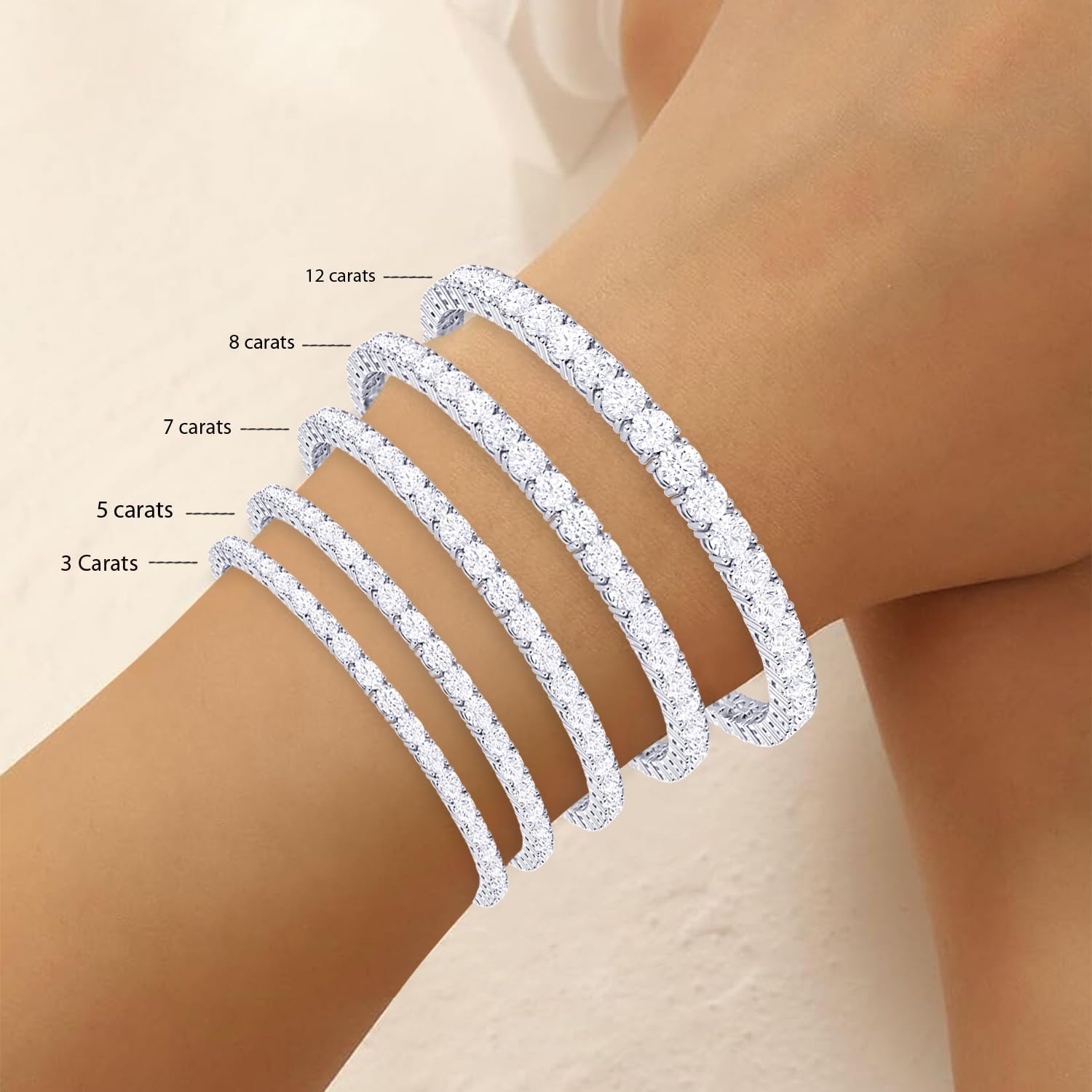
Picture this: you’ve found a lab-grown diamond tennis bracelet on Amazon that looks like it belongs in a jewelry store window — rows of glittering, white stones set in gleaming metal, priced at a fraction of what a natural-diamond equivalent would cost. You add it to cart. You’re feeling smart. Then it arrives, you try to close the clasp, and nothing happens. Or worse: it arrives as a birthday gift, and the recipient discovers the clasp doesn’t function at all.
A tennis bracelet is a flexible, in-line bracelet set with a continuous row of identically sized stones — the name dates to 1987, when tennis player Chris Evert famously stopped a match to recover one she’d lost on court. Lab-grown diamonds (also called lab-created or synthetic diamonds) are chemically identical to mined diamonds — same carbon crystal structure, same hardness — but grown in a controlled environment rather than extracted from the earth. They typically cost 60–80% less than natural equivalents of the same grade, per Pricescope’s lab-grown diamond value overview. That value gap is why lab-diamond tennis bracelets have flooded Amazon’s marketplace — and why the quality variance is enormous. This guide maps exactly what separates the buys worth celebrating from the ones that end up in a drawer.
| EDITOR'S PICKHouston Diamond District 2 to 5… | Mid-tier3 to 30 Carat 14K White Gold Ro… | Budget pickBelacqua Lab Grown Diamond Tenn… | |
|---|---|---|---|
| Carat Total | 5 Carats | 3 Carat | 1 Carat |
| Metal | 14K White Gold | 14K White Gold | Sterling Silver |
| Length | 7 Inches | 7 Inches | 6/7/8 Inches |
| Prong Count | 4 Prong | 3 Prong | — |
| Diamond Color | E-F Color | D-E Color | G Color |
| Clarity | VS2-SI1 Clarity | VS1-VS2 Clarity | SI Clarity |
| Price | $1,774.79 | $1,392.30 | $169.99 |
| See on Amazon → | See on Amazon → | See on Amazon → |
The Clasp Problem Is Real — and It’s the Most Consequential Variable
Let’s start with the failure mode that shows up most often in aggregated buyer feedback, because it’s the one that turns an otherwise beautiful bracelet into a frustrating experience.
Reviewers across multiple SKUs report a clear split: bracelets with a well-engineered double-lock box clasp (a hinged metal box closure with a secondary safety catch — two points of failure instead of one) get praised as “top notch” and “secure for daily wear.” Bracelets with a cheaply manufactured version of the same mechanism arrive with clasps that don’t engage at all, or that snap open within days of normal wear. One reviewer specifically documented clasp failure within three days. Another received a bracelet as a gift that was discovered to be non-functional only at the recipient’s birthday — a logistics nightmare with no clean fix in the moment.
The underlying issue is tolerances. A double-lock box clasp requires the tongue (the flat insertion piece) to seat flush inside the box and then engage a folded safety tab. When the stamped metal parts are cut imprecisely — which happens at lower manufacturing price points — the tongue either rattles loose or the tab doesn’t catch. Neither problem is visible in a product photo.
What this means for your purchase decision:
- Price tier is a proxy, but not a guarantee. Bracelets in the 3–5 CT total weight range from established jewelry brands with verifiable manufacturing (rather than anonymous third-party marketplace sellers) show better clasp consistency in aggregated reviews.
- Read one-star reviews specifically for the word “clasp.” If multiple one-star reviewers mention clasp failure in the same listing, the problem is systemic — not a one-off shipping casualty.
- A double-lock design is necessary but not sufficient. The question is whether the specific unit’s clasp was manufactured to spec.
By the Numbers
| Clasp Type | Security Level | Common Failure Mode |
|---|---|---|
| Single-tab box clasp | Low | Tab bends open under light flex |
| Double-lock box clasp (quality) | High | Rare — tongue seats and tab engages |
| Double-lock box clasp (poor tolerance) | Very low | Tongue doesn’t seat; bracelet opens freely |
| Figure-8 safety clasp (secondary add-on) | Moderate backup | Bends with heavy wear |
Prong vs. Channel Setting: The Trade-Off You’ll See in Every Listing
After clasp reliability, the second decision that determines long-term ownership experience is the setting style. On a tennis bracelet, you’ll encounter two dominant types:
Prong setting (also called claw setting): each stone is held by individual metal prongs — typically three or four — that reach up and over the stone’s girdle (its widest edge). The GIA’s diamond quality education resources note that prong settings maximize light entry and exit, which directly translates to brilliance and the “fire” that reviewers consistently praise. The trade-off is that prongs can catch on fabric (sweaters, knit sleeves), and over years of wear, individual prongs can bend or wear thin, increasing the risk of stone loss.
3-prong vs. 4-prong specifically: A 3-prong setting uses less metal, which means more of the stone’s surface is exposed to light — maximally brilliant, maximally attention-getting. A 4-prong setting adds a fourth contact point, which distributes stress more evenly and reduces the chance of a stone shifting if one prong is compromised. For daily wear, 4-prong earns the practical nod. For occasional or event wear where sparkle is the primary goal, 3-prong is visually hard to beat.
Channel setting: stones sit in a continuous metal channel, with the channel walls holding stones in place rather than individual prongs. The result is a smoother profile — no snag risk, a slightly more modern silhouette, and better durability for active wearers. The cost is light performance: the channel walls block some of the light that would otherwise enter from the sides and bottom of each stone. Reviewers consistently describe channel-set tennis bracelets as beautiful but note that prong-set versions catch the eye more aggressively across a room.
Decision rule: If you’re buying for daily wear by someone who works with their hands, wears knit fabrics regularly, or wants low-maintenance ownership — lean channel. If the bracelet is primarily for events, dinner occasions, or a recipient who prioritizes visible sparkle above all else — lean prong, and budget for a periodic prong check at a local jeweler (typically $25–$50 per visit, annually).
Carat Weight Regret Is the Most Predictable Mistake
A recurring pattern in buyer reviews is what might be called carat regret — the experience of receiving a bracelet, seeing it in person, and immediately wishing for the next size up. This happens because stone size on a wrist reads very differently than it does in a product photo or on a spec sheet.
A few benchmarks worth internalizing:
- 3 CT total weight (total carat weight distributed across all stones in the bracelet) on a standard 7-inch bracelet typically uses stones in the 0.08–0.10 CT each range. This reads as elegant and delicate — noticeable, but refined. It is not the bold, full-coverage look that leads the category imagery.
- 5 CT total weight moves into clearly visible territory. Stone faces are larger; the bracelet has more presence on the wrist.
- 7–10 CT total weight is the range where the bracelet reads as a statement piece at a distance.
Reviewers who sized to 3 CT expecting the look from high-engagement product photography and then felt underwhelmed are expressing a real gap between expectation and reality — not a defect in the product. The solution is to anchor expectations to actual stone size (typically listed as mm diameter per stone) rather than total carat weight alone, and to size up by at least one tier if you’re uncertain.
The Knot’s tennis bracelet coverage reinforces this: on a 7-inch wrist, 3 CT reads “classic,” while 5 CT reads “glamorous.” Neither is wrong — but they’re distinctly different looks.
Color Grade: Why E-F Performs Well in This Format
Lab-grown diamonds are graded on the same GIA color scale as natural diamonds — D (colorless) through Z (light yellow). In a tennis bracelet format, the repeating row of stones means any consistent warmth in the color grade is amplified by proximity. Buyers who purchase E or F color (near-colorless, just one step below the colorless D) consistently report that the stones look bright white and that no color tint is visible to the naked eye, even under direct light.
Per GIA’s diamond quality documentation, the difference between D and F is detectable only by trained graders under controlled conditions — not by the wearer or observers in normal settings. For lab-grown stones specifically, which are often produced with very high color consistency, E-F is the practical sweet spot: visually equivalent to D-E at a lower cost per stone, which allows the manufacturer to allocate more budget to setting quality or clasp engineering.
Brides.com’s tennis bracelet guidance similarly notes that for in-line stone formats (where stones are compared directly against each other), color consistency across stones matters more than absolute color grade.
What to Do Immediately If Your Clasp Doesn’t Work
This is a practical contingency that belongs in any honest guide. If your bracelet arrives with a non-functional clasp:
- Document immediately. Photograph the clasp in the open and attempted-closed position before you do anything else. This protects your return claim.
- Initiate the return within the return window. Amazon’s standard return policy for jewelry is typically 30 days for items sold and fulfilled by Amazon. Third-party marketplace sellers have variable policies — check the listing’s return terms at time of purchase, not after.
- Do not attempt to bend or force the clasp tab. Thin stamped metal fatigues quickly; a forced bend may prevent the clasp from functioning even after a potential repair attempt, complicating your return argument.
- If the bracelet was a gift and the window has passed: a local jeweler can often retrofit a replacement box clasp for $30–$60. It’s not the ideal outcome, but it salvages an otherwise beautiful bracelet.
Frequently Asked Questions
How reliable is the clasp on Amazon lab-diamond tennis bracelets for daily wear? Reliability varies significantly by SKU and seller. Double-lock box clasps from established jewelry brands with consistent manufacturing quality are genuinely secure for daily wear. Anonymous marketplace listings at the lowest price points show higher rates of clasp failure in aggregated reviews. The pattern is clear enough that checking one-star reviews specifically for clasp mentions before purchasing is a reasonable pre-buy step.
What’s the visible difference between a 3-prong and 4-prong setting on a tennis bracelet? A 3-prong setting exposes more of each stone’s surface to light, producing a marginally brighter, more open sparkle. A 4-prong setting adds a fourth metal contact point, which distributes stress better and reduces the risk of stone loosening if one prong wears down. The visual difference is subtle at a distance; the durability difference is meaningful over years of daily wear.
Is a 3 CT tennis bracelet noticeable enough, or should I size up? On most wrists, 3 CT reads as elegant and delicate — not bold. Reviewers consistently report wishing they had sized up after seeing the bracelet in person. If your goal is visible presence and impact, 5 CT is a safer target. If refined and classic is the intended aesthetic, 3 CT delivers that well.
What should I do if my tennis bracelet clasp doesn’t work when it arrives? Photograph the defect immediately, then initiate a return or exchange before the return window closes. Do not attempt to manually bend or force the clasp mechanism. If the bracelet was a gift and the window has passed, a local jeweler can often replace the clasp hardware for $30–$60.
Do these bracelets come with certification or appraisal paperwork? Most Amazon-listed lab-grown diamond tennis bracelets do not come with GIA grading reports for individual stones. Some include a general certificate of authenticity or a lab-grown diamond certification from the manufacturer; others include no documentation. If certification matters for insurance or resale purposes, confirm documentation before purchasing — it is rarely included at mass-market price points unless explicitly stated in the listing.
Can I fasten a tennis bracelet clasp by myself, or do I need help? This is a common practical frustration. Box clasps on tennis bracelets typically require one hand to hold the bracelet against the wrist and the other to seat the tongue — which most people can manage solo with practice, though it takes coordination. A figure-8 safety clasp as a secondary lock adds one more step. Reviewers who wear tennis bracelets daily generally report that the motion becomes habitual within a week. If fine motor difficulty is a factor, a magnetic clasp conversion is available from most local jewelers.