Picture this: you have chosen moissanite — a lab-created silicon carbide gemstone that rivals diamond in brilliance and costs a fraction of the price — and now you are staring at a gallery of ring settings trying to figure out what “hidden halo” actually means and whether a “twisted vine band” is going to snag your scrubs. A setting is the metalwork that holds the center stone and shapes everything about how a ring looks, wears, and stacks with a wedding band. It is not a cosmetic detail — it is, arguably, the decision. The center stone you chose will look completely different depending on whether it is surrounded by a hidden halo of micro-pavé diamonds, cradled in a smooth bezel of metal, or flanked by two side stones in a three-stone design. This article walks through four settings that consistently generate the most buyer conversation, maps out who each one is actually for, and gives you the honest tradeoffs so you are not discovering the gap-stack problem six months after the wedding.
| EDITOR'S PICKTHELANDA 14k White Gold All Pri… | Mid-tierOval/Marquise/Emerald Cut Moiss… | Budget pickSterling Silver 4-Prong Petite… | |
|---|---|---|---|
| Metal | 14k White Gold | 925 Sterling Silver | Sterling Silver |
| Center Cut | Princess | Oval | — |
| Stone Type | Moissanite or Simulated | Moissanite | Simulated/Moissanite |
| Total Carat | 2 CT main | 2.1 cttw | 1.0 CT |
| Setting Style | Three Stones | 3-Stone | Twisted Vine |
| Certificate | — | ✓ | — |
| Price | $397.99 | $89.99 | $57.99 |
| See on Amazon → | See on Amazon → | See on Amazon → |
The Four Settings Compared
Before going deep on each format, it helps to see the key decision variables in one place. The four H3 sections below each cover one setting and are structured so you can jump directly to the format you are already leaning toward. Each section closes with a tier marker that reflects how the setting positions itself on the market.
Hidden Halo: The Setting That Steals the Compliments
A hidden halo places a ring of small accent stones — usually micro-pavé diamonds or diamond simulants — underneath the girdle of the center stone. The girdle is the widest edge where the top faceted crown meets the lower pavilion. From directly above, you see only the center stone. From the side or at a slight angle, you catch a halo of sparkle that appears to bloom from nowhere. That is where the “jaw-dropping” and “breathtaking” language in buyer reviews originates: the effect is disproportionate to what you would expect from a product description alone.
Buyer reviews aggregated in PriceScope’s moissanite setting comparison threads — “Moissanite Setting Comparison: Halo vs. Bezel vs. Solitaire” — consistently cite the hidden halo as the format that photographs closest to its real-life appearance. That matters more than it sounds, because many buyers finalize a decision based on listing photos and then feel either let down or pleasantly surprised when the ring arrives. The hidden halo trends toward the latter. One note that surfaces repeatedly in those threads: a 3CT cushion cut in a hidden halo can appear larger in person than in photos, not smaller, because the micro-pavé ring underneath catches ambient light and visually expands the face-up area of the stone beyond what flat photography captures.
Who it is for: Buyers who want ornate without ostentatious. The Knot’s Engagement Ring Settings Guide 2025 describes the hidden halo as sitting in a middle register between a plain solitaire and a full above-the-girdle halo — elaborate enough to reward a second look, restrained enough for professional settings where an oversized halo feels performative.
The stacking problem: This is the setting’s most consistent practical complaint, and it is worth naming before purchase. Because the micro-pavé stones sit below the center stone’s girdle, they add height and a slight outward flare to the base of the head — the mounting that cradles the center stone. A flat wedding band will sit against that flare and create a visible gap, sometimes a millimeter, sometimes two, rather than flush contact. Brides’ Best Moissanite Engagement Rings 2025 edition flags this as the number-one post-purchase surprise across halo settings, and the hidden format is not exempt. The fix is a curved or contoured wedding band, also called a shadow band, designed to nest against the engagement ring’s profile. Budget for it from the start.
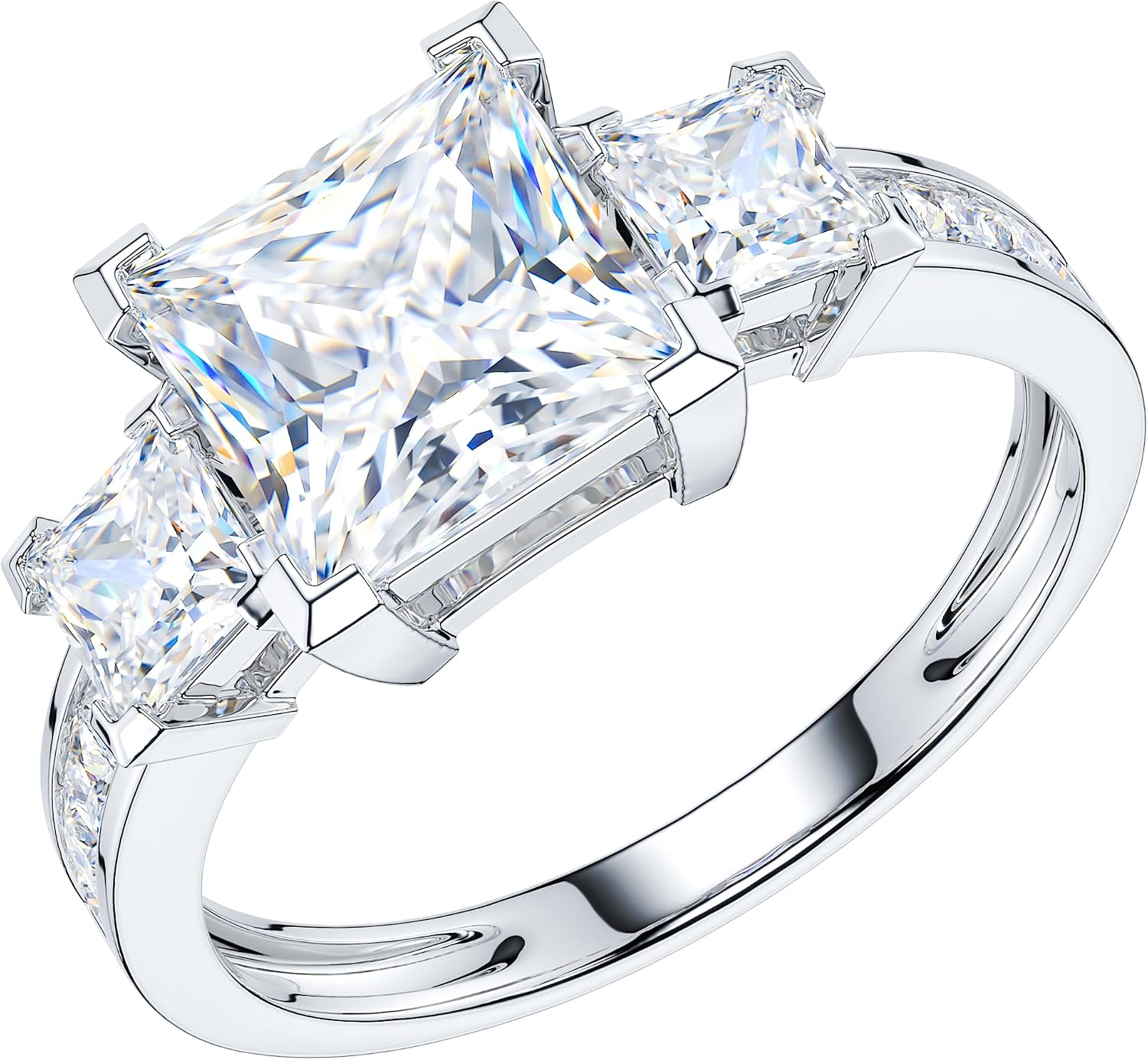
THELANDA
$397.99
In stock on Amazon
Check price on AmazonTwisted Vine and Pavé Bands: High Emotion, Honest Risk
The twisted vine setting — where the band spirals or braids toward the center stone, often with micro-pavé stones set along the twist — generates the strongest emotional language in buyer reviews: “so feminine,” “like something from a fairy tale,” “I get compliments every single day.” That response reflects genuine design merit. The visual complexity of a vine band makes a smaller center stone read larger and more elaborate than a plain solitaire of identical carat weight.
The tradeoff is physical: buyers in hands-on professions raise snagging concerns, and they are correct to do so. A twisted or braided band with raised pavé detail creates more surface texture than a plain shank, and texture catches on nitrile gloves, bar rags, and sweater knit. Reviewers in active-profession communities are consistent on this point: a pavé vine band worn daily in a hands-on job will accumulate prong wear faster, and individual pavé stones can work loose over time if the ring takes regular lateral impact. This is not a dealbreaker — pavé bands are prong-set at a micro scale, and any competent jeweler can retip or replace individual stones — but it is a maintenance reality that a bezel or plain-shank buyer will not face at the same rate.
Gem Society’s Moissanite Gemstone Information (GemSociety.org) notes that pavé-set accent stones in active-wear conditions benefit from professional prong inspection on a regular schedule, with many jewelers recommending a check every 12 to 18 months for rings worn daily in physical work environments.
By the numbers:
- Pavé stones in a typical twisted vine band: 20–60 accent stones depending on band width and design
- Gap from ring base to a flat wedding band on a standard twisted vine head without a contour band: 0.5mm–2mm depending on head height
- Rhodium-plated white gold and rhodium-plated sterling silver: reported tarnish-free through 6–18 months of daily wear in PriceScope’s aggregated buyer review threads; yellowing typically appears at the 2–3 year mark in active-wear conditions
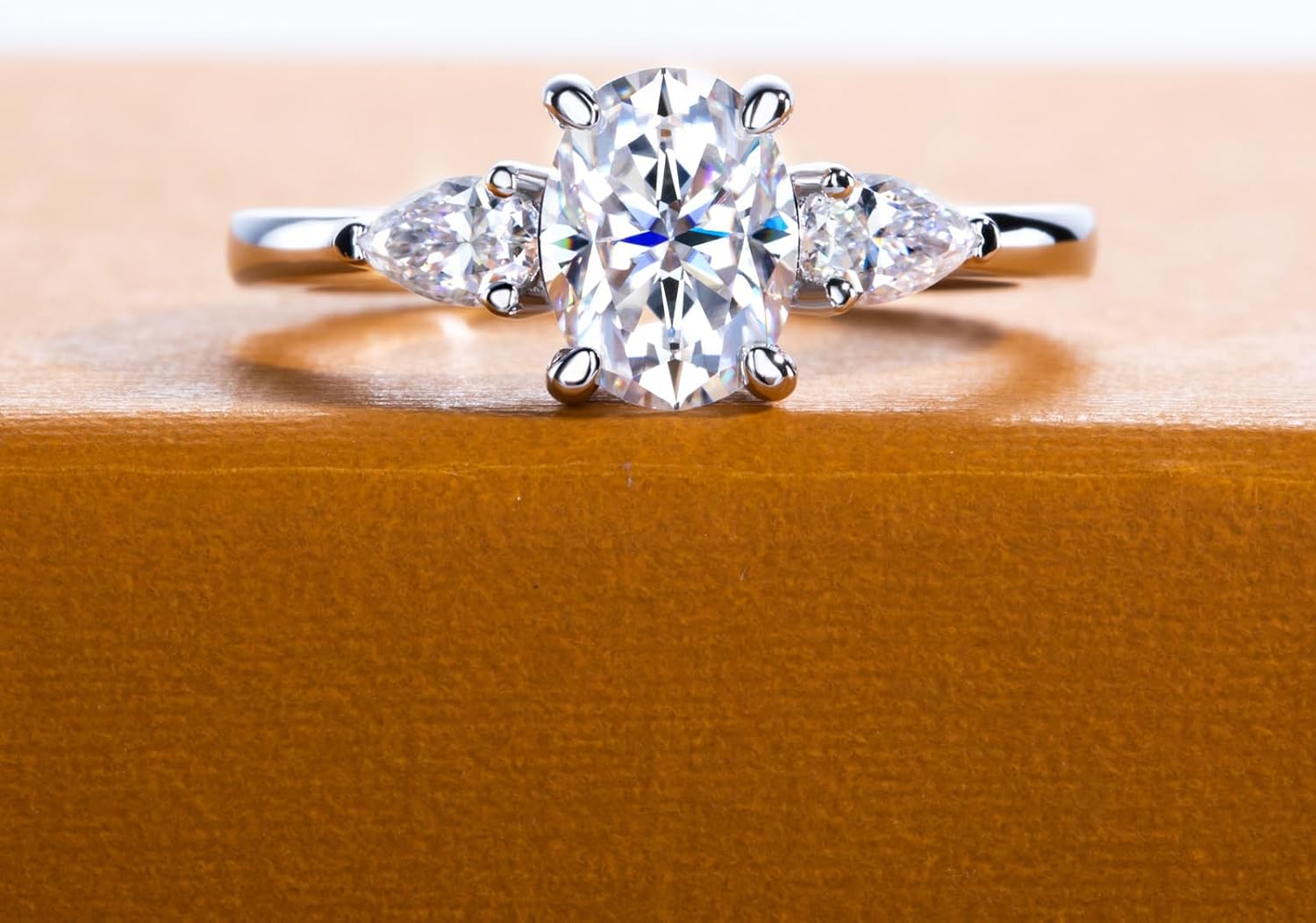
Oval/Marquise/Emerald
$89.99
In stock on Amazon
Check price on AmazonThree-Stone Settings: The Most Honest Value Statement
The three-stone setting — one center stone flanked by two side stones, typically in matching or complementary shapes — carries traditional symbolic weight (past, present, future is the standard narrative), but what makes it interesting as a value proposition is more geometric than romantic. Two well-matched side stones fill the visual field of the ring without requiring a larger center stone to make the piece look substantial on the finger. A 1CT center moissanite flanked by two 0.5CT trillion or half-moon side stones will present on the hand closer to a 2CT-equivalent face-up spread, at a fraction of what a single 2CT stone costs.
The practical notes here differ meaningfully from halo settings. Three-stone rings typically have a lower profile than halo designs — there is no under-halo to create a flare at the base — which means many contoured wedding bands will sit closer to flush. That said, the head still has more east-west width than a solitaire, and buyers should try a plain band against their specific ring before committing. Stacking works better here than with hidden halos, but “works better” is not the same as “always seamless.”
The Knot’s Engagement Ring Settings Guide 2025 notes that three-stone rings have seen a significant resurgence since 2023, partly driven by buyers who want the visual drama of a halo without the maintenance complexity of micro-pavé underneath the center stone. For moissanite specifically, the three-stone format showcases the stone’s fire — the spectral rainbow flashes moissanite produces in direct light — effectively from multiple angles. The side stones catch and redirect light differently than the center stone, creating a dynamic, shifting appearance as the hand moves.
The Gemological Institute of America’s documentation “Moissanite: A New Jewel for a New Century” confirms that moissanite’s fire dispersion value of 0.104 is higher than diamond’s 0.044, meaning the stone produces more spectral color flash per unit of light. A three-stone setting maximizes the number of active facets presented to ambient light, which plays directly to that optical strength.
Oval/Marquise/Emerald
$89.99
In stock on Amazon
Check price on AmazonBezel Settings: The Practical Pick That Divides Opinion
A bezel setting wraps the center stone in a continuous rim of metal — fully (full bezel) or partially (partial or semi-bezel, which leaves the stone’s sides more exposed). There are no prongs to snag, no micro-pavé to lose, and the stone is better protected against impact than in any prong-set design. For nurses, bartenders, travelers, and anyone whose hands take daily punishment, the bezel’s durability case is straightforward. The Gemological Institute of America’s “Moissanite: A New Jewel for a New Century” consistently ranks bezel-style settings as the highest-protection option for stones worn in active conditions, noting that the continuous metal rim shields the girdle from lateral impact that would chip or loosen a prong-held stone.
The division in buyer reviews is real, and it deserves an honest reading. The bezel’s metal rim covers a portion of the stone’s girdle and the very edges of its crown facets. With brilliant cuts — round, cushion, oval — the loss is modest; brilliance and fire come through clearly from the table and upper facets. With step cuts — emerald, Asscher — where much of the visual interest comes from the open, mirror-like table and long linear facets running to the girdle edge, the bezel rim can interrupt that line and reduce the “hall of mirrors” effect that step-cut buyers are specifically choosing the shape to achieve.
Gem Society’s Moissanite Gemstone Information (GemSociety.org) confirms that moissanite carries a refractive index of 2.65–2.69, slightly higher than diamond’s 2.42, which means moissanite is optically positioned to reward settings that expose maximum facet area to light. A bezel, which reduces that exposure at the girdle, does cost some of that advantage. If sparkle-per-dollar is the primary metric, a prong setting with moissanite will outperform a bezel using the same stone. If durability and snag-free daily wear are the real priorities, the tradeoff may be worth it — but going in with eyes open matters here.
Brides’ Best Moissanite Engagement Rings 2025 edition specifically recommends prong settings over bezels for step-cut moissanite for this reason, and that guidance holds whether you are buying at the entry level or the top of the market.
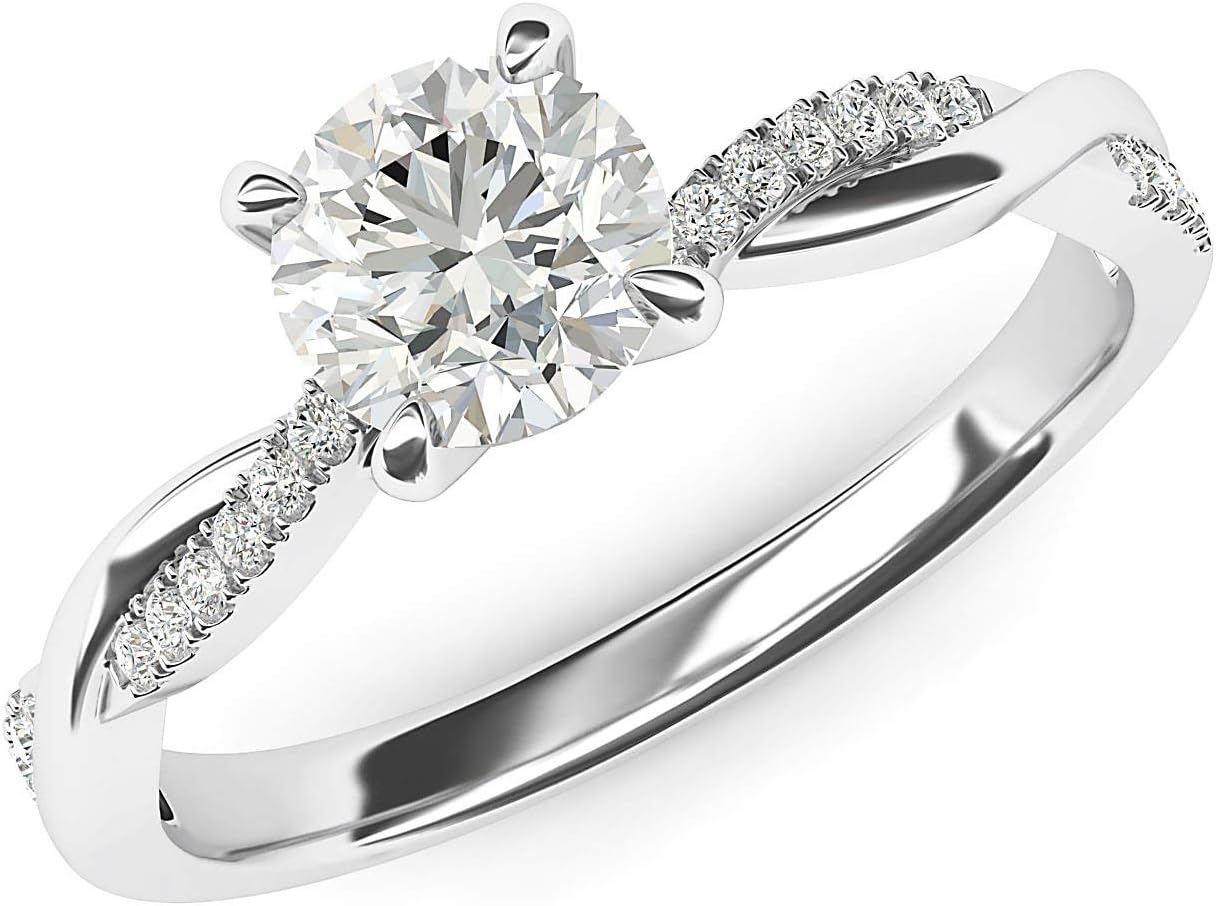
Sterling
$57.99
In stock on Amazon
Check price on AmazonStacking, Maintenance, and Metal: Three Cross-Setting Topics
Stacking Logic Across All Four Formats
The gap-stack problem is not unique to hidden halos — it is a spectrum. Hidden halos create the largest typical gap (1–2mm) against a flat band. Twisted vine heads create a moderate gap (0.5–1.5mm depending on head height). Three-stone settings create the smallest gap of the four, though they still have more east-west width than a plain solitaire. Bezels, depending on profile height, sit closest to flush with a plain band but still benefit from trying both pieces together before purchase. The universal solution is a curved or contoured wedding band matched to the engagement ring’s specific head profile. Brides’ Best Moissanite Engagement Rings 2025 edition recommends ordering or at minimum fitting the wedding band at the same time as the engagement ring rather than treating it as a post-wedding purchase.
Metal and Plating: What to Expect Over Time
White gold and rhodium-plated sterling silver both carry a rhodium plating layer over the base alloy. That layer is what produces the bright white finish buyers see at purchase. In high-contact areas — the inner shank, the underside of the band where it contacts surfaces — rhodium plating wears thin over time. Under warm incandescent light, any thinning reveals the warmer metal underneath, which owners describe as “brass-toned” or “yellowing.” This is normal wear, not a manufacturing defect. Re-plating is a standard jeweler service, typically running $30–$75 depending on band complexity. PriceScope buyer reviews in the moissanite setting comparison threads report that sterling silver with rhodium plating typically holds its finish without visible change through the first 12–18 months of daily wear; yellowing is reported more commonly at the 2–3 year mark in active-wear conditions.
Prong Maintenance by Setting Type
Not all prong commitments are equal across these four formats. A plain four- or six-prong solitaire head has four to six prong tips to inspect. A twisted vine band with 40 micro-pavé stones has 40 individual prong clusters. Gem Society’s Moissanite Gemstone Information (GemSociety.org) recommends professional prong inspection every 12–18 months for rings worn daily in physical work environments, with higher-pavé-count settings warranting more frequent checks. The bezel, by contrast, has no prongs to inspect — its maintenance profile is the lowest of the four settings reviewed here.
Frequently Asked Questions
Does a bezel setting make moissanite look less sparkly than a prong setting? Yes, measurably so — and the effect is most pronounced with step cuts like emerald and Asscher. The metal rim reduces how much light enters from the stone’s edges. With round brilliants and cushions, the difference is modest. With step cuts, it is significant enough that most buyers who prioritize the “hall of mirrors” look should use a four- or six-prong setting instead. Brides’ Best Moissanite Engagement Rings 2025 edition recommends prong settings specifically for step-cut moissanite for this reason.
Will a hidden halo sit flush against a plain wedding band? Usually not. The micro-pavé stones that form the hidden halo add height and a slight outward flare to the base of the ring head. A flat wedding band will typically leave a visible gap — often 1–2mm — at that junction. A curved or contoured shadow band is the standard solution and should be budgeted for alongside the engagement ring purchase.
Is a twisted vine or pavé band safe for hands-on jobs like nursing or bartending? Wearable, but with maintenance expectations. The raised pavé detail can snag gloves and bar rags, and individual band stones are more susceptible to loosening from lateral impact than a plain shank. Gem Society’s Moissanite Gemstone Information (GemSociety.org) recommends professional prong inspection every 12–18 months for pavé rings worn daily in active conditions. A bezel or plain-shank setting is the lower-maintenance alternative.
How does a 3CT hidden halo cushion look in real life compared to product photos? Larger, typically — not smaller. The micro-pavé halo catches ambient light and visually expands the face-up appearance of the stone beyond what flat product photography captures. PriceScope’s moissanite setting comparison threads note this as a consistent positive surprise: the ring reads more impressive in person than the listing suggested.
Can a standard diamond tester verify that moissanite is genuine? Yes, with a caveat. A standard electrical conductivity diamond tester will read moissanite as diamond, because moissanite conducts electricity similarly to diamond. To distinguish moissanite from diamond, you need a dual tester — also called a moissanite-and-diamond tester — that measures both thermal and electrical conductivity. Passing either tester confirms the stone is a genuine gemstone rather than glass or cubic zirconia. The Gemological Institute of America’s “Moissanite: A New Jewel for a New Century” documents moissanite’s unique optical and physical properties that distinguish it from both diamond and simulants.
Why does a white gold band sometimes look brass-toned in certain lighting? The rhodium plating layer over white gold or sterling silver wears thin over time in high-contact areas. Under warm incandescent light, any thinning reveals the warmer base alloy underneath, which owners describe as brass-toned or yellow. This is normal wear. Re-plating is a standard jeweler service typically costing $30–$75. PriceScope buyer reviews report that rhodium-plated bands generally hold their finish through the first 12–18 months of daily wear, with yellowing appearing more commonly at the 2–3 year mark in active-wear conditions.