You’re wearing your engagement ring every day and something is quietly bothering you: the wedding band beside it looks like a placeholder. Maybe it’s too plain, or maybe it’s already showing wear you didn’t expect. A moissanite half eternity band is one of the most popular upgrades buyers make in that situation. Moissanite is a lab-created gemstone (silicon carbide) that ranks 9.25 on the Mohs hardness scale — second only to diamond at 10 — and it refracts light with even more fire than diamond, meaning it produces colorful, rainbow-like flashes. A half eternity band is a ring with stones set only along the top half (roughly 180 degrees), leaving the bottom plain metal. That’s the opposite of a full eternity band, where stones circle the entire ring. This distinction matters more than it sounds, and we’ll get into exactly why below.
What follows is a decision guide built from published buyer reviews, material science, and the pattern of questions that come up repeatedly when people shop this category. If you already know what moissanite is and you’re currently weighing specific bands or worrying about sizing and chlorine pools, you’re in the right place.
| EDITOR'S PICKLab Grown Diamond Wedding Bands… | Mid-tierIMOLOVE Moissanite Wedding Band… | Budget pickWES 1.5/1.8/2.0mm Moissanite We… | |
|---|---|---|---|
| Stone Type | Lab diamond | Moissanite | Moissanite |
| Stone Count | — | 3 | 6 |
| Metal | 925 silver + 14K | Sterling silver | 925 sterling silver |
| Stone Shape | Marquise | — | Round |
| Band Width | — | — | 1.5mm |
| Size Range | 5-10 | 4-11 | 4-11 |
| Price | $159.99 | $59.99 | $36.99 |
| See on Amazon → | See on Amazon → | See on Amazon → |
Half Eternity vs. Full Eternity: The Trade-Off That Actually Matters
The Knot’s eternity ring guide and Brides’ half eternity vs. full eternity comparison both arrive at the same conclusion: half eternity bands are more practical for daily wear, and full eternity bands are more dramatic but come with real trade-offs.
Here’s the short version of each trade-off:
Comfort and wearability. Because the interior bottom of a half eternity band is smooth metal, it sits flat against your finger without stone edges pressing into adjacent fingers. Buyers of the IMOLOVE Moissanite Half Eternity Band specifically call this out in reviews — they emphasize the comfort of stones only on the top half, especially when the band is stacked next to an engagement ring. A full eternity ring, by contrast, creates a 360-degree ridge that some wearers find uncomfortable after hours of wear.
Resizing. This is the practical killer for full eternity bands: because stones circle the entire ring, resizing is extremely difficult or impossible without disrupting the stone alignment. A half eternity band, by contrast, has plain metal on the bottom shank, giving a jeweler clean material to work with. The International Gem Society’s moissanite gemstone information notes that rings with stones set in the lower shank create structural challenges for resizing — so if you’re between sizes, a half eternity gives you more flexibility long-term.
Visual impact when stacked. The half eternity’s sparkle is concentrated where you actually see it: the top of the finger. When stacked against a solitaire engagement ring, that tends to complement rather than compete. Buyers who deliberately purchase two different widths of the same half eternity style — a narrower and a slightly wider band — and alternate them report that having stones only on top keeps the overall look cohesive even when layering multiple bands.
The Chlorine Problem: What Actually Turns a Ring Black
One of the most specific and useful data points in the buyer review landscape for this category comes from a buyer who switched products because of chlorine damage. That buyer originally wore a gold-dipped moissanite band — meaning a base metal core electroplated with a thin gold coating — into a chlorine pool and reported the ring turning black. They replaced it with a solid-gold lab diamond eternity band and reported no discoloration after the same pool exposure.
This is not a random anecdote. It reflects chemistry.
What actually causes blackening: Chlorine does not damage gold or moissanite directly. What it attacks is the base metal underneath a plated ring — typically brass or copper — once the plating wears thin. Chlorine strips the plating faster, accelerating exposure of the reactive core metal, which then oxidizes and turns dark. PriceScope forum discussions on moissanite and lab diamond for daily wear bands consistently flag rhodium-plated sterling silver and gold-dipped brass as the two most chlorine-vulnerable substrates in budget and mid-range rings.
What survives the pool test:
- Solid 10K, 14K, or 18K gold: stable in chlorine (the alloy metals do react slightly over years, but not dramatically)
- Solid platinum: fully chlorine-stable
- Solid sterling silver: moderate risk (silver itself can tarnish in chlorinated water, though it won’t turn black as dramatically as plated base metals)
- Gold-plated or gold-filled: vulnerable; timeline depends on plating thickness
Marquise lab diamond eternity bands that buyers specifically praise for producing no green finger or darkening are consistently constructed in solid gold — that result is consistent with the metal science above, not a coincidence.
Bottom line: If you swim regularly or wear your ring in the hot tub, material disclosure matters more than price. Verify whether a listing states “solid 14K gold” or “14K gold plated” before purchasing. These are not the same product.
Sizing a Half Eternity Band: The Half-Size Problem
Sizing is the friction point that comes up most consistently across eternity band reviews, and it’s worth naming explicitly before you order.
By the numbers:
- Half eternity bands typically add 0.25–0.5 mm to effective interior diameter versus a plain shank of the same stated size, due to prong or bezel geometry at the setting edge
- Most budget-to-mid-range eternity bands are available only in whole sizes (5, 6, 7…), not half sizes
- The physical gap between a size 6 and size 7 ring is approximately 0.4 mm in interior diameter — enough to feel loose but not enough to feel dramatically wrong
Buyers of the IMOLOVE moissanite half eternity band report that sizing ran accurate for their measured ring size, but they specifically note — based on other reviews they read before purchasing — that going half a size up is a common recommendation. Cushion-set eternity bands in this category generate the same frustration: half sizes are often unavailable, and buyers report having to choose between a ring that fits snugly (with the risk it won’t slide over the knuckle) or one that’s slightly loose.
Decision rule on sizing:
- If your knuckle is noticeably larger than your finger base (common), size up by half; if a half size isn’t available, accept the full size up and consider a ring adjuster insert for the short term until you can confirm your true fit
- If your ring fits your engagement ring with no gap, size up by half for any eternity band — prong settings add slight friction on the inside of the band
- A jeweler with the lower shank to work with (half eternity) can re-size ±1 full size; don’t treat your first purchase as final
The products in this category that buyers return to most often for a second or third stacking band are the ones where sizing notes are clearly published in the listing. If a listing does not specify stone width, metal thickness, and available size increments, contact the seller before ordering rather than after.
What to Look for When You Shop
Budget-Friendly Moissanite Half Eternity Bands
Entry-level moissanite half eternity bands — typically priced under $150 — are almost always constructed with a gold-plated or rhodium-plated base metal. The plating is cosmetically convincing when new, but as the chlorine discussion above makes clear, it is the weak link in long-term durability. Buyers in this tier frequently report satisfaction for the first six to eighteen months, with color shift or greenish tinting appearing after sustained exposure to chlorine, sweat, or hand sanitizer.
If budget is the primary constraint and you understand the maintenance trade-off (replating every one to two years, or removing the ring before swimming), the sparkle output of moissanite at this price point is genuinely hard to beat. Look for listings that specify stone color in the DEF-equivalent range and confirm whether the prong style is shared-prong or individual-prong — shared prong settings in this tier tend to show more stone face-up and produce more visible fire.
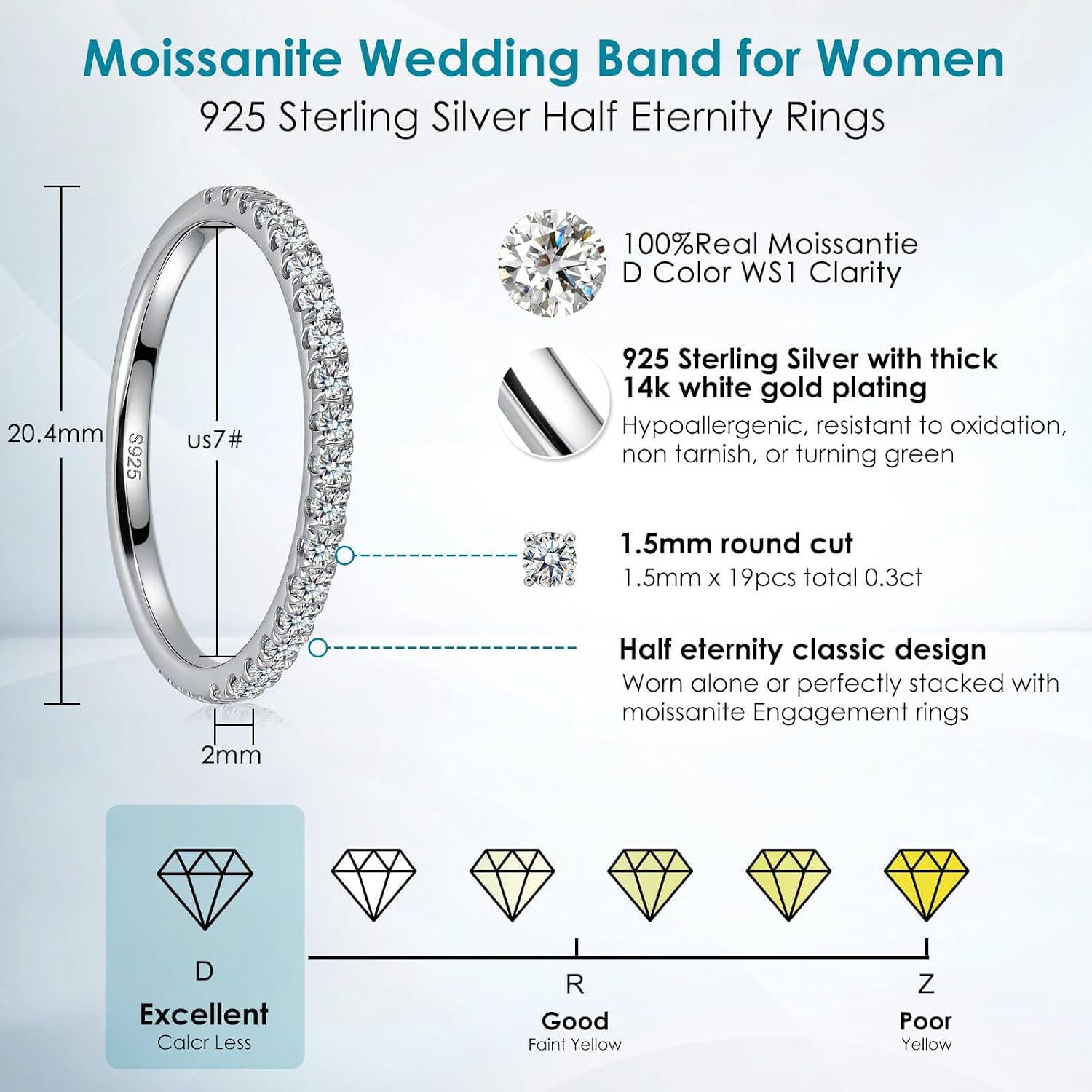
WES
$36.99
In stock on Amazon
Check price on AmazonMid-Range Moissanite Half Eternity Bands in Solid Gold
The most consequential upgrade between budget and mid-tier in this category is not stone quality — it is metal. A solid 10K or 14K gold half eternity band with moissanite stones typically runs $250–$600 depending on stone size, gold karat, and band width. This is the tier where the chlorine problem largely disappears, where resizing by a local jeweler becomes straightforward, and where the band is realistically a keep-forever purchase rather than a replace-in-two-years purchase.
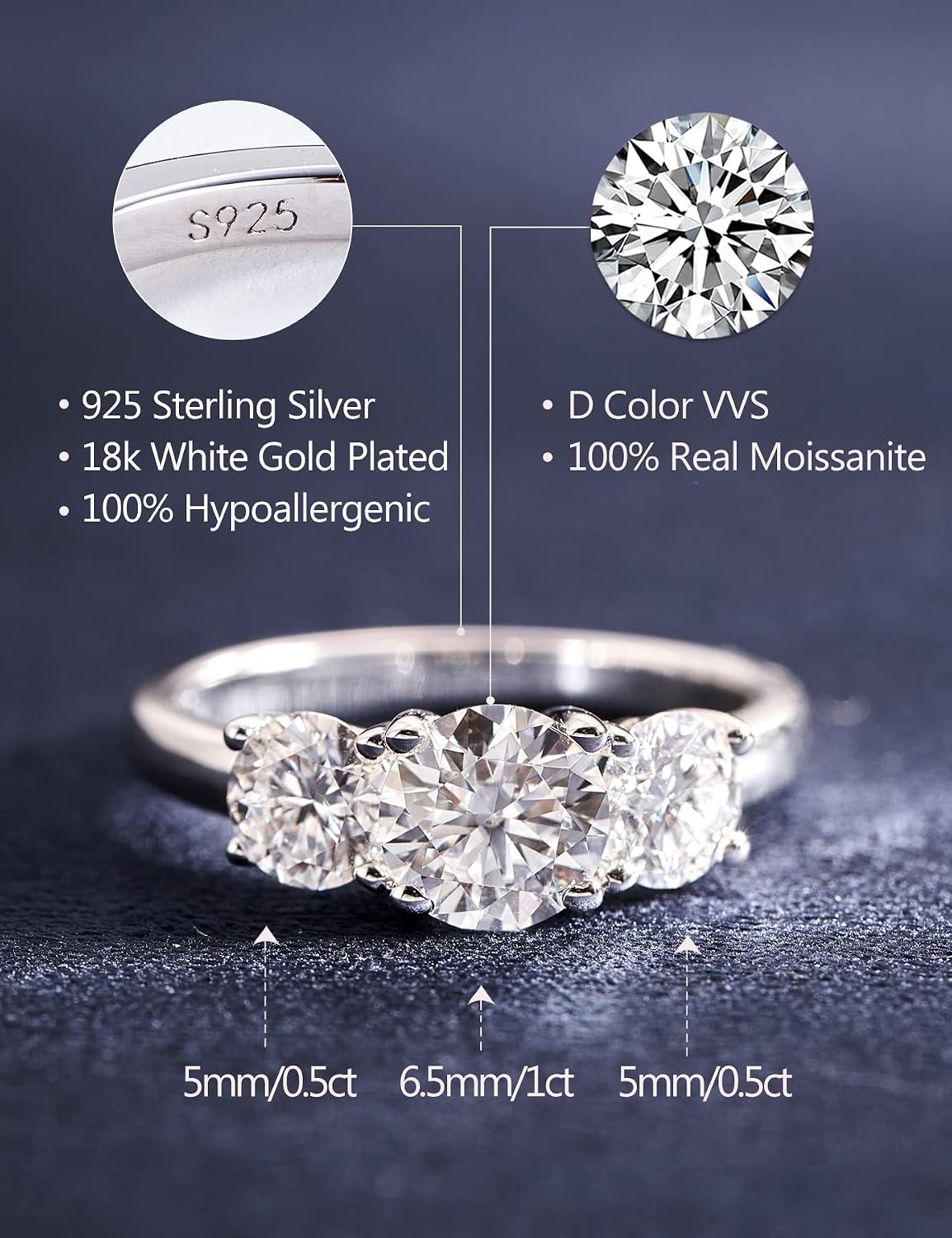
The IMOLOVE Moissanite Half Eternity Band falls in this tier and is the band most frequently cited in buyer reviews for comfortable daily wear stacked alongside an existing engagement ring. Buyers specifically note that the stones-only-on-top design means the interior of the band feels smooth against the finger, not ridged. Width options in the 2–3 mm range are the most common pairing choice for solitaire engagement rings with shanks in the 1.5–2.5 mm range, consistent with the stacking proportion guidance from Brides’ ring stacking coverage.
IMOLOVE
$59.99
In stock on Amazon
Check price on AmazonSolid Gold Lab Diamond Half Eternity Bands
For buyers who want the optical signature of diamond — white brilliance rather than moissanite’s more colorful fire — or who need the band to visually match an existing natural or lab-grown diamond engagement ring, a solid gold lab diamond half eternity band is the appropriate upgrade. The Gemological Institute of America’s moissanite gem profile confirms that moissanite’s refractive index and dispersion values differ measurably from diamond, producing a distinctly different light output. In a band setting with many small stones, this difference is more visible than in a single-stone comparison.
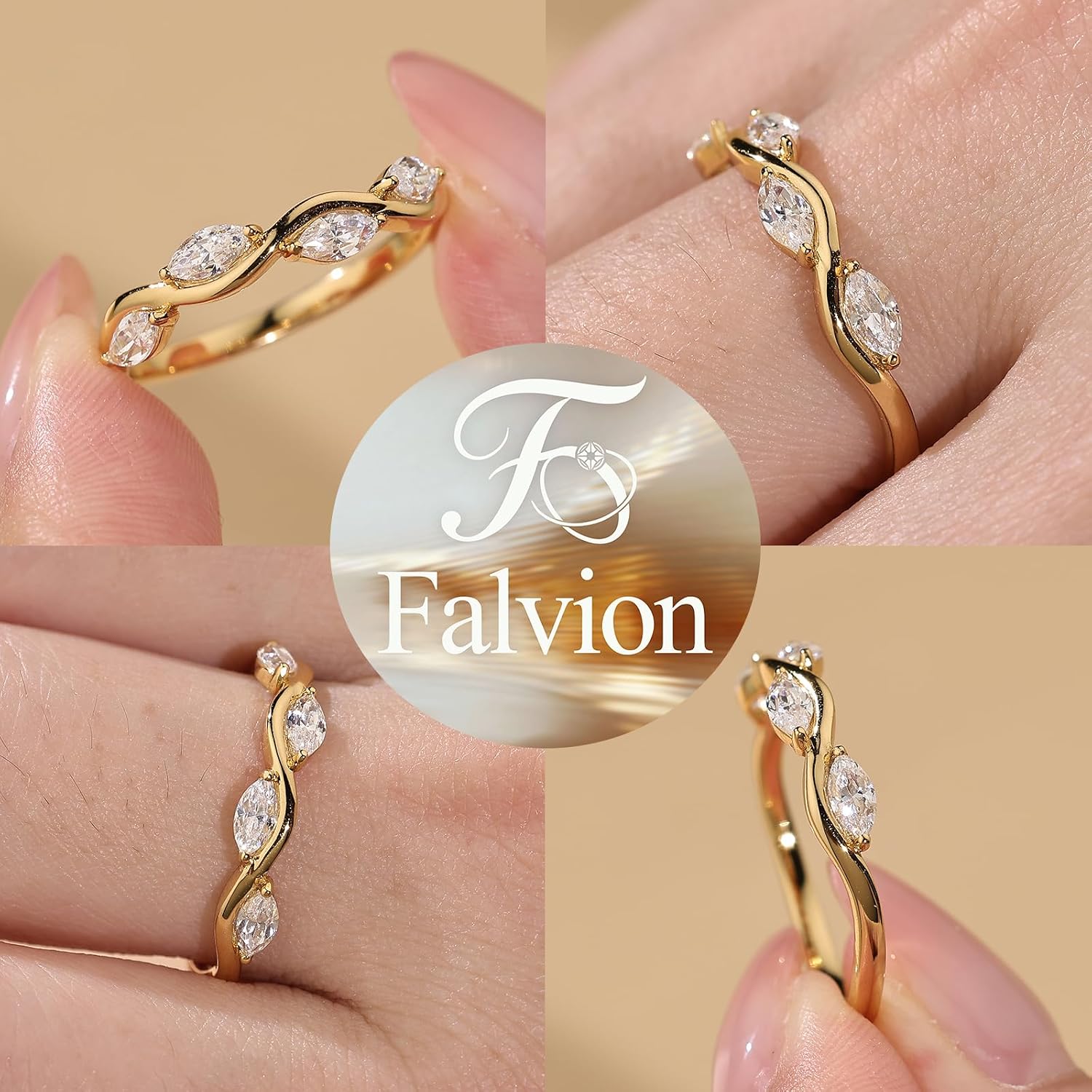
The IMOLOVE lab diamond eternity band in solid gold is the product one documented buyer switched to specifically after chlorine pool damage to a plated moissanite band — and the solid gold construction is the reason that switch resolved the darkening issue. Lab diamond at 10 Mohs hardness is marginally harder than moissanite at 9.25, though for a band worn flat against the finger (rather than a high solitaire setting), the practical scratch-resistance difference is minimal for most wearers.
Lab
$159.99
In stock on Amazon
Check price on AmazonStacking Logic: Width, Proportion, and What Pairs with a Solitaire
The solitaire engagement ring — a single stone on a plain or slightly tapered band — is the most common pairing context for buyers shopping this category. The proportional question is: how wide a band actually complements without fighting?
Brides’ stacking ring coverage and PriceScope forum discussions on stacking bands converge on a practical rule: your stacking band should be no wider than the shank width of your engagement ring, or up to 1 mm wider at most. Most solitaire engagement ring shanks fall between 1.5 mm and 2.5 mm wide. A 2 mm eternity band alongside a 2 mm engagement ring shank reads as a matched set. A 4 mm eternity band alongside a 1.8 mm shank starts to visually overpower the engagement ring.
Buyers who own two widths of the same half eternity style report interchanging them depending on context — a narrower band for formal or minimalist days, a slightly wider one when they want more visual weight. Having stones only on top keeps the stacking profile clean regardless of which width is worn.
For buyers pairing with a halo engagement ring (where the center stone is surrounded by a ring of smaller stones), the calculus shifts: a slightly wider eternity band can balance the visual mass of the halo better than a very slender band, which can look like an afterthought.
Frequently Asked Questions
Should I size up for a half eternity moissanite band compared to my regular ring size? Yes, typically by half a size. The prong or bezel setting at the band’s interior edge creates slight friction that a plain shank doesn’t. If half sizes aren’t available, consider whether the whole size up would require a ring adjuster — most buyers find the slight looseness manageable short-term.
Will a gold-plated moissanite wedding band turn black or green in a chlorine swimming pool? It can. Gold-plated rings with a base metal core — brass or copper — are vulnerable because chlorine accelerates the wearing of thin plating, exposing the reactive metal underneath. Solid gold bands (10K, 14K, 18K) perform significantly better in chlorine exposure. One buyer’s documented switch from a plated moissanite band to a solid gold band explicitly confirmed this difference in pool use.
What is the practical difference between a half eternity and full eternity band for everyday wear? A half eternity band has stones only on the top half of the ring and smooth metal on the bottom shank. This makes it more comfortable against adjacent fingers, easier to resize, and typically more affordable. A full eternity band has stones all the way around, which is visually dramatic but harder to resize and occasionally uncomfortable during extended wear.
Can a moissanite eternity band be resized by a jeweler if it doesn’t fit? A half eternity band can usually be resized ±1 full size because the plain lower shank gives a jeweler clean metal to work with. A full eternity band is very difficult or impossible to resize without disturbing stone alignment. This is one of the most practical arguments for choosing a half eternity style.
How wide should a stacking band be to complement a solitaire engagement ring without overpowering it? Match or come close to the shank width of your engagement ring. Most solitaire shanks are 1.5–2.5 mm wide; a 2 mm eternity band is the most versatile pairing. Going above 3 mm risks dominating the visual balance, especially with a slender engagement ring shank.
Is lab-grown diamond or moissanite a better choice for a wedding band that will be worn 24/7? Both are highly durable for daily wear — moissanite at 9.25 Mohs and lab diamond at 10 Mohs, per the Gemological Institute of America’s published gem profiles. The more consequential variable for 24/7 wear is metal: solid gold or platinum will outperform plated settings significantly over time. Between the two stones, lab diamond produces a whiter, more diamond-like optical character; moissanite produces more colorful fire. Neither choice is wrong — the decision comes down to aesthetic preference and whether you want the band to visually match an existing diamond ring.