Somewhere in a bathroom drawer, there’s a diamond solitaire that hasn’t been worn in eight months. Its owner is not upset about this. She bought a moissanite stand-in last spring for a beach vacation — moissanite (moy-suh-NITE) being a lab-created gemstone that looks nearly identical to diamond to the naked eye — and somewhere between the airport security line and the postpartum finger swelling that followed, the swap became the default. The diamond is safe. The moissanite just… stayed on.
This is no longer an edge case. Across aggregated buyer reviews in 2025 and into 2026, a consistent pattern has emerged: people who purchase moissanite rings for a defined temporary purpose — travel, pregnancy, sizing fluctuation, a stone at the jeweler — and then quietly decide not to go back. If you’re someone who has already made this purchase or is considering it with real intention, this article is for you. We’ll cover what’s actually driving that behavior, the durability math, the social friction (or lack of it), and how to choose a stand-in worth keeping.
| EDITOR'S PICK2.5/3.5ct Elongated Cushion Cut… | Mid-tierSterling Silver 4-Prong Petite… | Budget pickJewelryPalace Classic 1ct 2ct 3… | |
|---|---|---|---|
| Metal | 925 Sterling Silver | Sterling Silver | 925 Sterling Silver |
| Center Carat | 2.5ct | 1.0 CT | 1ct / 2ct / 3ct |
| Stone Cut | Elongated Cushion | — | Round |
| Stone Color | D | — | D |
| Clarity | VVS1 | — | — |
| Setting | Solitaire | 4-Prong | Solitaire |
| Price | $129.00 | $57.99 | $29.99 |
| See on Amazon → | See on Amazon → | See on Amazon → |
The Psychology of the “Temporary” Ring That Becomes Permanent
The word “stand-in” implies a placeholder, but buyer language tells a different story. A reviewer of one round brilliant moissanite solitaire describes the ring as beating her own wedding ring. Another buyer explicitly purchased three sizes of the same style ahead of a honeymoon — planning for both travel safety and future pregnancies — and reports it stays on 24 hours a day without any issues. A third compares sparkle side by side against a mined diamond and concludes the moissanite wins in direct light.
What’s happening here isn’t substitution regret. It’s a values recalibration that happens quietly in daily wear.
The GIA’s gemstone overview notes that moissanite scores 9.25 on the Mohs hardness scale (diamond is 10), making it among the most durable gems available — harder than sapphire, harder than ruby, suitable for daily wear across decades. The Knot’s buyer guidance on moissanite engagement rings confirms this durability framing, noting that the stone does not chip, scratch, or lose transparency the way cubic zirconia (CZ — a much cheaper, softer simulant) does over time. That distinction matters enormously for anyone who has watched a CZ ring turn cloudy inside a year.
The practical math: a woman whose ring finger fluctuates between sizes 6 and 8 across pregnancy and postpartum isn’t going to resize a $4,000 diamond solitaire twice. She’s going to wear a $60–$180 moissanite that she can size-swap. When that ring also happens to be genuinely beautiful and functionally indistinguishable from her real ring at dinner, “temporary” becomes a label that no longer applies.
Durability Over Time: Moissanite vs. CZ vs. Silicone
This is where the decision logic gets concrete. Three categories compete for the stand-in role:
Cubic zirconia (CZ): Inexpensive, widely available, but softer (Mohs 8–8.5) and porous at the surface. The International Gem Society’s moissanite entry notes that CZ is prone to surface scratching and the absorption of oils from skin, which causes the haze that buyers describe as “going dull.” With everyday wear, CZ rings typically look worn within 12–18 months.
Silicone rings: Purpose-built for safety in physical work environments (machinery, medical settings, jobs where a metal ring is a caught-ring hazard). They solve a real problem and solve it well — but they read as silicone. No one looks at a silicone band and thinks engagement ring.
Moissanite in a metal setting: The durable choice for anyone who wants a ring that still looks like a ring. Per Brides’ comparative coverage of moissanite vs. diamond, moissanite’s brilliance is actually higher than diamond’s by refractive index (moissanite: ~2.65, diamond: ~2.42), which explains why reviewers consistently describe moissanite as “sparkling more” in side-by-side comparisons. The stone doesn’t cloud. It doesn’t scratch in normal wear. It doesn’t need re-plating if set in sterling silver, though owners report that sterling silver bands benefit from occasional polishing — a minor maintenance note.
By the numbers:
| Material | Mohs Hardness | Visual Longevity (daily wear) | Reads as Ring? |
|---|---|---|---|
| Diamond | 10 | Indefinite | Yes |
| Moissanite | 9.25 | Indefinite | Yes |
| CZ | 8–8.5 | 12–24 months | Yes (briefly) |
| Silicone | ~3 | Years (functional) | No |
If your constraint is hands-on job safety, silicone wins. If your constraint is “looks like my ring and lasts,” moissanite is the clear answer. CZ doesn’t belong in the long-term conversation.
The Metal Question: Sterling Silver vs. Gold-Plated vs. Solid Gold
This is where buyers make quiet mistakes. The stone will outlast almost any setting — the question is whether the metal will.
Sterling silver (925): The most affordable base for moissanite stand-ins and, importantly, a real metal — not a plating over brass. It does tarnish with exposure to moisture, lotions, and chlorine, but owners report it responds well to polishing cloths and does not turn skin green (a concern that comes up in reviews, specifically about the rings that don’t have that problem). One reviewer notes their ring “doesn’t turn green” as a primary selling point, which suggests they’ve encountered plated alternatives that do. Sterling silver is a viable long-term metal for someone who understands basic maintenance.
Gold-plated / vermeil: The visual appeal of gold at a lower price, but the plating wears through at contact points — knuckles, palms — within months of daily wear. Not a long-term answer unless you’re comfortable with re-plating or color inconsistency.
10K or 14K solid gold: The durable option if you’re spending more. Reviewers at PriceScope note that buyers who upgrade moissanite stand-ins into solid gold settings often report the ring becoming their permanent preference — particularly when the original diamond was in a style they’d never fully loved.
The decision rule: if the stand-in is genuinely temporary (under 3 months), sterling silver is fine. If you’re buying for pregnancy sizing across two pregnancies and postpartum, consider spending the incremental amount for 10K gold or at minimum a high-quality sterling silver with rhodium plating for tarnish resistance.
The Social Question: Do You Have to Explain Anything?
One buyer friction point that comes up in reviews is the certification card. At least one reviewer explicitly wished the word “Moissanite” wasn’t printed prominently on the documentation that comes with the ring — not out of embarrassment about the stone, but because it removed the option of discretion. This is worth naming directly.
Here’s the social reality as of 2026: moissanite is no longer a secret category. The Knot’s survey data and editorial coverage of the category confirm that awareness of moissanite as a deliberate, non-apologetic choice has increased substantially among millennial and Gen Z buyers. A moissanite engagement ring is increasingly understood — at least in urban and coastal markets — as a values-forward decision, not a budget concession.
That said, the decision to disclose is entirely personal. Moissanite is not visually identifiable as non-diamond without equipment. No jeweler at a dinner party can tell. The question of whether to explain your ring is a social preference, not a factual obligation. What’s worth noting: buyers who frame moissanite as a deliberate choice (“I didn’t want to wear a $5,000 ring on a trip to Thailand”) report far less social friction than those who treat it as something to hide. Brides’ editorial coverage of moissanite positioning reflects this shift — the stone is increasingly framed as aspirational, not defensive.
Carat Size, Sizing Nuance, and What “Reads as Real” Actually Means
Two practical questions come up constantly in aggregated reviews:
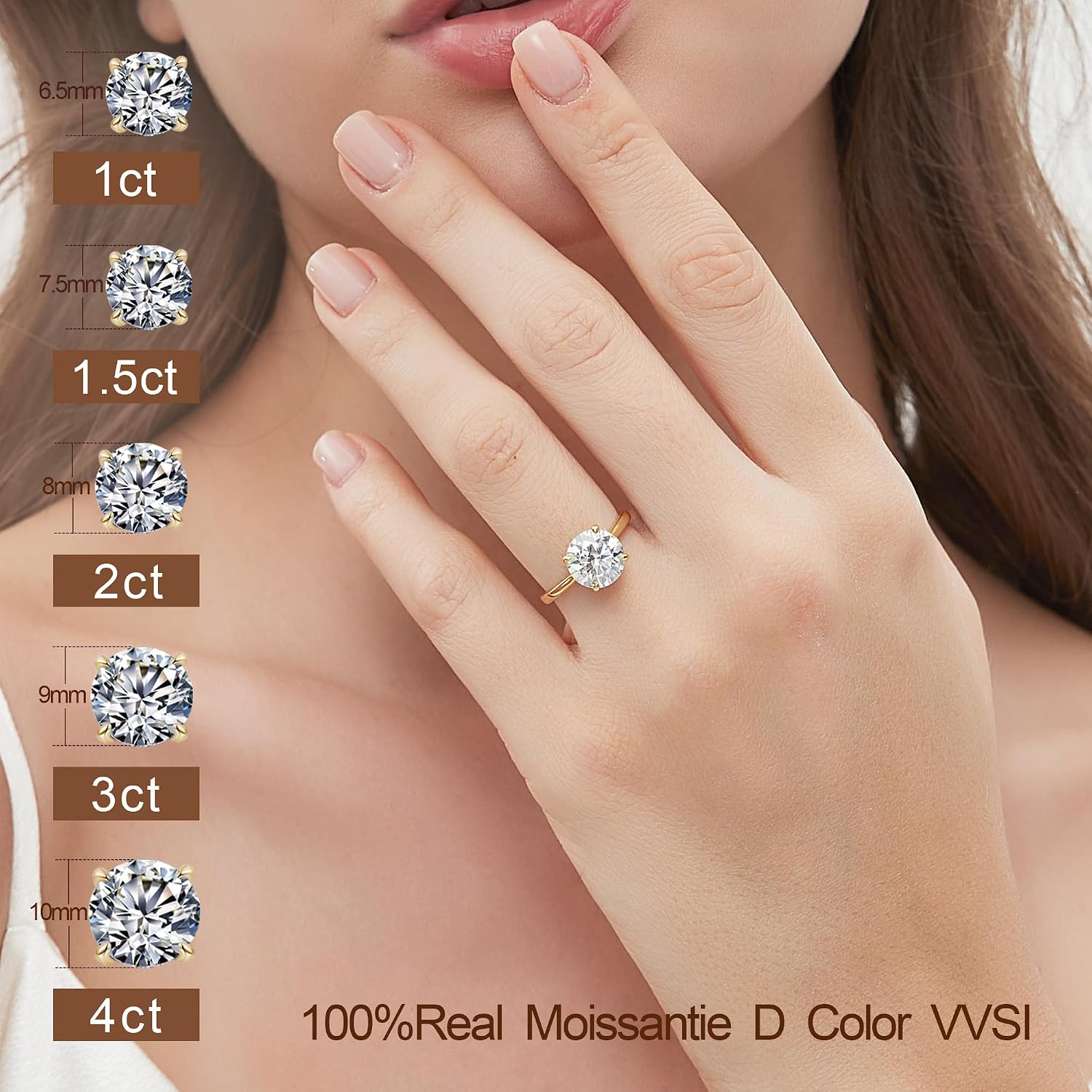
What carat size reads as real without looking oversized? The answer depends on finger width and the setting style, but across reviewer consensus, a 1.0–1.5ct equivalent (in terms of millimeter diameter — moissanite is priced and sized by mm, not carat weight) hits the range that reads as a credible engagement ring without entering the territory where people think “that’s too big to be real.” A 6.5mm round moissanite is the diamond-equivalent of approximately 1.0ct. A 7.5mm reads closer to 1.75ct equivalent. At 8.5mm and above, the ring starts reading as a statement piece rather than a solitaire — which may be exactly what you want, but it shifts the visual register.
The Gem Society’s pricing and sizing reference confirms that moissanite is sold in millimeter dimensions rather than carat weight, which is the first thing to understand when comparing across listings.
Do these rings come in half sizes? Across aggregated listings, yes — most reputable moissanite ring sellers offer half-size increments, and some offer quarter sizes on select styles. This matters enormously for the pregnancy and postpartum use case, where a buyer who is a true 6.25 should not be forced into a 6 or 6.5. Reviews of specific styles note that buyers purchasing multiple sizes for different life stages explicitly look for half-size availability as a prerequisite.
Frequently Asked Questions
Can you wear a sterling silver moissanite ring every day long-term without it looking worn? Yes, with modest maintenance. Sterling silver doesn’t degrade the way plated metals do, but it does tarnish. Owners who wear their rings 24/7 report that a monthly polish with a jewelry cloth keeps the metal looking clean. Avoiding prolonged exposure to chlorine (pools, hot tubs) and removing the ring for heavy lotion application extends the time between cleanings significantly.
Will moissanite lose its sparkle over time the way CZ does? No. This is the most important practical distinction between the two. CZ hazes because it is porous and softer — oils and micro-scratches accumulate. Moissanite’s hardness (9.25 Mohs) means it does not scratch under normal wear conditions, and its surface remains optically clear. Cleaning with warm water and dish soap restores any surface film. GIA’s gemstone documentation confirms moissanite’s durability profile as suitable for heirloom-level wear.
How do moissanite stand-in rings compare to silicone rings for hands-on jobs? Different tools for different problems. Silicone rings are specifically designed for environments where a rigid metal ring poses a safety risk — think nursing, construction, or mechanical work where a caught ring can deglove a finger. For those jobs, silicone is the correct answer. For jobs where the ring is fine to wear but you don’t want to risk your diamond, moissanite is the better answer because it still reads as a ring.
Is it socially awkward to explain that your engagement ring is moissanite? Less than it used to be. As of 2026, moissanite has enough mainstream visibility — through retailer marketing, editorial coverage in Brides and The Knot, and general awareness of lab-grown gemstones — that explaining it rarely draws negative reactions. The framing matters more than the fact: “I chose moissanite because I wanted to wear my ring everywhere without anxiety” lands very differently than an apologetic explanation.
What’s the best carat size for a moissanite ring that reads as real without looking obviously oversized? For most hand sizes, a 6.5mm–7.5mm round (approximately 1.0–1.75ct diamond equivalent) hits the sweet spot. Below 6mm, the ring can read as understated to the point of looking like a fashion piece rather than an engagement ring. Above 8.5mm, the size starts to read as a statement choice. If you’re buying a round brilliant for a stand-in role, 6.5mm is the most conservative credible size; 7mm is the most versatile.
Do these rings come in half sizes? Most reputable sellers offer half sizes, and it’s worth filtering for this explicitly if you’re buying for pregnancy or postpartum wear. Half-size availability is mentioned as a specific decision factor in multiple aggregated reviews — buyers who purchased the wrong size found that a full-size jump (say, from 7 to 8) was too loose at postpartum but too tight at full term. If the listing doesn’t specify half sizes, contact the seller before ordering.
The pattern in the data is consistent: people who buy moissanite as a stand-in and then keep it are not settling. They’re recalibrating what they actually want from a ring worn daily. The stone is durable enough to be permanent, beautiful enough to stop the conversation, and practical enough to solve the real problems — travel, sizing, safety — that caused the original purchase. Whether you call it a stand-in or not is, increasingly, a matter of semantics.