You’ve found a pair of stud earrings that look almost identical in the product photos — one listed as moissanite, one as lab-grown diamond — and the price difference is significant. Maybe double, maybe more. The moissanite listing mentions a “GRA certificate.” The lab diamond listing says “IGI certified.” You’re wondering: does any of that actually matter for a stud earring you’re going to wear three days a week?
Good question, and it deserves a real answer. Moissanite is a lab-created gemstone (originally discovered in a meteorite crater) that mimics the look of a diamond but is chemically and optically distinct. Lab-grown diamonds are chemically and physically identical to mined diamonds — same carbon crystal structure, same hardness — just made in a controlled facility rather than excavated from the earth. Both can look stunning in a small stud setting, but they differ in meaningful ways on sparkle character, price, and how credibly they’re certified. This article maps those differences across three buyer tiers so you can make a clear call on which is right for your specific situation.
| EDITOR'S PICK0.5 to 12 Carat 14K White Gold… | Mid-tierAmazon Essentials 0.25 to 1 Car… | Budget pickMoissanite Stud Earrings | |
|---|---|---|---|
| Center Stone | Lab-Grown Diamond | Lab-Grown Diamond | Moissanite |
| Min Carat | 0.5 | 0.25 | 0.5 |
| Max Carat | 12 | 1 | 2 |
| Metal Karat | 14K | 14K | 18K plated |
| Metal Color | White Gold | Yellow Gold | White Gold |
| Clarity | VS2/SI1 | VS1-VS2 | VVS1 |
| Price | $337.37 | $124.90 | $13.29 |
| See on Amazon → | See on Amazon → | See on Amazon → |
How Moissanite and Lab Diamond Studs Actually Look in Your Ear
The visual comparison gets more nuanced once you shrink the stone down to stud size — typically 0.5 ct to 2 ct total weight — and mount it in a simple four-prong or bezel setting.
Fire and brilliance, explained: Diamonds (natural or lab-grown) have a refractive index of 2.42. Moissanite’s refractive index is higher, at 2.65, as documented in the International Gem Society’s “Moissanite Gemstone Information” reference article. What does that mean in practice? Moissanite throws more fire — those rainbow-colored flashes — than a diamond of equivalent size. In a large center stone on a ring, some buyers find this effect too obvious. In a 6.5 mm stud earring viewed at normal conversational distance, that difference is genuinely subtle. Owners of moissanite studs consistently describe the sparkle as rivaling diamonds and hard to tell apart, especially under typical indoor lighting.
Lab diamond studs, by contrast, produce the white-light brilliance and subtler fire that most people associate with a classic diamond look. The visual floor is very high for both materials at stud scale.
The practical stud truth: In a small setting, both stones look excellent. The bigger visual differentiator at this scale is often cut quality and setting craftsmanship, not which material the stone is. A well-cut moissanite stud can outshine a poorly cut lab diamond. When evaluating listings, look for “excellent” or “ideal” cut grades, and pay attention to the metal setting — a well-made four-prong in solid 14K gold will hold and present either stone better than a flimsy gold-plated base metal.
Sparkle, Price, and Certification: A Tier-by-Tier Breakdown
Buyers for stud earrings in this category fall into three fairly distinct spending tiers. The right choice depends heavily on which tier matches your actual priorities.
H3: Budget Tier — Maximum Visual Size Per Dollar
This is the moissanite sweet spot. At approximately $100–$350 for 1 ct total weight round brilliant studs in 14K gold, moissanite delivers visual impact that reviewers across multiple platforms consistently describe as indistinguishable from diamond at normal wearing distance.
The certificate that accompanies most entry-to-mid moissanite — GRA (Gem Research Assayer) — confirms that the stone is genuine moissanite and provides basic measurements. It is not equivalent in global market standing to GIA or IGI reports. As Pricescope’s “Lab-Grown Diamonds” wiki entry explains, GIA and IGI reports are the industry benchmarks for graded gemstones — they include full 4C grades, are independently verifiable, and are accepted by insurance appraisers and estate jewelers worldwide. A GRA certificate is more accurately described as an authenticity card from the manufacturer’s preferred lab rather than a graded valuation report. For a buyer whose primary goal is personal wear confidence, GRA does the job. For resale or insurance documentation, it does not.
The Knot’s “Moissanite vs. Diamond: What’s the Difference?” confirms that the moissanite-to-diamond price gap is structural, not a sale anomaly — moissanite is simply less expensive to produce and has a lower resale floor.
Who this tier is for: Buyers purchasing for personal daily wear, multi-piercing wearers who want coordinated sets, and anyone who wants maximum carat-equivalent size without a large investment.
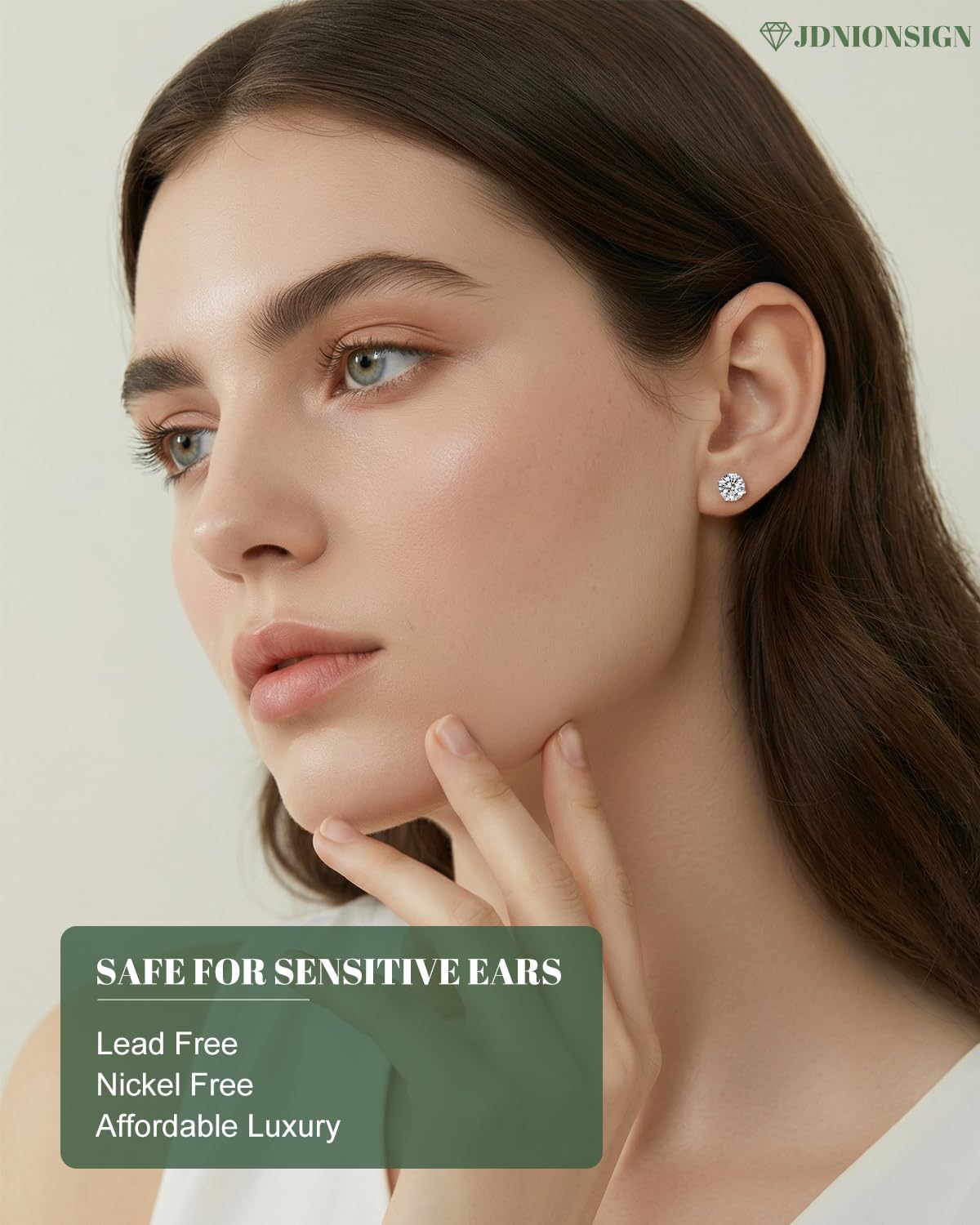
Moissanite
$13.29
In stock on Amazon
Check price on AmazonH3: Mid-Tier — IGI-Certified Lab Diamond Studs With Documentation
At approximately $400–$900 for 1 ct total weight IGI-certified lab diamond studs in 14K gold, this tier bridges the gap between budget moissanite and premium GIA-certified stones. Lab-grown diamonds are chemically identical to mined diamonds, as the GIA’s “Moissanite: A Gemstone Born From the Stars” gemological reference confirms when distinguishing between the two materials — the lab diamond is composed of pure carbon in a cubic crystal structure, while moissanite is silicon carbide.
IGI (International Gemological Institute) provides a full graded report that documents cut, color, clarity, and carat weight. Pricescope’s lab diamond grading documentation identifies IGI as one of the two primary standards for lab diamond grading alongside GIA. That report is accepted by insurers, estate jewelers, and secondary market buyers — a meaningful differentiator if you’re buying studs as a gift, plan to insure them, or anticipate explaining the stone to someone who will verify its credentials.
Brides’ “Lab-Grown Diamonds vs. Moissanite: Which Is Right for You?” draws this distinction clearly: GRA confirms material identity; IGI or GIA confirms graded quality against an international standard. They serve different purposes and are not interchangeable for formal documentation.
Who this tier is for: Gift buyers, buyers who want certification credibility, and those who anticipate showing the paperwork to a jeweler or insurer.

Amazon
$124.90
In stock on Amazon
Check price on AmazonH3: Premium Tier — GIA-Certified Lab Diamond Studs
At approximately $600–$1,400 or more for 1 ct total weight GIA-certified lab diamond studs in 14K gold, this tier carries the most globally recognized documentation in the industry. GIA grading reports for lab-grown diamonds follow the same methodology and standards as those for natural diamonds — the same organization that literally developed the 4C grading system applies that system consistently to both material types.
The premium over IGI reflects both GIA’s market reputation and, in some cases, more conservative grading — a stone that earns VS1 clarity from GIA has cleared a rigorous bar that secondary market buyers recognize. For buyers purchasing studs as a significant gift, for formal occasions, or as part of a documented jewelry collection, GIA certification is the most defensible choice.
The International Gem Society’s moissanite reference notes that even trained gemologists need equipment to reliably distinguish moissanite from diamond at small stud scale — which underscores that at this premium tier, you are paying primarily for documentation infrastructure and resale positioning, not for a visual upgrade the room will notice.
Who this tier is for: Buyers where documentation integrity is paramount — formal gifts, insured collections, and buyers with a long investment horizon on the piece.
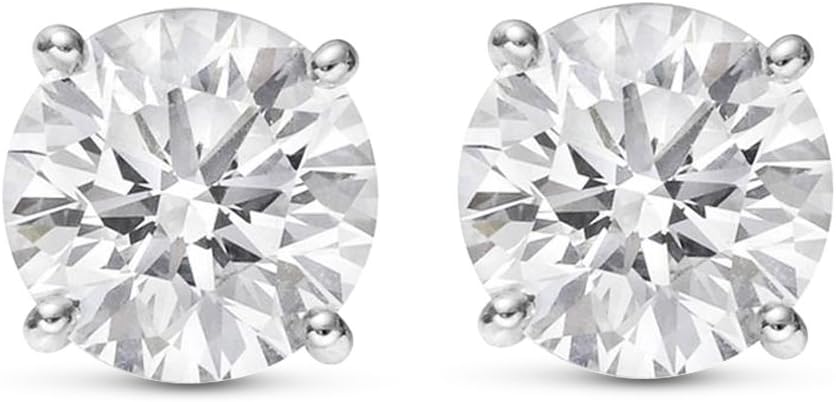
0.5
$337.37
In stock on Amazon
Check price on AmazonSensitive Ears, Metal Type, and Everyday Wearability
For stud earrings specifically — which sit against your skin continuously — the post and setting metal matters as much as the stone.
The GIA notes in its moissanite gemological materials that moissanite rates 9.25 on the Mohs hardness scale, while diamond rates 10, making both highly resistant to scratching and appropriate for daily wear. Neither stone itself causes skin irritation; the posts do.
The pattern that holds consistently across aggregated buyer feedback for both moissanite and lab diamond studs: reviewers cite hypoallergenic posts — typically implant-grade titanium, 14K gold, or sterling silver — as the feature that determines comfort, regardless of stone type. Gold-plated posts on a base metal stem can irritate sensitive ears over extended wear; solid 14K gold or platinum posts almost universally do not.
Practical checklist for sensitive ears:
- Look for solid 14K or 18K gold posts, not gold-plated
- Implant-grade titanium backs are the most hypoallergenic option
- Avoid nickel-containing alloys regardless of stone type
- The stone itself — moissanite or lab diamond — is not the irritant
Multi-piercing wearers (second or third hole studs) report particularly high satisfaction with lightweight moissanite studs. Because moissanite has a slightly lower density than diamond, stones at comparable visual size weigh marginally less — a minor but real comfort factor when wearing multiple pairs simultaneously.
Frequently Asked Questions
Can most people tell the difference between moissanite and lab diamond studs?
At normal viewing distance, in a small stud setting, the vast majority of people cannot reliably distinguish the two. Jewelers using a loupe or a thermal-and-electrical diamond tester can differentiate them — moissanite conducts electricity differently than diamond, so modern dual-mode testers catch it. But at conversational distance? The International Gem Society’s “Moissanite Gemstone Information” confirms that even trained eyes need instruments to reliably make that call at stud scale.
Is a GRA moissanite certificate equivalent to an IGI lab diamond certificate?
No. GRA confirms that the stone is genuine moissanite. IGI provides a full graded report — cut, color, clarity, carat — accepted by insurers, estate jewelers, and secondary market buyers. Pricescope’s lab diamond grading documentation describes IGI as one of the two primary lab diamond grading standards alongside GIA. Think of GRA as an authenticity confirmation and IGI as a graded valuation report; they are useful for different purposes.
Which is better for sensitive ears — moissanite or lab diamond studs?
Neither stone causes irritation. The metal in the post and backing determines comfort. Solid 14K gold or implant-grade titanium posts are the best choice for either stone type, and buyer feedback across both categories consistently identifies post metal — not stone type — as the deciding comfort factor.
What size moissanite matches a 0.5 ct lab diamond stud visually?
Because moissanite is cut to millimeter dimensions that match diamond sizing, a moissanite labeled “0.5 ct DEW” (diamond equivalent weight) will have the same diameter as a 0.5 ct diamond — typically around 5.0–5.1 mm in a round brilliant. For visual matching, use the millimeter diameter as your comparison point, not the carat weight, since moissanite’s lower density means it weighs slightly less than diamond at the same diameter.
Are lab diamond studs worth the extra cost over moissanite for everyday wear?
The decision frame is clear even if the answer depends on your situation. If the primary goal is maximum sparkle and visual size per dollar for personal daily use, moissanite delivers and buyer feedback consistently backs that. If the goals include certification credibility, gift prestige, insurance documentation, or the ability to describe the stone as a diamond without qualification, lab diamond studs — IGI-certified at minimum — justify the premium. For a pair you’re buying for yourself to wear daily and never sell, moissanite is genuinely hard to argue against at the price gap. For a meaningful gift or a piece you want formally appraised and insured, IGI-certified lab diamond earns its price difference.
The Decision Rule
Budget tier, personal wear: Moissanite studs in solid 14K gold with implant-grade posts deliver exceptional value. GRA certification gives you basic purchase assurance that the stone is what it claims to be.
Mid-tier, gift or documentation: IGI-certified lab diamond studs are the right call. The premium is real, but the certification infrastructure around them is meaningfully more robust and universally recognized.
Premium tier, formal documentation: GIA-certified lab diamond studs carry the most credible grading report in the industry and the strongest secondary-market positioning.
If you’re genuinely undecided between moissanite and an IGI lab diamond at this scale: buy the moissanite pair first. At that price point, if you later want the documented lab diamond, you haven’t foreclosed the option. The reverse — discovering you overspent on certification you didn’t need for personal daily wear — is harder to undo.