If you’ve ever stood in front of a mirror holding three necklaces at once and thought I have no idea which one goes in the middle, you’re exactly who this article is for. Layering necklaces—wearing two, three, or even four chains at different lengths so they sit in a visible cascade on your collarbone—has moved from a runway trick to an everyday wardrobe habit. Sterling silver (an alloy that’s 92.5% pure silver mixed with copper for strength, stamped “.925” on the clasp) is the go-to metal for this because it’s affordable enough to buy in multiple lengths without guilt and bright enough to hold its own against skin. The question isn’t whether to layer—it’s which chain styles actually work together, and which ones snap, tangle, or go dull after a few weeks of real wear. This guide breaks down four styles that buyers are gravitating toward right now—paperclip, sparkle disk, box, and cable—with honest notes on where each one earns its place in a layered stack.
| EDITOR'S PICKKISPER 925 Sterling Silver Box… | Mid-tierJewlpire 925 Sterling Silver Ch… | Budget pickAmazon Essentials Sterling Yell… | |
|---|---|---|---|
| Chain Style | Box | Cable | Box |
| Chain Width | 1mm | 1.1mm | 0.8mm |
| Metal Purity | 925 Silver | 925 Silver | Sterling |
| Length Options | 7 sizes, 14–30" | 14, 16, 18, 20, 22, 24" | 18" |
| Diamond Cut | ✓ | — | — |
| Clasp Type | — | Spring-Ring | — |
| Price | $49.99 | $18.99 | $15.20 |
| See on Amazon → | See on Amazon → | See on Amazon → |
What Makes a Chain “Layering-Ready”?
Before comparing specific styles, it helps to understand the three variables that determine whether a chain works in a layered context or fights against you every time you put it on.
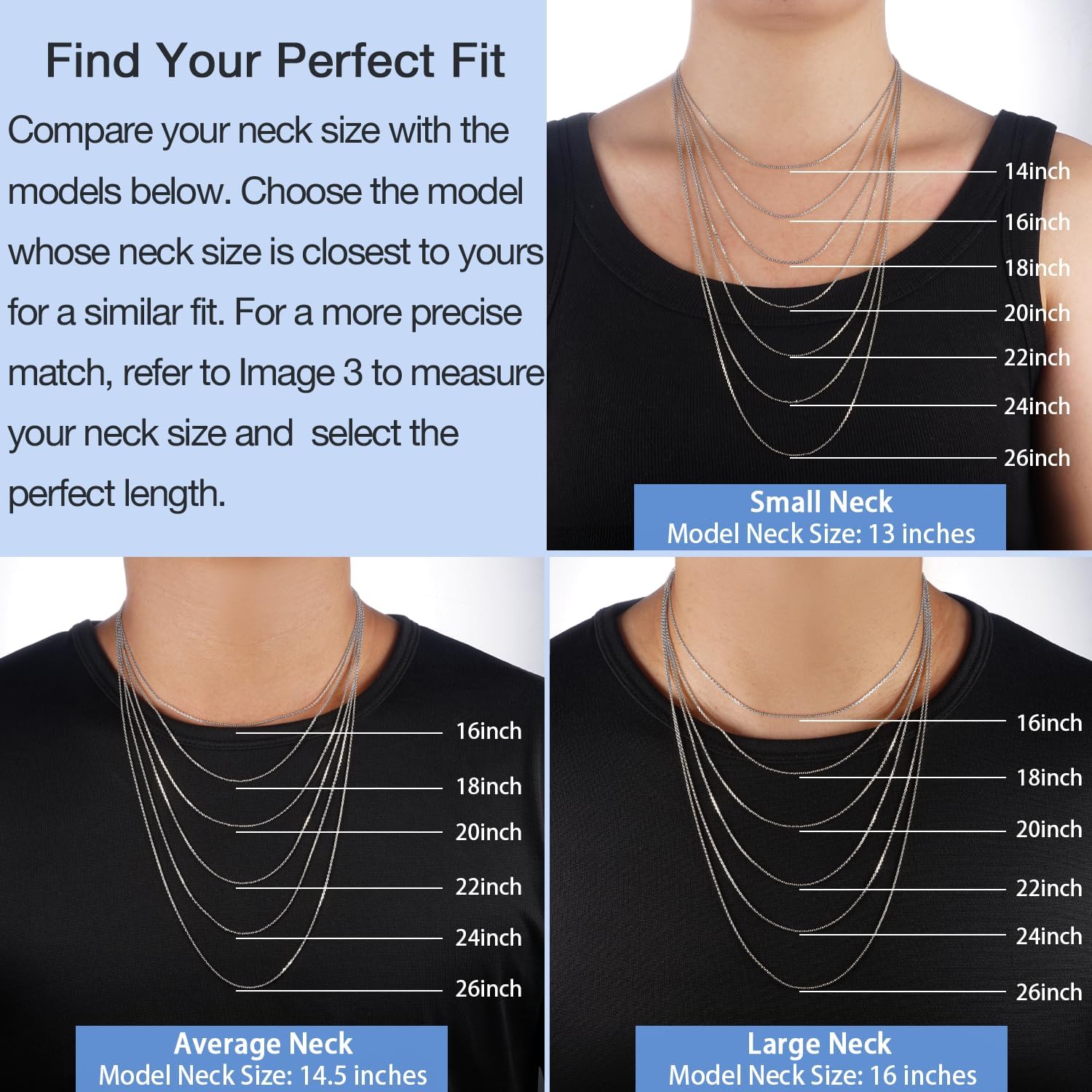
Weight and gauge. Gauge refers to the thickness of the wire or link that forms the chain. A 0.8mm box chain is roughly the diameter of a thick thread; a 2–3mm paperclip link has more visual mass. In a layered stack, you want a gradation—not four chains of identical visual weight competing with each other.
Kink resistance. Some chain constructions lie flat and separate naturally when you move. Others—particularly very fine rope or wheat-style chains—twist around neighboring chains as soon as you turn your head. According to The Knot’s 2024 layered necklace trend coverage, flat-link constructions consistently outperform round-wire chains for tangle-free stacking.
Tarnish timeline. Sterling silver oxidizes when it contacts air, moisture, and skin oils. This is chemistry, not a quality defect—but it’s accelerated by swimming, showering, and lotion. Some chains carry an anti-tarnish coating that meaningfully extends the bright-silver window. Others do not, and the math on that matters when you’re buying a piece you plan to wear daily.
By the numbers:
- .925 — minimum silver purity required to be called sterling, per Jewelers of America’s Sterling Silver Care and Characteristics Guide
- 0.8mm — gauge of a thin box chain; functional for lightweight pendants, at-risk under heavy ones
- 2–4mm — typical paperclip link width; enough visual presence to anchor a layered stack
- 16”, 18”, 20” — the three lengths that create clean separation in a three-chain layered look
How These Four Chain Styles Compare
The sections below walk through each style individually, but the underlying framework is consistent: every chain in a layered stack needs to occupy a distinct visual lane (fine vs. bold, flat vs. round, matte vs. sparkle) and a distinct length slot. Mixing lanes is what makes a stack look intentional rather than accidental.
Paperclip Chains: The Statement Anchor
Jewlpire
$18.99
In stock on Amazon
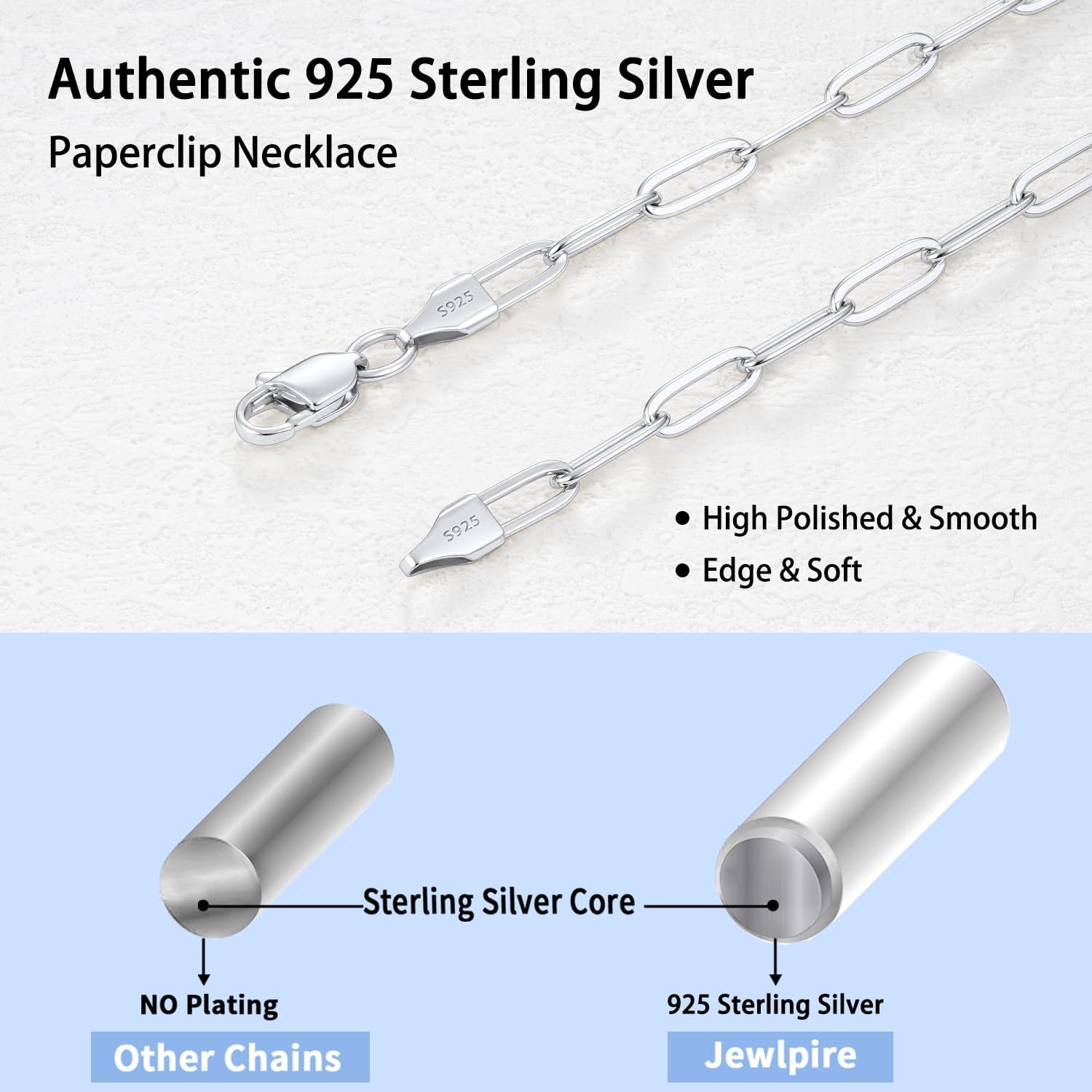
Check price on AmazonThe paperclip chain—named for its elongated oval links that look exactly like the office staple—emerged as a significant trend around 2021–2022 and has settled into what Vogue’s 2025 chain necklace coverage describes as a “wardrobe staple” rather than a trend piece. Its value in a layered stack is clarity: the flat, wide links sit flush against the skin and don’t compete visually with finer chains above or below it.
Reviewers of the Jewlpire paperclip chain consistently describe it as “very shiny”—a sensory signal that the polished finish is hitting the mark that buyers expect from sterling silver. Multiple owners note it reads well dressed up or down, specifically calling out the combination of jeans and the chain as something that just works. That cross-context versatility is exactly what you want from a piece you plan to wear as the centerpiece of a layered look: it can’t be so formal that it clashes with casual outfits, and it can’t be so minimal that it disappears.
The tradeoff with paperclip chains is their visual weight. A bold paperclip at 18” pairs well with a fine sparkle disk or cable chain at 16” and a longer pendant chain at 20”—but pairing two paperclip chains of different lengths produces visual noise rather than a layered cascade. Use one paperclip link per stack, and let it do the anchoring work.
Gold-plated paperclip chains (sterling silver base with gold vermeil or plating) carry an additional variable: coating durability. Buyer reviews indicate that plated paperclip chains survive occasional water contact but degrade with repeated shower or pool exposure—the plating thins at high-contact points like the clasp and the links that rest on the collarbone. If a warm-toned look is the goal, this is worth knowing before committing to daily shower wear.
Jewlpire
$18.99
In stock on Amazon
Check price on AmazonSparkle Disk and Diamond-Cut Box Chains: Light-Catching Precision
Amazon
$15.20
In stock on Amazon
Check price on AmazonThe sparkle disk chain is less widely known by name but immediately recognizable by effect: it’s constructed from small disk-shaped or faceted links that are cut at angles specifically to maximize light reflection. The phrase “diamond cut” on a chain’s product listing doesn’t mean the chain contains diamonds—it means the metal has been machine-faceted with precise cuts to create multiple flat surfaces that bounce light in different directions. The Gemological Institute of America’s Jewelry Metals Overview explains this as a manufacturing technique applied to the wire or link surface before chain assembly, creating a brighter apparent finish than a smooth-finish chain of the same gauge.
The pattern in buyer reviews for the Jewlpire sparkle disk chain is specific: owners describe it as “dainty but well made.” One buyer reports her daughter has worn the chain through swimming and showering for two months without tarnish—an unusually durability-forward data point for sterling silver. That suggests either a particularly effective rhodium or anti-tarnish finish, or a construction that minimizes the micro-crevices where oxidation typically accelerates. Either way, it’s a detail that matters for buyers who want the light-catching effect of a sparkle chain without the maintenance overhead.
In a layered stack, a sparkle disk or diamond-cut chain functions best at the shortest length—typically 14” or 16”—closest to the collarbone. Its visual contribution is texture and shimmer rather than mass, so it benefits from sitting above heavier chains where light hits it directly.
Amazon
$15.20
In stock on Amazon
Check price on AmazonBox Chains: The Honest Performance Trade-Off
Amazon
$15.20
In stock on Amazon
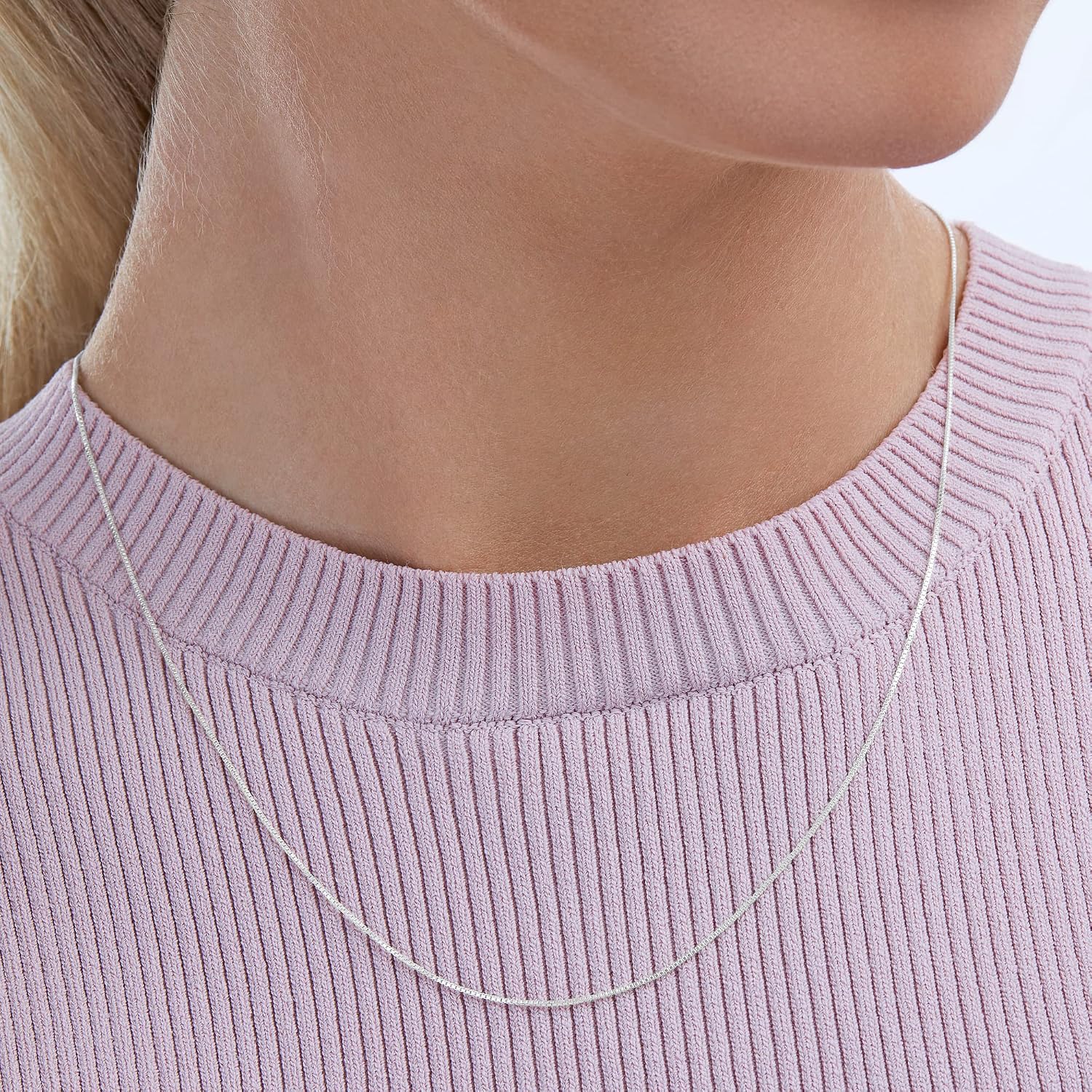
Check price on AmazonThe box chain—made from small square links connected in a uniform grid—is among the most popular sterling silver styles for everyday wear because it lies flat, resists kinking, and has a clean geometric look that pairs with almost any pendant. But buyer data on box chains at 0.8mm gauge tells a specific and honest story that prospective buyers need to hear.
The Amazon Essentials box chain at 0.8mm shows a notable split in reviewer experience. One buyer wore it continuously for a year and a half before it broke—and self-reported that the break was accidental, likely from snagging. Another reviewer notes simply that it broke after initially calling it pretty, with no additional context. That pattern is meaningful: a 0.8mm box chain is fine for pendant-free daily wear or for suspending a very lightweight charm (under roughly 5 grams), but it is not engineered for a heavier pendant stone or for buyers who are rough on jewelry. At this gauge, the chain’s integrity depends significantly on how you treat it.
Amazon
$15.20
In stock on Amazon
Check price on AmazonThe KISPER Italian box chain earns praise for two specific qualities that address exactly this concern: its anti-tarnish finish and what reviewers describe as having “some weight to it” despite being thin. That sensory note about weight is a proxy for construction density—Italian-made box chains often use a tighter link-to-link construction that increases durability without visibly changing the gauge. Buyers who want a box chain that feels like it will last tend to respond strongly to this quality.
Jewlpire
$18.99
In stock on Amazon
Check price on AmazonCable Chains: The Reliable Workhorse
Amazon
$15.20
In stock on Amazon
Check price on AmazonThe cable chain—round or oval interlocking links, the most traditional chain construction—is what most people picture when they think of a necklace chain. It’s not flashy, but it’s structurally forgiving and layering-compatible across almost every style combination.
What’s notable in buyer behavior around sterling silver cable chains is the intentional multi-length purchasing pattern: buyers frequently purchase 14”, 16”, and 18” lengths at the same time, explicitly for layering. This isn’t impulse buying—it’s a considered strategy. The cable chain’s neutrality is its advantage; it doesn’t compete visually with a sparkle disk or a paperclip chain, it simply fills a length slot in the stack and does it reliably.
Harper’s Bazaar, in its guidance on layering necklaces without tangling, consistently points to using chains with different link constructions at different lengths as the most effective approach—a cable chain at one length, a flat-link chain (paperclip or box) at another, and a sparkle or pendant chain at the third. That editorial framework maps cleanly onto the four styles reviewed here.
Amazon
$15.20
In stock on Amazon
Check price on AmazonFrequently Asked Questions
What is the difference between a paperclip chain and a cable chain for everyday wear? A paperclip chain has elongated, flat oval links that sit flush on the skin and have more visual mass—it’s a statement-adjacent piece even without a pendant. A cable chain has round interlocking links and reads as a traditional, neutral base. Both are durable for everyday wear in sterling silver; the paperclip just brings more visual presence. If you’re building a layered stack, one of each at different lengths gives you contrast without clash.
Can a 0.8mm box chain hold a pendant without breaking? At 0.8mm gauge, a box chain can hold a lightweight pendant—think small enamel charms, thin disks, or fine birthstone drops under roughly 3–5 grams. Buyer reviews suggest the 0.8mm gauge is at its limit with heavier stones or bulky bails. If your pendant has any real weight to it, move up to a 1.2mm or 1.5mm box chain, or look specifically for chains marketed as Italian-made with tighter link construction, which reviewers note feel more substantial than the gauge suggests.
What does “diamond cut” mean on a box or sparkle disk chain? It means the metal surface has been machine-faceted with angled cuts designed to reflect light—similar in concept to the facets on a gemstone, but applied to the chain link itself. No diamonds are involved. The Gemological Institute of America’s Jewelry Metals Overview describes this as a surface finishing technique applied before chain assembly. The effect is a noticeably brighter, more sparkly appearance compared to a smooth-finish chain of the same style.
Which sterling silver chain styles are best for layering multiple necklaces? The combination that comes up most consistently across buyer reviews and editorial guidance: a sparkle disk or cable chain at the shortest length (14”–16”), a paperclip or flat-link box chain in the middle (17”–18”), and a pendant chain or longer cable at the longest length (20”+). Mixing flat-link constructions with round-link constructions reduces tangling and creates visual contrast. The Knot’s 2024 layered necklace trend reporting reinforces this framework, specifically calling out flat-link chains as better performers for tangle-free stacking.
How do I keep a sterling silver chain from tangling when I layer it with other necklaces? Use chains with meaningfully different lengths—at least 1.5–2 inches of separation between each piece. Flat-link chains (paperclip, box) tangle less than round-wire chains (rope, wheat). Putting on each chain separately rather than clasping all three and dropping them over your head together also reduces the initial tangle risk. Storing layered chains flat in a divided tray—not coiled together in a pouch—prevents the knots that seem to form overnight.
Does a gold-plated sterling silver paperclip chain hold its color in the shower? Occasional shower exposure typically doesn’t strip gold plating immediately, but daily shower, swim, or gym wear accelerates wear at high-friction points—the clasp, the links against the collarbone, and any area where the chain contacts skin repeatedly. Plating will thin over time regardless of care, but daily water exposure shortens the timeline measurably. For a piece you want to shower in long-term, solid gold vermeil (at least 2.5 microns of plating) holds up better than standard plating, or opt for a plain sterling silver finish that won’t show a wear pattern. Jewelers of America’s Sterling Silver Care and Characteristics Guide notes that keeping sterling away from chlorine and harsh chemicals is the single most effective way to extend both plating and base-metal finish.