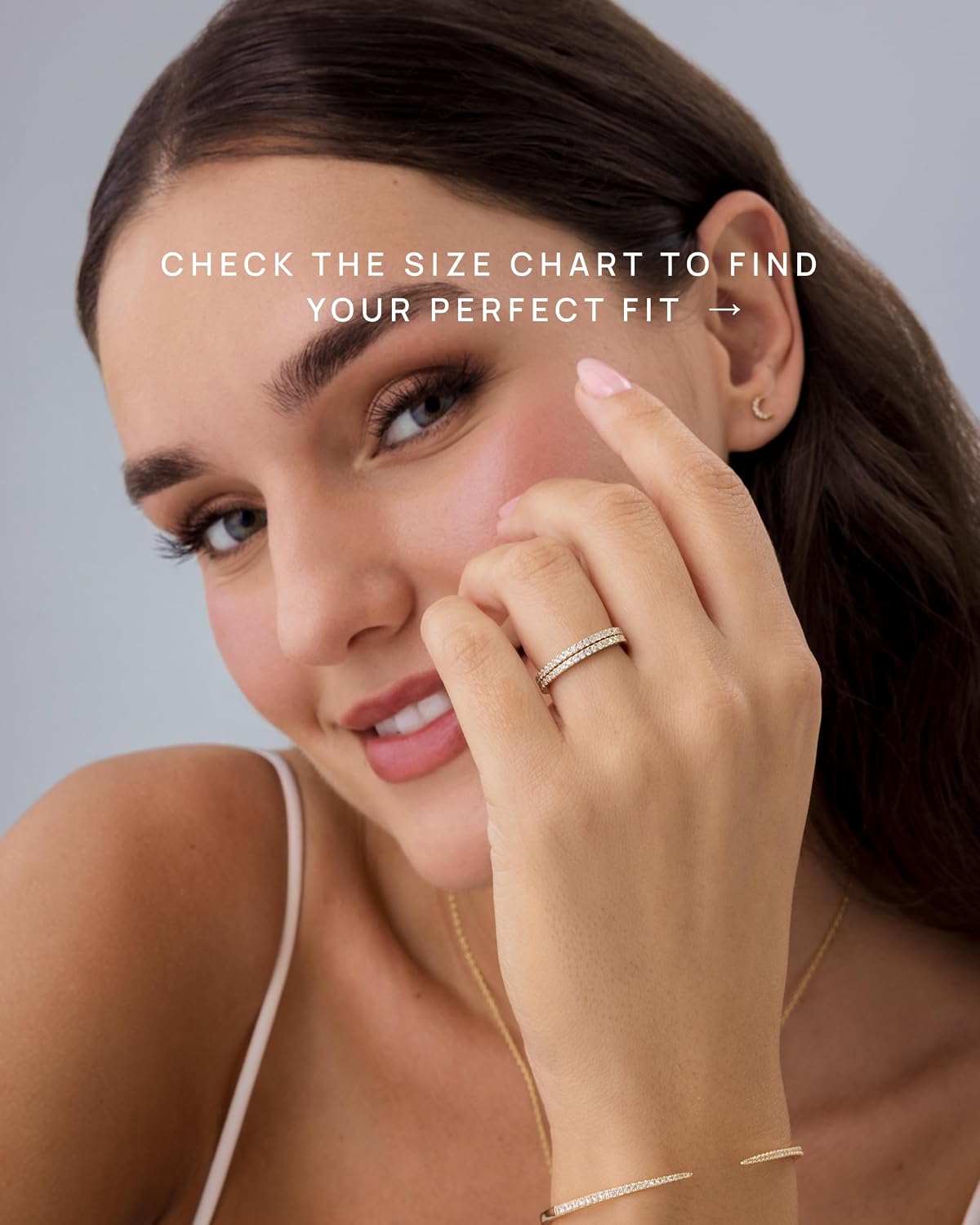
You know how some purchases feel like a small bet you’re happy to lose? Stackable eternity bands — rings designed to be worn in multiples, side by side on the same finger — sit firmly in that category when you’re shopping under $30. But “happy to lose” doesn’t mean you want to lose it. The difference between a band that still looks good after six months of daily wear and one that turns your finger green in two weeks comes down to a few specific details: what the metal base actually is, how thick the plating runs, and whether the stones (usually cubic zirconia, or CZ — a synthetic, lab-made crystal that mimics a diamond’s sparkle at a fraction of the price) are set to last. This guide walks through those details in plain language, flags the sizing traps that trip up even experienced stackers, and explains what “14K gold plated” and “18K gold plated” actually mean when they appear on a $12 ring listing.
If you’ve already bought one stacking set and have questions — why it tarnished, why your sizes don’t sit flush, whether it’s worth stepping up to moissanite (a different synthetic stone with higher durability) — this is where those answers live.
| EDITOR'S PICKWES 1.5/1.8/2.0mm Moissanite We… | Mid-tierPAVOI Gold Plated Solid 925 Ste… | Budget pickPAVOI 14K Gold Plated Eternity… | |
|---|---|---|---|
| Stone type | Moissanite | CZ | Cubic zirconia |
| Stone cut | Round | — | Square-cut |
| Band width | 1.5mm | — | — |
| Metal | 925 sterling silver | 925 silver, gold plated | 14k gold plated |
| Style | Half eternity | Eternity | Eternity |
| Available sizes | 4–11 | — | — |
| Price | $36.99 | $19.95 | $14.95 |
| See on Amazon → | See on Amazon → | See on Amazon → |
What You’re Actually Buying: The Anatomy of a Budget Eternity Band
An eternity band is a ring with stones set all the way around — or, in the case of a half-eternity design, set across the top half that faces outward. At the under-$30 price point, the standard construction is 925 sterling silver as the base metal, meaning 92.5% pure silver alloyed with copper for strength. That base is then electroplated — coated via an electrical current — with a thin layer of gold-toned metal. The “14K” or “18K” designation refers to the purity of that plating layer, not the ring as a whole.
Here’s the number that matters most and is almost never disclosed on a product listing:
By the Numbers
- Typical budget gold plating thickness: 0.5–1.0 microns
- Vermeil (a higher-quality standard): 2.5+ microns, sterling silver base required
- Heavy gold plating (boutique / semi-fine): 2.5–5 microns
- Solid 14K gold alloy: no plating — the gold is the metal itself
A micron is one-thousandth of a millimeter. At 0.5 microns, daily friction — hand-washing, lotion, stacking friction from adjacent rings — wears through the plating in months, sometimes weeks. This is the baseline reality of the under-$30 category, and designing your purchase strategy around it matters more than brand loyalty.
The stones in most budget eternity bands are cubic zirconia (CZ), a crystalline form of zirconium dioxide synthesized in a lab. Per the Gemological Institute of America’s overview of CZ versus diamond, CZ scores an 8–8.5 on the Mohs hardness scale (diamond is 10). That’s hard enough to resist casual scratching but soft enough to cloud over time as surface micro-abrasions accumulate. The sparkle CZ produces right out of the box is genuinely impressive — the GIA notes CZ’s refractive index is slightly lower than diamond’s but its high dispersion (the “fire,” or rainbow flashes) can actually exceed it. That’s why reviewers of PAVOI’s round CZ eternity band consistently describe a “more expensive look than expected.” The optical engineering is real. The durability ceiling is also real.
The PAVOI Stacking Bands: What Buyer Patterns Reveal
Two PAVOI products dominate this category in aggregated review data: the round CZ eternity band and the square-cut (princess-cut profile) CZ eternity band. Across both, the pattern in buyer reviews is consistent enough to be analytically useful.
On the round CZ band: Owners repeatedly cite the delicate, lightweight feel as a feature, not a compromise. Multiple buyers describe wearing it all day without noticing it — meaningful for a ring you might stack three or four at once. The “more expensive than the price” aesthetic read holds up across reviewers with and without fine jewelry experience.
One practical note that no standard jewelry guide covers: at least one documented buyer purchased the round CZ band specifically to pair with an Oura Ring 4 — a smart wearable worn on the finger. The buyer flagged that a previous stacking set had failed to sit flush against the Oura Ring’s curved profile. This is a real design consideration. The Oura Ring 4 has a chamfered inner edge and a relatively wide band profile; rings with high stone settings or uneven inner diameters create a gap, which causes both discomfort and premature wear on the plating where metal contacts metal. Thin, low-profile eternity bands like the PAVOI round style appear to seat more cleanly alongside it — but this remains an area where individual ring combinations vary and no universal fit guarantee exists.
On the square-cut CZ band: Reviewers consistently describe it as “sleek” and “modern,” and the princess-cut visual effect reads convincingly as a fine jewelry piece in photos and at arm’s length. Multiple buyers describe this band specifically as a “safe sparkle” option for work or outdoor activities where they wouldn’t wear a fine diamond ring — a use case that actually justifies the under-$30 price point rather than treating it as a compromise. The trade-off named by buyers: the sharper corner cuts on square-profile CZ stones mean the stones feel slightly less forgiving to the touch than round stones, and corner chipping is a minor long-term risk.
Sizing for Stacking: The Compounding Problem
This is the most underserved topic in the stacking ring category, and it’s where buyers lose money on returns.
A single ring fits at your measured ring size. Stack two rings, and the combined width of both bands effectively pushes the fit tighter — the total band material occupying finger space increases. A general rule cited in The Knot’s stacking rings guide: for every two to three bands added, consider sizing up by a half size. The math is intuitive once you think about it — each 2–3mm band adds friction and lateral pressure — but it’s rarely surfaced at the point of purchase.
For buyers considering three or more bands on a single finger:
- Fingers swell slightly in heat and at the end of the day. What fits in the morning might be snug by evening, and a stack of four bands amplifies that effect.
- Dominant-hand sizing runs slightly larger for most people due to minor muscle development.
- Mixed-width stacks (pairing a 2mm band with a 4mm band, for example) create uneven pressure distribution; the wider band effectively sets the tightest point.
The most common complaint across both PAVOI products in aggregated reviews centers on sizing uncertainty for multi-band stacks. This isn’t a PAVOI-specific failure — it’s a category-wide education gap. If you’re ordering blind for a stack of three or more, ordering two half-sizes and returning the worse fit is a more defensible strategy than betting on a single size.
The Case for Stepping Up: Moissanite Half-Eternity Bands
Once you’ve decided stackable rings are a daily habit rather than an occasional piece, the moissanite half-eternity band at the $40–$80 price tier becomes worth evaluating on its own terms.
Moissanite is silicon carbide — a different compound from CZ — originally discovered in meteorite fragments and now synthesized in labs at commercial scale. Per the International Gem Society’s moissanite guide, moissanite scores 9.25 on the Mohs hardness scale, meaningfully harder than CZ’s 8–8.5 and approaching diamond’s 10. In practical terms, moissanite resists the surface micro-scratching that causes CZ to cloud over six to eighteen months of daily wear.
The moissanite half-eternity bands in this cluster earn a specific type of praise that CZ bands don’t: buyers repeatedly cite the included certificate and 925 stamp as reassurance of authenticity. That’s a meaningful signal. A GIA or equivalent lab certificate accompanying a stone under $100 is unusual and builds legitimate confidence. At the same time, buyers should understand that “moissanite certificate” in this price tier is typically issued by the stone’s manufacturer (Charles & Colvard is the dominant brand, though house-brand moissanite appears across many listings) rather than an independent gemological lab — still useful documentation, but a different trust tier than a GIA report on a diamond.
The trade-off is visual: moissanite’s higher refractive index produces more “rainbow fire” than either CZ or diamond — beautiful in some light conditions, occasionally described as slightly synthetic-looking in direct sunlight by buyers accustomed to diamond’s more controlled dispersion. Whether that visual character reads as “better sparkle” or “slightly off” is genuinely a matter of personal preference. Brides’ stacking ring coverage consistently notes this fire pattern as moissanite’s most discussed aesthetic attribute.
The decision rule: If you’re building a stack you’ll wear every day and want it to still look good in two years without re-purchasing, the moissanite step-up pays for itself. If you’re buying for occasional wear, a vacation stack, or as a gift for someone who may outgrow the style, CZ at the PAVOI price point is a fully rational choice.
Frequently Asked Questions
Will gold-plated sterling silver eternity bands tarnish if I wear them in the shower?
Yes, with caveats. Water alone is less damaging than the combination of water, soap, shampoo, and heat. Shower products accelerate plating wear because surfactants (the cleaning agents in soap and shampoo) strip the thin gold layer more aggressively than plain water. Sterling silver underneath will tarnish when the plating wears through. The practical answer: take them off for showers if longevity matters. If convenience matters more, buy a second set and rotate.
Do CZ stackable rings sit flush against wearable fitness trackers like the Oura Ring?
Not always, and this is more of a design-fit question than a quality question. The Oura Ring 4’s profile has a slight curve and wider width (varies by size) that can create a gap with rings that have high stone settings or uneven inner surfaces. Low-profile, thin eternity bands sit closer to flush — which is why some buyers specifically select the PAVOI round CZ band for this pairing. No universal guarantee exists without trying your specific combination.
How many stackable bands can I wear at once before sizing becomes an issue?
Most stacking guides, including The Knot’s overview, suggest re-evaluating fit at three or more bands. A practical starting point: if stacking three or four bands, size up a half size from your measured single-ring size. If stacking five or more, consult sizing for each finger individually during the day’s end when swelling is highest.
What is the difference between 14K gold plated and 18K gold plated on sterling silver?
Both refer to the purity of the gold layer applied to the sterling silver base. 14K gold is 58.3% pure gold; 18K is 75% pure gold. In plating terms, the difference in color appearance is slight — 18K reads as slightly warmer and richer yellow. Neither designation tells you the thickness of the plating, which is the variable that actually determines how long the finish lasts. Both 14K and 18K plating at 0.5–1 micron thickness will wear at roughly similar rates.
How long does the sparkle in CZ stones last compared to moissanite?
CZ’s surface hardness (Mohs 8–8.5) means it collects micro-scratches from daily contact — lotion, bag linings, other ring surfaces — that gradually dull its optical clarity. Most daily-wear CZ pieces show visible cloudiness within one to two years. Moissanite (Mohs 9.25) resists this degradation meaningfully better; owners in long-term reviews routinely describe moissanite retaining its sparkle through multi-year daily wear. The Gem Society’s moissanite guide confirms its hardness advantage over CZ directly.
Is it worth paying more for a moissanite eternity band over a CZ version for daily stacking?
For daily wear: yes, in most cases. The durability gap is real, the price premium at the half-eternity level is modest (often $30–$60 more), and you avoid the replacement cycle that erodes the apparent value of sub-$20 CZ bands. For occasional wear, gifts, or experimental stacking: CZ is the rational choice. The decision hinges entirely on wear frequency.