You bought a pendant you love — a meaningful charm, a gemstone drop, a family initial — and the chain it arrived with snapped within a month. Maybe it was thin as thread. Maybe the lobster clasp gave out. Either way, you’re now hunting for a replacement, and suddenly you’re wading through listings that say things like “2mm rope chain, 925 sterling, anti-tarnish, 18 inch.” This guide is for you. A rope chain is a style of necklace where small metal links are twisted together in a helical pattern — like braided rope — creating a sturdy, textured surface that catches light beautifully. Sterling silver means the metal is 92.5% pure silver alloyed with copper for strength; you’ll see this marked as “925.” The questions that actually matter when buying one are: How thick should it be? How heavy is it really? And will it stay shiny after six months of daily wear? Let’s work through all three.
| EDITOR'S PICKKISPER 925 Sterling Silver Box… | Mid-tierJewlpire 14K Gold Plated 925 St… | Budget pickJewlpire 2mm Rope Chain 925 Ste… | |
|---|---|---|---|
| Plating | — | 14K gold plated | 14K gold plated |
| Chain style | Box | Paperclip | Rope |
| Width | 1mm | 4mm / 5mm | 2mm |
| Length range | 14–30 in | 16–26 in | 16–26 in |
| Made in Italy | ✓ | — | — |
| Price | $49.99 | $17.99 | $9.99 |
| See on Amazon → | See on Amazon → | See on Amazon → |
Why “The Chain Snapped” Is the Most Common Reason People Buy These
The replacement-chain use case is not a niche scenario — it is, based on aggregated buyer reviews, probably the primary reason people seek out rope chains in the sub-$30 category. Pendant necklaces sold at retail are routinely paired with chains in the 0.8mm–1.2mm range because thin chains photograph better and reduce production cost. They are not built for everyday movement, tension from a pendant, or any kind of accidental snag.
This framing matters for your decision because it changes the spec you should optimize for. You are not buying fashion jewelry to be swapped out seasonally. You are buying a working chain — one that needs to hold weight, survive a shower you forgot to take it off for, and not turn your neck green in two weeks.
The rope chain braid construction gives it a mechanical advantage here. The interlocking twist distributes tension across multiple link contact points rather than concentrating stress at a single solder joint, which is why rope chains consistently outperform box and cable chains of similar gauge in flex-failure reviews. Per the Gem Society’s silver jewelry care overview, the braided structure also creates less exposed surface per unit of length compared to an open-link chain, which modestly slows the tarnish process by reducing air contact.
Width and Weight: The Numbers That Actually Drive the Decision
The 1.5mm vs. 2mm Question
This is the most common “which one?” split among buyers in the budget-to-mid rope chain market, and the answer depends on two things: your pendant weight and the look you want.
By the numbers:
| Width | Approx. weight (18”) | Best pendant weight | Visual read |
|---|---|---|---|
| 1.5mm | ~3–4g | Up to ~10g pendant | Delicate, layerable |
| 2mm | ~5–7g | Up to ~20g pendant | Substantial, solo-wear |
| 3mm+ | ~9–14g | Statement/heavy pieces | Bold, clearly silver |
Weight estimates are based on published product specifications across multiple sterling silver rope chain listings; individual pieces will vary by manufacturer.
Here is a nuance worth naming explicitly: owners of the 2mm Jewlpire rope chains consistently report that the chain reads as “more like white gold than silver” — the tighter braid and polished finish give it a brightness that flattens the distinctive rope texture into something more refined and less obviously silver. If you want a chain that looks unmistakably like sterling silver — with visible texture and a warmer, slightly matte-between-the-links character — the 1.5mm or a wider 3mm braid will serve you better. The 2mm hits an odd sweet spot where it’s pretty enough to confuse people about the metal type. That’s a feature for some buyers and a misalignment for others.
Weight as a Pendant-Matching Variable
The Gemological Institute of America’s guidance on silver settings reinforces what jewelers know intuitively: a chain should weigh at least as much as the pendant it carries, and ideally more. When the pendant is heavier than the chain, the clasp and jump ring take disproportionate stress and the chain twists at the bail (the small loop the pendant slides onto).
For lightweight pendants — small charms, thin disc initials, single gemstone drops under 5mm — a 1.5mm rope chain is sufficient and layers cleanly. For chunky pendants, large lockets, or anything with a stone over 8mm, step to 2mm minimum, and consider a 20-inch or 22-inch length so the chain lies flat rather than pulling upward toward the collar.
Tarnish: What Owners Report vs. What the Science Says
Let’s be honest about what the reviews can and can’t tell you.
Sterling silver tarnishes. That is chemistry, not a defect. The copper content in 925 silver reacts with sulfur compounds in the air, in your skin oils, and in water — especially pool water treated with chlorine. The Gem Society’s care guide notes that sweat, perfume, and chlorinated water are the three fastest accelerants of silver tarnish, roughly in that order.
What buyers say: Owners of the Jewlpire rope chains are enthusiastic about tarnish resistance, with multiple reviewers noting the chains stayed bright after daily wear for several months. At least one reviewer reports swimming in a Jewlpire rope chain without visible tarnish. These are genuine owner reports and they are worth weighing — but most come from short-term ownership windows of a few weeks to a few months. Whether a chain maintains that appearance at the 12- or 24-month mark under daily wear is simply not established by the current review pool. Attribute this appropriately: promising early signals, not a verified long-term claim.
The KISPER box chain (a different chain style, worth including here for comparison) earns consistent praise for its “Made in Italy” anti-tarnish finish and heavier-than-expected weight for a thin chain. Italy has a long metallurgical tradition in silver finishing, and the anti-tarnish coating referenced in those reviews is typically a thin rhodium or e-coating layer applied post-polish. Per Brides.com’s overview of chain necklace materials, rhodium plating extends the tarnish-free window significantly — often to 12–18 months of daily wear — before it requires re-plating. This is meaningfully different from uncoated sterling, and it’s a spec worth asking about explicitly when buying.
Practical maintenance reality: Even the best sterling rope chain benefits from a quick wipe with a soft cloth after wearing. Remove it before swimming in chlorinated pools — the damage is real and cumulative. Per The Knot’s jewelry care guidance, storing silver in an airtight zip bag or anti-tarnish pouch between wears is the single highest-impact habit for extending shine, ahead of any coating.
Gold-Plated Sterling vs. Plain Sterling: The Daily Driver Trade-Off
A number of rope chain listings occupy the gold-plated sterling silver category — sometimes listed as “gold vermeil” if the plating meets a minimum thickness standard (typically 2.5 microns over sterling, per U.S. FTC guidance). The Jewlpire rope chains are available in gold-plated versions alongside plain sterling, which raises the durability question buyers ask constantly: Is the plated version worth it for daily pendant use?
The honest answer is: it depends on your pendant load and skin chemistry. Gold plating over sterling adds a warm aesthetic and provides its own modest corrosion barrier, but plating thins with friction. High-friction points — the bail where the pendant slides, the clasp area, any spot where the chain rubs clothing or skin — will show base metal first. On a rope chain, the twisted texture creates more surface contact per inch than a flat box or cable chain, which slightly accelerates plating wear at contact points.
If you’re a pendant wearer who removes the chain nightly, wipes it down, and stores it properly, a gold-plated sterling rope chain can remain presentable for 12–18 months. If you sleep in it, shower in it, and layer it against other chains (friction on friction), plain sterling is more forgiving because tarnish on sterling is reversible with a polishing cloth; once plating wears through, you need re-plating or you live with the exposed silver showing through.
The Paperclip Alternative: When a Rope Chain Isn’t the Right Tool
The Jewlpire paperclip chain deserves a mention here not as a competitor but as a decision clarifier. A paperclip chain uses elongated flat oval links — they lie flat against the chest, show a lot of light surface area, and read clearly as silver (or gold, in plated versions). Reviewers consistently note its versatility: it transitions from casual to dressed-up more easily than a rope chain because the flat links interact with fabric and neckline differently.
If your primary use is a single statement pendant on a dressed occasion, the paperclip geometry actually holds pendants more centered (the wider bail contact keeps pendant drift minimal). If you’re layering multiple chains at different lengths or want a chain that reads as jewelry in its own right — without a pendant — the rope chain’s texture carries more standalone visual weight.
Frequently Asked Questions
Will a rope chain tarnish if I wear it in the shower or pool? Showering occasionally with a sterling rope chain is unlikely to cause immediate visible tarnish, but chlorinated pool water is a genuine accelerant of silver oxidation. Owner reports for the Jewlpire rope chains include at least one buyer who swims in theirs without tarnish — but this is a short-term report, not a long-term guarantee. For the chain’s longevity, removing it before pool use is the safer habit.
What is the difference between 1.5mm and 2mm rope chains in everyday wear? In practice: the 1.5mm reads as delicate and layers cleanly with other chains; the 2mm reads as a solo-wear statement piece, and owners note it can read as white gold rather than obviously silver due to its polished braid. For a lightweight pendant, either works. For a pendant over 8–10g, the 2mm is the more stable choice mechanically.
Is gold-plated sterling silver rope chain durable enough for daily pendant use? Yes, with caveats. Daily wear is manageable if you remove the chain at night, avoid pools and heavy perspiration, and store it dry. Heavy daily wear without removal will thin the plating at friction points (bail, clasp) within 6–12 months. Plain sterling is more forgiving if low-maintenance wear is your priority.
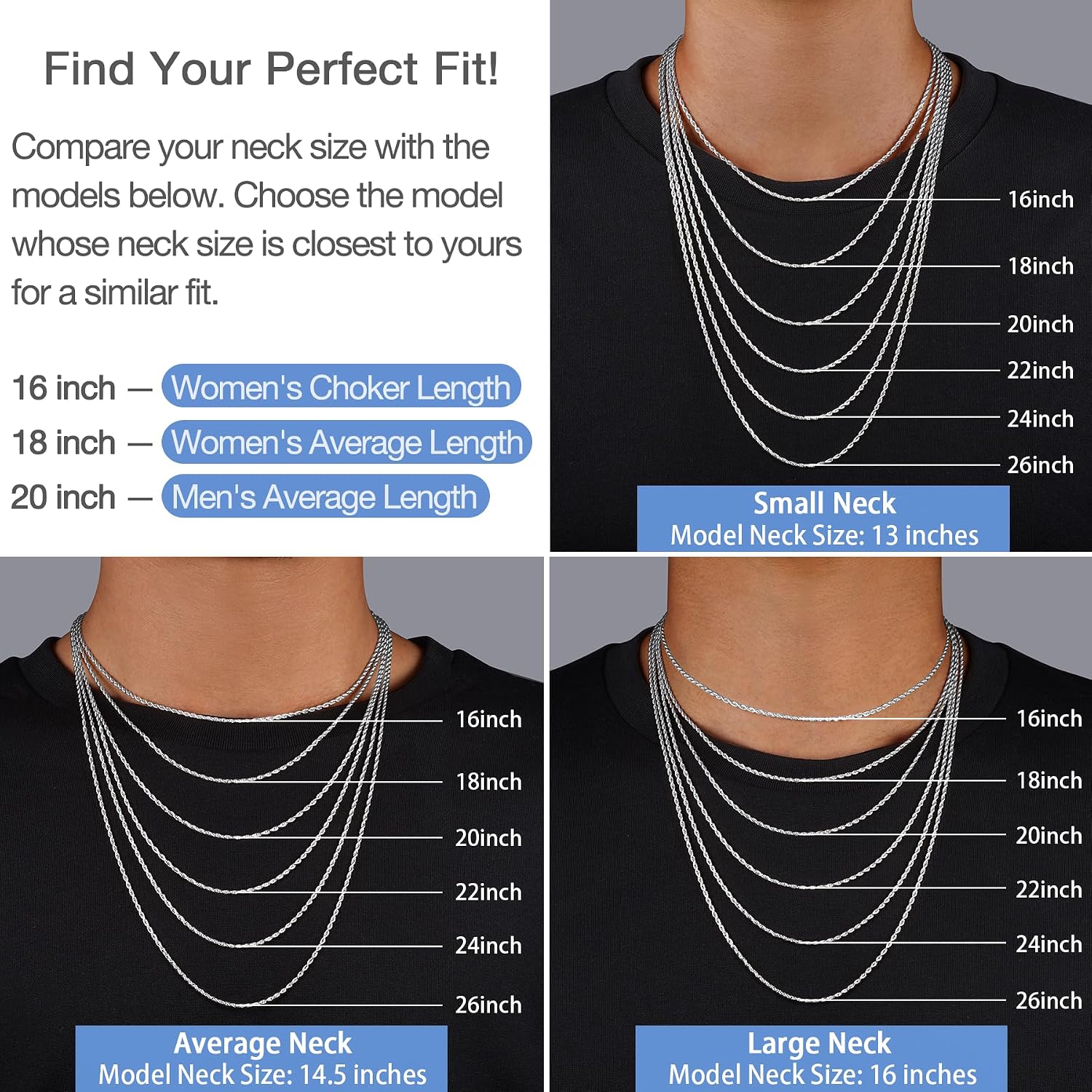
What length should I buy if I want to layer two chains? The standard layering formula: anchor chain at 16 or 18 inches (sits at collarbone), second chain at 20 or 22 inches (sits mid-chest). Mixing a rope chain with a paperclip or cable chain at different lengths creates contrast; two rope chains in different widths at staggered lengths also reads well without competing.
How do I know if the chain can hold the weight of my pendant? Weigh your pendant if you can (a kitchen scale works), or estimate: small charms are typically under 3g; medium stone pendants run 5–10g; large lockets or chunky bails can exceed 15g. Match pendant weight to chain width using the table above. When in doubt, size up — a 2mm chain holding a lightweight pendant looks intentional; a 1.5mm chain sagging under a heavy pendant looks strained.
The Decision Rule
If you’re replacing a snapped or too-thin pendant chain: buy a 2mm rope chain in plain sterling at 18 or 20 inches. It will hold nearly any standard pendant, wear comfortably, and last through the occasional forgotten shower.
If you want a layering chain that reads clearly as silver and sits close to the collarbone: go 1.5mm at 16 or 18 inches. The 2mm will look white-gold-adjacent, which may or may not be your goal.
If anti-tarnish finish and a heavier feel for a thin chain are your priorities — and you’re willing to go box-chain style — the KISPER box chain’s Italian-finished construction earns that reputation for a reason.
And if your pendant is more fashion accessory than heirloom, and you want a chain that works equally at brunch or a gallery opening: the Jewlpire paperclip chain’s flat-link profile and bright polish give you that flexibility in one piece.
Pick the spec that matches the job. The chain you reach for every day is always the right one.